How an IoT gateway Collects Data from Your Facility's bluetooth beacon Infrastructure
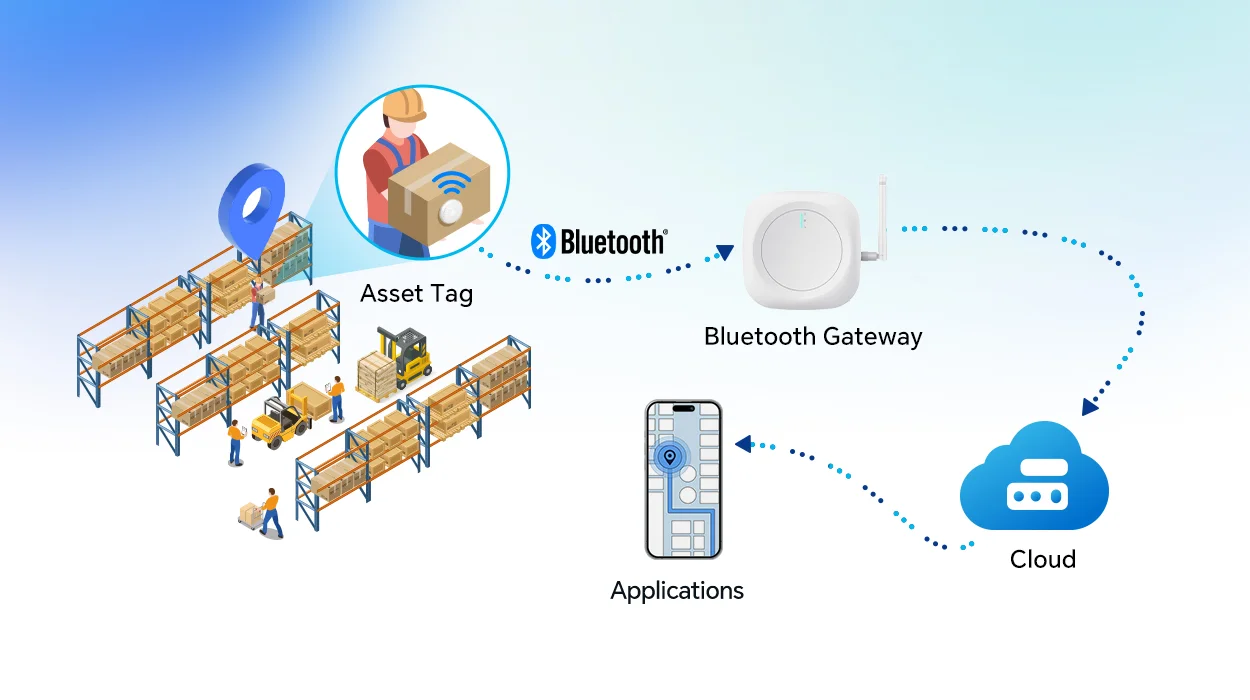
Facility managers are tasked with an increasingly complex mandate: optimize operations, ensure safety, and reduce costs, often with limited visibility into the physical movements and conditions within their buildings. The promise of data-driven decision-making can feel out of reach without a practical, reliable way to gather granular, real-time information from the environment itself. This is where a well-architected sensor network comes into play, with Bluetooth Low Energy (BLE) beacons acting as the eyes and ears of your physical space.
The critical link that transforms raw beacon signals into actionable business intelligence is the IoT gateway. This device performs the essential function of aggregating, filtering, and transmitting data from potentially hundreds of Bluetooth beacons scattered throughout a facility. Understanding this process is key to unlocking the value of an asset tracking system, environmental monitoring solution, or any location-aware application. It’s the foundational step that moves data from the physical world into the digital realm where it can be analyzed and acted upon.
This article will explain the technical workflow of how an IoT gateway collects data from a Bluetooth beacon infrastructure. We'll break down the roles of each component, the data journey from transmission to the cloud, and the practical considerations for deploying a system that delivers reliable, secure, and valuable operational insights.
The Core Components: Beacons, Gateways, and the Cloud
Every data collection system built on Bluetooth beacon technology relies on three fundamental layers: the edge sensors, the aggregation hardware, and the cloud platform. Each plays a distinct and crucial role.
Bluetooth Beacons: The Data Sources
A Bluetooth beacon is a small, battery-powered wireless transmitter. Its primary job is to broadcast a simple, repeating radio signal at set intervals. This signal contains a unique identifier (like a UUID) and, depending on the beacon model, may also transmit sensor data such as temperature, humidity, or motion. Importantly, beacons are typically "dumb" devices; they broadcast information but do not receive it. They are deployed on assets (like pallets or tools), worn by personnel, or placed in fixed locations to mark specific zones.
The IoT Gateway: The Aggregation Hub
The IoT gateway is the intelligent bridge between the physical beacon network and the internet. Positioned strategically within a facility—often in areas with strong Wi-Fi or ethernet connectivity—its role is to scan for and receive the broadcast signals from all nearby beacons. Unlike a simple Bluetooth receiver, a commercial-grade IoT gateway is designed for robustness. It can manage connections from dozens to hundreds of beacons simultaneously, apply filters to reduce network noise, timestamp each received packet, and package the data for secure upstream transmission.
Cloud Platform: The Command Center
The cloud platform is where data aggregation, analysis, and visualization occur. Once the IoT gateway collects data from the beacons, it sends this information via Wi-Fi, Ethernet, or cellular networks to a cloud server. Here, software applications process the data, turning raw beacon sightings into actionable insights: plotting asset locations on a floor plan, triggering alerts for unauthorized movements, or logging environmental condition histories.
The Data Collection Workflow: From Broadcast to Insight
The process of how an IoT gateway collects data from your beacon infrastructure follows a consistent, automated sequence. This workflow happens continuously, often many times per minute, to provide near real-time visibility.
Step 1: Beacon Broadcast. Each Bluetooth beacon in your facility is configured to transmit its advertising packet at a predetermined interval, such as every 100 milliseconds to 10 seconds. A shorter interval provides more granular data but consumes battery life faster.
Step 2: Gateway Scanning. The IoT gateway operates in a constant scanning mode, listening on Bluetooth Low Energy channels for these advertising packets. When it detects a packet, it captures several key pieces of data: the beacon’s unique ID, the Received Signal Strength Indicator (RSSI) which helps estimate proximity, the timestamp of detection, and any embedded sensor readings.
Step 3: Data Processing & Filtering. Raw scanning generates immense data. A sophisticated IoT gateway applies on-device processing to reduce load. It may filter out duplicate packets from the same beacon received microseconds apart, or employ algorithms to smooth erratic RSSI values for more stable location accuracy. This step ensures only meaningful data is forwarded.
Step 4: Secure Transmission. The processed data packets are then formatted (often into lightweight JSON structures) and transmitted securely via MQTT, HTTP, or other IoT protocols over the facility’s IP network to the designated cloud application. This is where the critical link is made: the IoT gateway serves as the reliable, managed conduit for this upstream flow.
Step 5: Cloud-Side Analysis. In the cloud, the application logic takes over. It uses the beacon ID to reference a database (e.g., "this ID belongs to Forklift #12"). It uses the RSSI value from one or more gateways to triangulate an approximate location. Sensor data is logged and charted. Alerts are generated based on business rules (e.g., "if Tool #45 leaves Geofence A, notify the supervisor").
Key Technical Considerations for Deployment
Designing a system that reliably collects data requires more than just plugging in devices. Several technical factors directly impact performance, accuracy, and total cost of ownership.
Gateway Density and Placement: The number and placement of gateways determine coverage and location accuracy. A single gateway can collect data from any beacon within its ~100-150 foot range (obstructed), but for precise indoor positioning (IPS), multiple gateways are needed to enable triangulation. Place gateways in open areas with reliable power and network access, avoiding physical obstructions and sources of radio frequency interference.
Beacon Configuration: The broadcast power and advertising interval of your beacons must be tuned for your use case. High broadcast power increases range but drains batteries faster. A frequent advertising interval improves data freshness but also increases radio traffic and battery consumption. Finding the right balance is essential for system responsiveness and maintenance overhead.
Network Infrastructure: The IoT gateway depends on your facility’s LAN and internet connection. A weak or unreliable Wi-Fi network where gateways are installed will cause data loss. For critical applications, a wired Ethernet backbone for gateways is often recommended. Furthermore, the system must have a fallback strategy, such as local data buffering on the gateway during network outages.
Power Management: For battery-powered beacons, estimating and planning for battery life is a key operational task. Using a bluetooth beacon with a multi-year battery lifespan or one that supports user-replaceable batteries can drastically reduce long-term maintenance labor. Gateways themselves are typically powered via Power-over-Ethernet (PoE) or a standard AC adapter.
Transforming Raw Data into Operational Value
The true purpose of this data collection is to drive tangible business outcomes. The raw "Beacon X was seen by Gateway Y at time Z" becomes valuable only when translated into context.
Real-Time Asset Tracking: In warehouses or hospitals, knowing the exact location of high-value equipment saves hours of search time daily. The system can show that a portable ultrasound machine is currently in Radiology on Floor 3, not lost in a storage closet.
Environmental Monitoring: Beacons with temperature and humidity sensors, whose data is collected by gateways, can autonomously monitor climate-controlled storage areas, pharmaceutical cabinets, or server rooms, automatically generating tickets if conditions fall out of spec.
Safety and Compliance: In industrial settings, beacons can ensure personnel are wearing required safety equipment or confirm that maintenance crews have visited designated checkpoints, creating automated audit trails.
Process Optimization: Analyzing movement patterns of goods or people can reveal bottlenecks. Data might show that a specific corridor experiences congestion at 10 AM daily, suggesting a process change or schedule adjustment to improve flow.
Security and Data Integrity in Beacon Networks
Any system that collects operational data must be designed with security as a priority from the outset. A Bluetooth beacon network presents several unique considerations.
Data Encryption: While the advertising packet from a standard beacon is broadcast in the clear, the transmission from the IoT gateway to the cloud must be encrypted using TLS/SSL. This protects the integrity and confidentiality of the data in transit.
Network Segmentation: The network segment hosting IoT gateways should be isolated from core corporate networks using VLANs or firewalls. This limits the potential attack surface if a gateway device were ever compromised.
Beacon Authentication: Advanced systems use rotating or cryptographically signed identifiers in beacon packets to prevent spoofing. This ensures that the data being collected is from a legitimate, trusted beacon, not a malicious device impersonating an asset.
Access Control: Cloud platform access must be governed by strict role-based permissions. A floor technician might only need to see asset locations, while a system administrator controls beacon configurations and gateway firmware updates.
Frequently Asked Questions
How many beacons can a single IoT gateway handle?
A typical industrial IoT gateway can effectively scan and manage data from 100 to 200 active Bluetooth beacons simultaneously. The practical limit depends on the beacon advertising rate, gateway processing power, and required data refresh rate. For large deployments, a network of multiple gateways is standard.
What is the typical range for communication between a beacon and a gateway?
In an open-space, indoor environment, a standard BLE beacon can be detected by a gateway at a range of up to 100 feet (30 meters). However, walls, machinery, and other obstructions can significantly reduce this range. Concrete walls may cut the effective range to 30-50 feet. Planning should always account for physical obstacles.
Do Bluetooth beacons require a direct line of sight to the gateway?
No, Bluetooth Low Energy radio waves can penetrate most non-metallic walls and obstructions. However, each obstruction attenuates (weakens) the signal. While line of sight provides the strongest and most reliable connection, it is not strictly necessary for detection, which is why the technology works well for indoor use cases.
How often does the gateway send data to the cloud?
This is configurable based on application needs. Many gateways send batched data every few seconds to one minute to balance timeliness with network efficiency. Some can stream data in near real-time. The gateway often has a buffer to store data temporarily if the network connection is lost, preventing data loss.
Can the system work without internet connectivity?
The data collection from beacon to gateway will continue without internet. However, the cloud-based visualization, analytics, and alerting will be unavailable until connectivity is restored. Some advanced gateways or on-premise servers can run limited local applications for critical functions during an outage.
How long do Bluetooth beacon batteries last?
Battery life varies dramatically based on broadcast settings. Beacons configured for aggressive tracking (high power, frequent broadcasts) may last 6-12 months. Beacons optimized for longer life with moderate settings can last 3-5 years. Newer models with user-replaceable standard coin cells or long-life lithium batteries simplify maintenance.
Conclusion
The process of how an IoT gateway collects data from a Bluetooth beacon infrastructure is a elegant solution to a complex physical-world problem. It bridges the gap between discrete, low-power sensor devices and the powerful analytical tools of the cloud. By continuously aggregating signals, filtering noise, and securely transmitting context-rich data, the gateway transforms simple radio broadcasts into a coherent stream of operational intelligence.
Implementing such a system is not merely a technical installation; it is a strategic investment in visibility. From optimizing asset utilization and ensuring environmental compliance to enhancing safety and streamlining workflows, the value is realized when data informs action. The journey begins with understanding this critical link—the reliable, intelligent IoT gateway that makes the invisible, visible, and the unmanageable, manageable.