# From Bridges to Execution Layers: How Cross-Chain Infrastructure Is Evolving
1. The illusion of bridge choice
Cross-chain users today appear to have more options than ever.
There are dozens of bridges, aggregators, messaging protocols, and liquidity networks competing for attention. On the surface, this looks like a healthy market with abundant choice.
In practice, the experience is far less predictable.
Most users do not actually know:
- which bridge has the best execution path
- where liquidity currently exists
- which route minimizes slippage or failure risk
Instead, they are forced to make infrastructure decisions manually, often without access to the information required to make them correctly.
This is the core contradiction of modern cross-chain UX:
Choosing a bridge is an attempt to solve an infrastructure problem at the user level.
As liquidity becomes increasingly fragmented across chains, that model becomes harder to sustain.
According to DefiLlama Bridges Overview, tens of billions of dollars now move through bridge infrastructure across dozens of ecosystems. At the same time, liquidity remains distributed unevenly across chains, pools, and protocols.
The result is simple:
more bridges do not automatically create better execution.
2. The first stage: the single-bridge model
The earliest generation of cross-chain infrastructure followed a straightforward architecture.
One bridge.
One route.
One liquidity system.
This model worked reasonably well when the ecosystem was smaller and liquidity conditions were relatively stable. Most bridges controlled their own pools and routed transactions through predefined paths.
But this architecture introduced structural limitations.
If liquidity was unavailable in a given direction:
- execution failed
- slippage increased dramatically
- users had to search for alternatives manually
The bridge itself became a bottleneck.
This was not necessarily a design flaw. It was simply a reflection of how early cross-chain systems evolved — isolated infrastructure solving isolated problems.
Projects like Multichain, early bridge systems, and chain-native liquidity networks demonstrated both the usefulness and limitations of this approach.
As ecosystems expanded into L2s, rollups, and appchains, static bridge architectures became increasingly difficult to scale.
3. The second stage: aggregation
The next phase of evolution introduced aggregation.
Instead of relying on a single bridge, aggregators began combining liquidity and execution paths across multiple providers.
This represented a meaningful improvement.
Projects like LI.FI and Bungee Exchange started abstracting away some complexity by allowing users to access multiple bridges and liquidity sources through a single interface.
Aggregation improved:
- route availability
- liquidity access
- pricing efficiency in some scenarios
But the architecture still had limitations.
Many aggregation systems remained partially dependent on static execution assumptions:
- limited fallback logic
- inconsistent execution guarantees
- fragmented routing intelligence
In many cases, aggregation improved access, but not necessarily execution reliability.
The infrastructure was becoming broader, but not yet adaptive.
4. The third stage: routing
As the number of chains continued to grow, the market gradually shifted from aggregation toward routing.
This changed the core question.
Instead of asking:
“Which bridge should be used?”
Systems increasingly began asking:
“How should this transaction be executed?”
This is a major architectural shift.
Routing systems dynamically construct execution paths based on:
- liquidity availability
- slippage conditions
- bridge capacity
- execution probability
Instead of depending on a single liquidity source, routing systems can combine:
- multiple bridges
- external liquidity networks
- DEX liquidity
- multi-hop execution paths
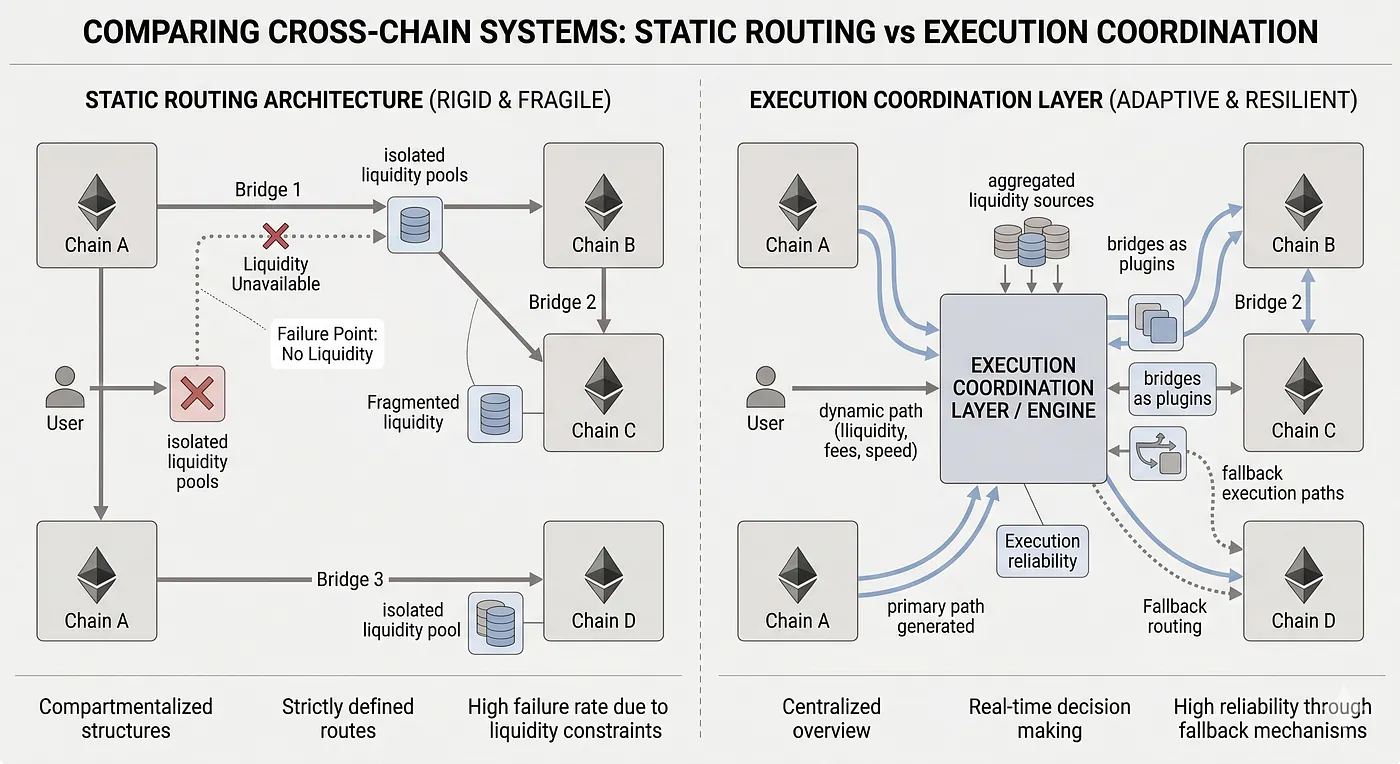
This is closer to how modern internet traffic routing works:
the system optimizes for delivery, not for a predefined path.
Routing transforms cross-chain execution from static infrastructure into adaptive infrastructure.
5. The problem routing still does not fully solve
Even routing systems leave an important gap.
Most existing architectures still lack a true execution layer.
In many cases:
- fallback logic remains limited
- systems are partially isolated
- execution optimization is incomplete
- infrastructure components compete instead of coordinating
This matters because routing alone does not guarantee outcomes.
A route may exist technically, while still producing:
- poor execution quality
- high total cost
- failed transactions under changing liquidity conditions
As cross-chain activity scales, execution reliability becomes more important than route discovery itself.
The market is slowly realizing that finding a route is not enough.
The infrastructure also needs to coordinate execution dynamically across fragmented environments.
6. The emergence of execution layers
This is where the concept of an execution layer begins to emerge.
An execution layer is not simply another bridge or another aggregator.
It is a coordination system that:
- abstracts away underlying bridge infrastructure
- evaluates liquidity conditions dynamically
- selects execution paths automatically
- adapts to changing network conditions
- optimizes for successful outcomes
The key shift is conceptual.
Users should not think in routes.
Systems should.
In this model, bridges become infrastructure primitives rather than standalone products.
The execution layer becomes responsible for determining:
- where liquidity exists
- which route is optimal
- how fallback mechanisms should behave
- how to minimize execution failure
This is the direction many infrastructure systems are naturally moving toward.
Projects across interoperability and routing infrastructure — including LayerZero, Axelar, and routing-focused systems — increasingly reflect this shift toward coordination-based execution.
7. CrossCurve as an execution-oriented routing layer
CrossCurve fits into this evolution as an execution-oriented routing layer rather than a standalone bridge.
Link: https://crosscurve.fi
Instead of depending on a single liquidity environment or enforcing one predefined execution path, CrossCurve combines:
- routing logic
- liquidity aggregation
- bridge integrations
- execution coordination
If local liquidity is unavailable, external routes can be incorporated dynamically.
From the user’s perspective, the focus is not on which bridge was used.
The focus is whether execution succeeded efficiently.
This reflects a broader architectural philosophy:
optimize for outcome, not for pathway ownership.
CrossCurve operates within the emerging category of systems that treat cross-chain execution as a coordination problem rather than a bridge-selection problem.
8. Conclusion
Cross-chain infrastructure is evolving in layers.
First came bridges.
Then aggregation.
Then routing.
The next logical step is execution coordination.
As ecosystems fragment further and liquidity spreads across more environments, the importance of static bridge competition declines. The systems that matter most will not necessarily be the bridges themselves, but the infrastructure layers coordinating how value moves between them.
Cross-chain infrastructure is becoming increasingly invisible to users.
At the same time, it is becoming more critical than ever.
The long-term winner is unlikely to be a single bridge.
It will be the layer that decides how execution happens across the entire ecosystem.