Multiple Virtual Cards as Budget Compartments: A Simple System
The problem with one card for everything
Most people run all their spending through one card and reconcile it later by reading the statement. This works but creates two problems: it's hard to see at a glance how much went to which category, and if the card is compromised or hits a limit, everything stops at once. Virtual cards offer a structurally different approach — since they're cheap to create and instant to issue, you can run a separate card for each spending category. Each card becomes a budget compartment with its own balance, and the separation creates both clarity and resilience.
How the compartment system works
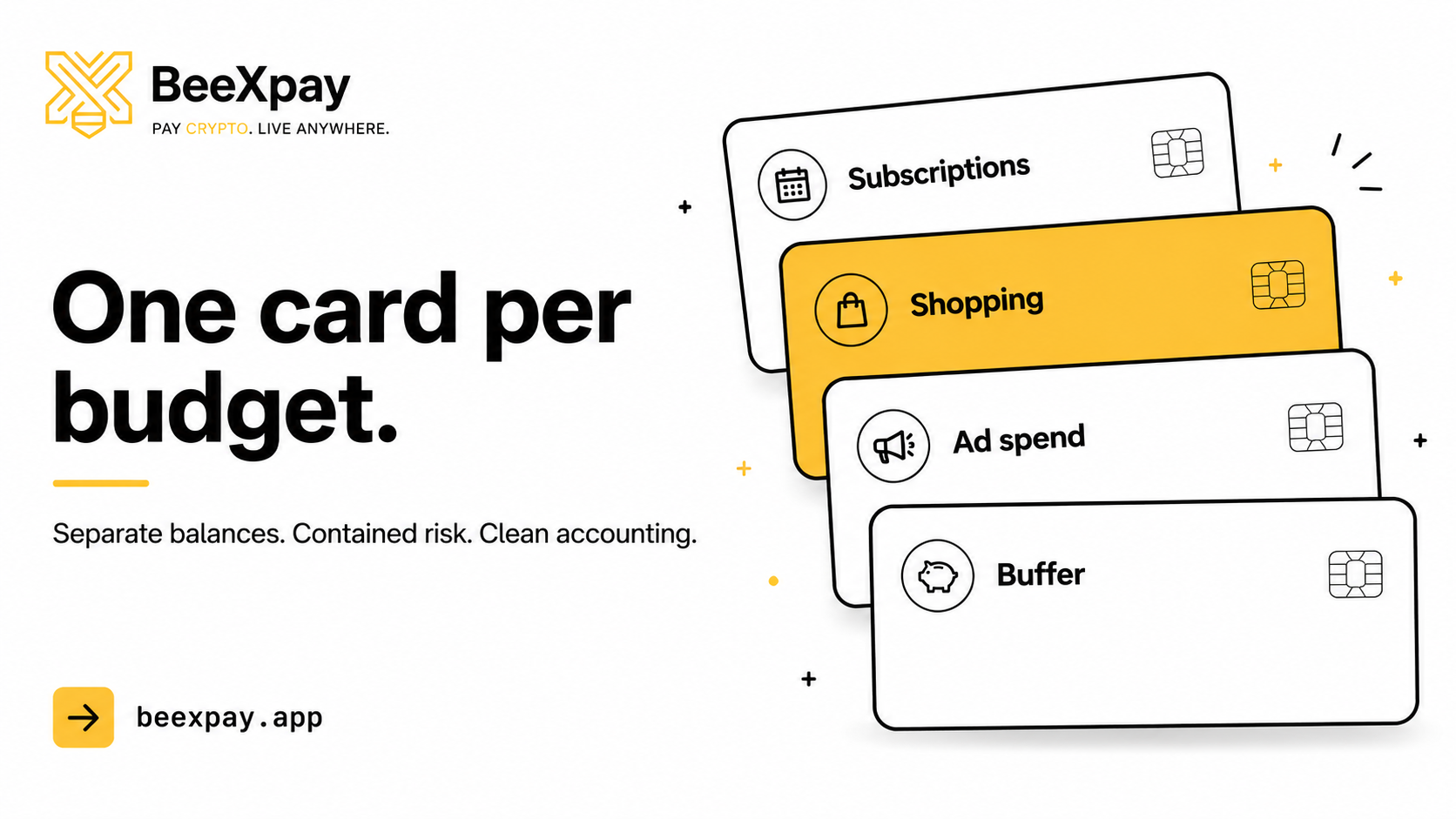
The idea is straightforward: instead of one card handling subscriptions, shopping, ad spend, and everything else, you create a dedicated virtual card for each category. A subscriptions card loaded with exactly your monthly subscription total. A shopping card loaded before each purchase. An ad spend card capped at your campaign budget. A travel card for trips. Each card has its own balance, funded for its own purpose. The compartmentalization happens at the card level rather than in a spreadsheet after the fact.
Why this beats spreadsheet budgeting
Spreadsheet budgeting tracks spending after it happens. Compartment budgeting enforces limits before spending happens. If your subscriptions card has $90 loaded and your subscriptions total $90, you physically can't overspend that category — there's no balance to draw from. This is a structural enforcement of the budget rather than a record of how you violated it. For people who struggle to stick to category budgets through willpower alone, the physical separation of funds is more effective than tracking.
The security dimension
The compartment system also improves security. If your shopping card details are compromised in a merchant data breach, only the shopping card balance is exposed — your subscriptions card, ad spend card, and everything else are untouched. You close the compromised card, spin up a new one, and continue. With a single card for everything, a compromise affects all your spending at once and requires updating the card details everywhere. The compartmentalization limits the blast radius of any single compromise.
How BeeXpay makes this practical
The compartment system only works if creating cards is cheap and fast. BeeXpay's virtual cards cost $10 each to issue, are generated in minutes via the Telegram Mini App or the main app, and can be funded independently. For a user running four budget compartments, the setup cost is $40 in issuance plus the reload fees on each card's balance. For the clarity and security the system provides, this is usually worth it for users who value structured spending. The economics work because virtual card issuance is cheap enough to justify multiple cards.
Practical setup for a typical user
A common setup for a knowledge worker or freelancer: a subscriptions card loaded monthly with the fixed total of recurring charges (AI tools, software, streaming). A shopping card loaded ad-hoc before online purchases. An ad spend card for those running marketing, capped at the monthly campaign budget. A buffer card with a small balance for unexpected needs. Each card is funded from the user's crypto wallet, converted to USD at the moment of spending. The user sees four clean balances rather than one mixed statement.
When the system is overkill
Honest framing: the compartment system isn't for everyone. Users with simple spending patterns — a few transactions a month, all in one category — don't need it. The setup cost and management overhead only pay off for users with enough spending complexity to benefit from the separation. For a user with one subscription and occasional shopping, a single card is simpler and cheaper. The compartment system is for users whose spending has enough categories and volume to justify the structure.
Tax and accounting benefits
For freelancers and small business operators, the compartment system has accounting benefits. A dedicated business card separates business expenses from personal spending cleanly, which simplifies tax preparation and expense tracking. An ad spend card isolates marketing costs. The separation that the compartment system creates at the card level maps naturally to the expense categories needed for accounting, reducing the reconciliation work at tax time. For users who currently mix business and personal spending on one card, the compartment system is worth considering for this reason alone.
Closing thought
The multiple-virtual-card approach is a simple system that leverages the cheap, fast issuance of virtual cards to create budget compartments. It enforces limits structurally, contains security compromises, and maps cleanly to accounting categories. It's not necessary for everyone, but for users with enough spending complexity, it's a meaningful improvement over running everything through one card and reconciling later.
→ Try it: https://beexpay.app