Chemical Fume Hood Selection Guide: Materials, Sizes & Safety Standards
What Makes a Chemical Fume Hood Different from Other Fume Hood Types?
Designed for Corrosive Vapors — Acid-Resistant Liners and Coatings
A chemical fume hood is built specifically to handle corrosive vapors from acids, bases, and many inorganic reagents.
Compared with a generalpurpose chemistry fume hood used only for light solvents, chemical hoods prioritize:
Acidresistant liners (PP, FRP, epoxycoated steel, or 316L)
Nonmetallic duct options for corrosive exhaust
Sashes and hardware designed to resist aggressive cleaning and fumes
From the projects we’ve completed in wet chemistry QC labs, hoods with officegrade painted steel liners started rusting after only 1–2 years of daily HCl use.
Why General-Purpose Hoods Fail When Handling Concentrated Acids or Bases
Generalpurpose chemical fume hoods may pass initial airflow tests but still be the wrong choice if:
Liners are plain painted steel or lowgrade FRP
Ducts are galvanized steel without protective coating
Work surfaces lack dished containment and chemical resistance
Resulting problems:
Corrosion leading to pinholes, leaks, and contamination risks
Seized sash mechanisms from acid exposure
Higher lifetime cost from repairs, recoating, or early replacement
In our experience, labs that “save” 10–20% on hood cost by underspecifying materials often spend that amount (or more) every 3–4 years on patching and repainting.
Liner Material Options — Choosing the Right Interior for Your Chemical Work
Polypropylene (PP) Liners — Best for Acid Handling (HCl, HNO₃, H₂SO₄)
PP is a popular choice for aggressive mineral acids:
Excellent resistance to HCl, HNO₃, H₂SO₄, and many bases
Nonmetallic, so no rusting from chloride exposure
Compatible with PVC or PP exhaust ducting
Limitations:
Poor resistance to some organic solvents (e.g., strong aromatic or chlorinated solvents)
Not ideal near open flames or very high temperatures
PPlined fume hood for chemical laboratory work is common in schools and industrial wet labs where acids dominate.
Epoxy Resin-Coated Steel — Cost-Effective for Mixed Organic/Inorganic Work
Epoxycoated steel liners strike a balance between cost and performance:
Good chemical resistance to many solvents and dilute acids/bases
Rigid structure with integrated steel shell
Generally cheaper than full PP or 316L construction
Weaknesses:
Prolonged exposure to hot concentrated acids can blister coatings
Chips or scratches can expose base metal to corrosion
From the projects we’ve completed in university labs, highquality epoxycoated hoods last 8–12 years with regular maintenance, provided users avoid chronic abuse with hot, concentrated acids.
Stainless Steel 316L Liners — For Pharmaceutical and High-Purity Applications
316L stainless liners are favored in pharma and highpurity environments:
Better resistance to chloride attack than 304 stainless
Smooth, easytoclean surfaces suitable for GMP contexts
Good mechanical strength, fitting into stainless furniture lines
Drawbacks:
Still vulnerable to some halogenated species and strong chlorides at high temperatures
Higher cost vs. epoxy or FRP systems
Many pharma QC labs pair 316L chemical fume hoods with stainless casework to align with GMP expectations and ISO 14644 cleanroom design.
Fiberglass Reinforced Polyester (FRP) — Heavy-Duty Corrosion Resistance
FRP liners provide:
Excellent corrosion resistance across a broad chemical range
Good structural integrity and impact resistance
Widely used in industrial fume hood for chemical laboratorysetups
Cons:
Rougher microtexture vs. stainless, slightly harder to clean perfectly
UV and thermal aging if exposed to prolonged high heat or sunlight
FRP often makes sense for heavy industrial chemistry where cosmetics are less important than longterm durability.
Chemical Compatibility Matrix — Liner Material × Common Lab Chemicals
Chemical / Reagent
PP Liner
Epoxy-Coated Steel
316L SS
FRP Liner
HCl (conc.)
Excellent
Fair–Good
Fair
Excellent
HNO₃ (conc.)
Good
Fair
Poor–Fair
Good
H₂SO₄ (conc.)
Excellent
Fair–Good
Good
Excellent
NaOH / KOH (strong base)
Excellent
Good
Good
Excellent
Acetone, Ethanol
Fair
Good
Good
Good
Toluene, Xylene
Poor–Fair
Good
Good
Good
Chlorinated solvents
Fair
Good
Good
Good
Always confirm compatibility with manufacturer charts for your exact concentration and temperature.
Sizing Your Chemical Fume Hood — Width, Depth & Height Considerations
Standard Widths: 4-Foot, 5-Foot, 6-Foot, and 8-Foot Models Compared
Choosing width affects both user capacity and exhaust load:
Nominal Width
Typical Use Case
4 ft (1200 mm)
Single operator, undergraduate teaching labs
5 ft (1500 mm)
Single operator with more glassware, QC prep
6 ft (1800 mm)
One–two operators, synthesis setups, pilot scale
8 ft (2400 mm)
Multiple operators, large apparatus, pilot plant
Most university labs standardize on 6 ft chemical fume hoods to balance flexibility and floor space.
Larger hoods require more exhaust CFM, increasing fan and HVAC costs.
Internal Depth Requirements — Accommodating Apparatus Behind the Sash Line
Depth is often overlooked:
Standard internal depth: 700–900 mm (28–36″)
Deep hoods are useful for distillation rigs, rotary evaporators, or tall column setups.
Aim to keep apparatus at least 150 mm (6″)behind the sash plane to maintain capture efficiency.
In our experience, tooshallow hoods force users to work near the sash, increasing turbulence and bypassing intended containment.
Sash Opening Height — How Working Height Affects Face Velocity and Safety
Face velocity is defined at a specific sash opening height, typically:
18″ (450 mm)for energyefficient hoods
24″ (600 mm)for traditional designs
Key points:
Higher sash opening = more area = more CFM required to maintain 0.5 m/s (100 fpm) face velocity.
Many labs now target 4–0.5 m/s (80–100 fpm)per ANSI/AIHA Z9.5, depending on risk assessment.
A variable air volume (VAV) system can help control energy use as the sash height changes, but adds complexity and cost.
Safety Features Every Chemical Fume Hood Must Have
Airflow Monitor/Alarm — Audible and Visual Alerts When Velocity Drops Below Safe Levels
A modern chemical fume hood should include:
Realtime airflow monitor or face velocity sensor
Visual indicator (green/amber/red) and audible alarm below set threshold
Calibration access and test points
ASHRAE 110 testing usually validates performance at 0.5 m/s (100 fpm); alarms often trigger around 0.3–0.4 m/s (60–80 fpm), depending on institutional policy.
Sash Stops and Counterbalance Systems — Preventing Operator Exposure
Safe sash design includes:
Mechanical stops to limit opening to tested height
Counterbalanced sashes that stay in place when released
Smooth movement so users actually keep the sash low
From the projects we’ve completed, labs with welltuned sash systems and user training see far fewer containment issues than those with stiff, hardtoposition sashes.
Spill Containment — Cup Sinks, Dished Work Surfaces, and Drain Options
Good practice for fume hood for chemical laboratory applications:
Dished work surfaces to contain small spills
Cup sinks (PP or epoxy) where wet work is frequent
Proper drain routing in line with NFPA 30and local codes, especially for flammable or hazardous waste
Spill containment is often overlooked until the first significant spill hits a flat, unprotected worktop.
Fire Suppression Integration — Sprinkler Head Placement Inside the Hood
Coordination with fire protection following NFPA 45:
Sprinkler heads often installed in the duct or within the hood chamber
Avoid obstructions from baffles, utilities, and light fixtures
Ensure sash materials and glazing meet local fire and safety codes
Integration should be reviewed by both mechanical and fire protection engineers before installation.
Chemical Fume Hood Standards & Compliance Requirements
ASHRAE 110-2016 — Performance Testing Protocol (AM, AI, AU Tests)
ASHRAE 110 is the benchmark for hood performance in North America:
AM: as manufactured
AI: as installed
AU: as used (with realworld obstructions, equipment, etc.)
Testing uses a tracer gas (SF₆) and a mannequin to evaluate containment.
An acceptable test typically yields <0.05 ppm average tracer gas concentration at the breathing zone.
EN 14175-3 — Type Testing Requirements for European Markets
For European labs, EN 14175 defines:
Containment tests with tracer gas
Robustness under crossdrafts and sash movement
Dynamic sash operation performance
From the projects we’ve completed in EU labs, many tenders now explicitly require EN 14175 typetested chemical fume hoods, not just generic “lab hoods.”
NFPA 45 — Fire Protection for Laboratories Using Chemicals
NFPA 45 addresses:
Hood construction for fire resistance
Maximum quantities of flammable liquids in use and storage
Requirements for hood location and separation distances
Lab planners should crosscheck hood selection with overall fire load and storage plans.
ANSI Z9.5 — Laboratory Ventilation System Design
ANSI Z9.5 covers the ventilation system serving hoods:
Recommended face velocities and diversity factors
Exhaust fan design, redundancy, and discharge height
Interaction with room supply diffusers and pressure control
A highperformance chemistry fume hood will still fail in practice if room ventilation ignores these guidelines.
Installation Best Practices for Chemical Fume Hoods
Room Airflow Patterns — Why Hood Placement Near Doors and HVAC Vents Causes Failure
Poor placement can ruin even a good hood:
Avoid locations directly opposite doors or under strong supply diffusers.
Maintain ≥1 m (3 ft)clearance from doorways where possible.
Design supply air patterns to sweep toward hoods, not across the operator’s face.
ASHRAE 110 “as used” tests often fail because of crossdrafts, not because the hood is poorly designed.
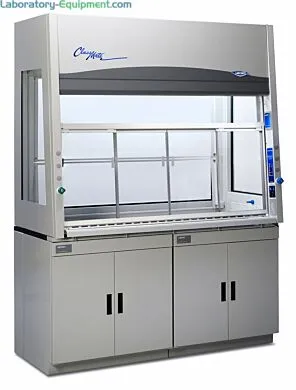
Laboratory Fume Hoods
Exhaust Duct Material Selection — PVC, PP, Stainless Steel, or Coated Galvanized
Duct selection must match your exhaust chemistry:
PVC / PP: excellent for acids; temperature limited (usually < 80–90°C).
Coated galvanized steel: acceptable for mild conditions but vulnerable to heavy acids.
304/316 stainless: good for many solvents and mixed use; may need internal coating for strong acids.
Many projects use PP or PVC for short duct runs, then transition to coated metal risers outside the building envelope.
Utility Connections — Gas, Water, Vacuum, Electrical Inside the Hood
Standard utilities often include:
Laboratory gas (N₂, air, sometimes fuel gas per local code)
Cold water and vacuum
Electrical outlets in explosionproof or labrated enclosures
Each penetration is a potential leak or failure point if not properly sealed and integrated with the liner system.
FAQ
Can I use a chemical fume hood for perchloric acid digestion?
Standard chemical fume hoods are not suitable for perchloric acid.
You need a dedicated perchloric acid hood with:
Washdown system for ducts
Nonsparkling construction
Special exhaust design rated for explosive salts
Always follow NFPA 45 guidance and manufacturer recommendations.
What width chemical fume hood is most common for university labs?
Most university teaching and research labs standardize on 6-foot (1.8 m) hoods.
They allow enough space for typical undergrad experiments or a single research setup while fitting standard lab modules.
How do I verify that my chemical fume hood meets ASHRAE 110?
Work with a certified testing firm to perform:
ASHRAE 110 tracer gas containment tests (AM/AI/AU as relevant)
Face velocity mapping at the design sash height
Smoke visualization to identify turbulence and dead spots
Request written reports and keep them with your safety and maintenance documentation.
What is the recommended face velocity for a chemical fume hood?
Most labs target 0.4–0.5 m/s (80–100 fpm) at the sash plane, as guided by ANSI Z9.5 and institutional policies.
Higher velocities can create turbulence and draw contaminants out; lower velocities risk inadequate capture unless the hood is specifically designed for lowflow operation.
A wellspecified chemical fume hood—with the right liner, size, airflow controls, and standards compliance—protects staff, instruments, and your longterm budget. Matching the hood to your actual chemistry and building ventilation strategy is the best way to avoid corrosion issues, safety incidents, and failed performance tests down the line.