Cleanroom Wall Panels: The Complete Guide to Types, Materials & Standards
What Are Cleanroom Wall Panels and Why Are They Critical to Contamination Control?
How Wall Panels Differ from Conventional Building Walls in Controlled Environments
Standard drywall and CMU (concrete masonry unit) construction might work for offices, but they fail in cleanrooms for three reasons: they generate particles, they harbor bacteria in porous surfaces, and they cannot maintain the airtight envelope a pressure cascade demands.
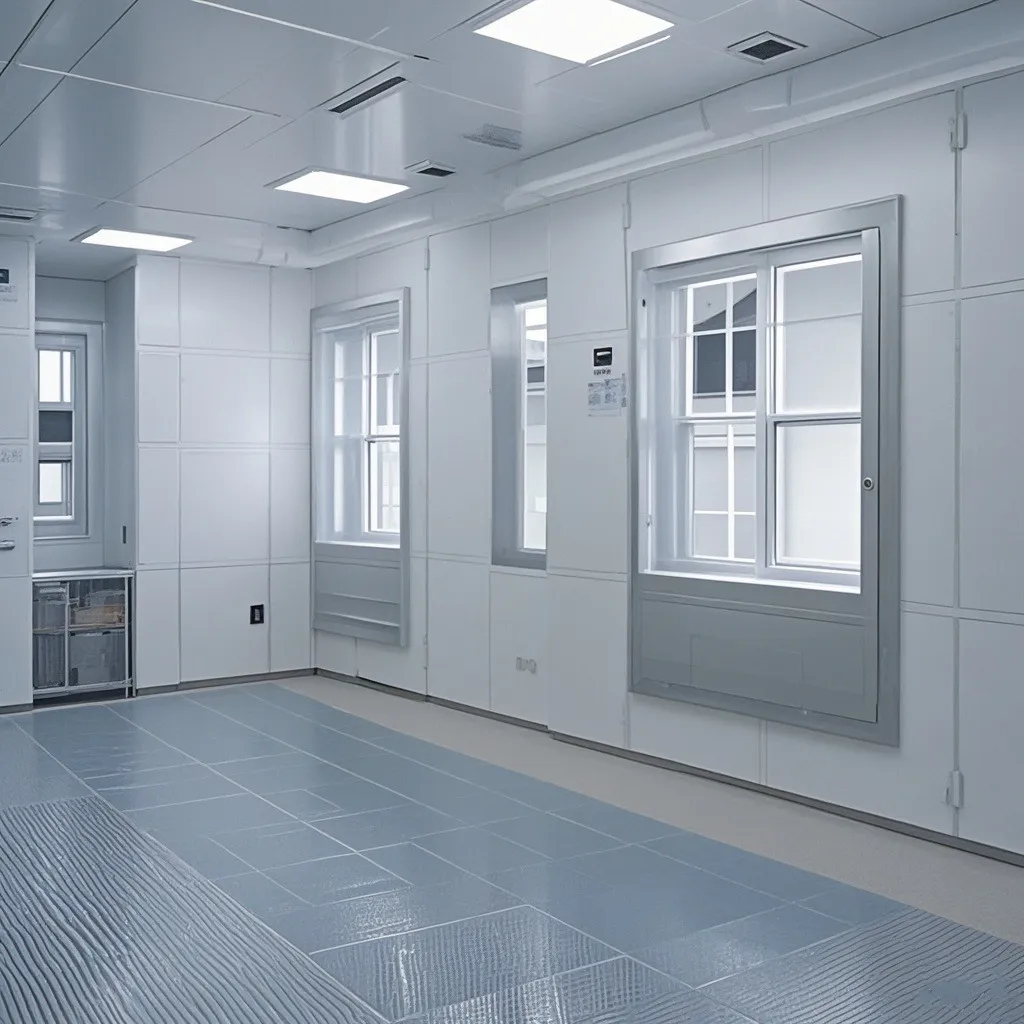
Cleanroom panels are engineered enclosure systems. They feature non-porous face sheets bonded to insulating cores, with factory-controlled joint profiles that minimize gaps. The result is a smooth, sealed barrier that supports directional airflow, withstands chemical cleaning, and contributes zero particles to the controlled space.
The Direct Relationship Between Panel Quality and ISO 14644 Classification Performance
Your HVAC system does the heavy lifting on air changes, but the room envelope determines whether that effort holds. A cleanroom wall with poor joint seals or rough surfaces creates turbulence and particle traps that HVAC alone cannot overcome.
From the projects we’ve completed, we’ve observed that rooms built with high-quality cleanroom wall panel systems achieve target classification 30โ€“40% faster during commissioning particle count testing compared to rooms where panels were value-engineered too aggressively. The panel is not where you want to cut costs.
6 Main Types of Cleanroom Wall Panels Compared by Construction & Application
Cleanroom Wall Panels
Steel-Faced Sandwich Panels (EPS, Rock Wool, PU, PIR Core)
The workhorse of the industry. Steel-faced sandwich panels account for roughly 70% of all cleanroom wall installations globally. Two pre-coated galvanized or galvalume steel sheets are bonded to an insulating core. Your core choice EPS, rock wool, PU, or PIR determines fire rating, thermal performance, and cost.
Best for: ISO 78 cleanrooms, electronics assembly, food processing, general manufacturing.
Aluminum Honeycomb Sandwich Panels Lightweight, High Flatness
Aluminum honeycomb cores deliver exceptional flatness (0.5 mm/m) at roughly 4060% less weight than steel sandwich panels. They carry an A2 non-combustible fire rating without chemical flame retardants.
Best for: Walk-on cleanroom ceilings, semiconductor fabs, any project where weight or flatness is a primary concern.
Solid HPL (High-Pressure Laminate) Panels
HPL panels offer excellent chemical resistance and are available in a wide color palette. They perform well in labs and cosmetics facilities where aesthetics matter alongside function. The downside: limited thermal insulation.
Best for: Laboratory partitions, cosmetics manufacturing, low-thermal-load environments.
Fiberglass Reinforced Plastic (FRP) Panels
FRP is virtually immune to corrosion, making it the go-to for aggressive chemical environments. However, FRP panels are harder to achieve truly flush joints with, and surface flatness is inferior to steel or honeycomb options.
Best for: Chemical processing areas, battery manufacturing wet rooms, acid/alkali handling zones.
Tempered Glass & Window Panels for Cleanroom Walls
Glass panels serve two functions: they let supervisors and visitors observe processes without entering the cleanroom, and they allow natural light into what would otherwise be a sealed box. Double-glazed, flush-mounted units with silicone perimeter seals are standard.
Best for: Viewing windows in pharma filling lines, visitor corridors, QC observation areas.
Stainless Steel Panels For Pharma & High-Chemical Exposure Zones
316L stainless steel panels with electropolished surfaces (Ra ‰ค 0.6 ฮผm) sit at the top of the specification and cost pyramid. They withstand VHP (vaporized hydrogen peroxide) decontamination, resist pitting from chloride-based cleaners, and satisfy the most demanding GMP auditors.
Best for: Grade A/B pharmaceutical zones, sterile API manufacturing, biocontainment.
Core Materials Explained EPS vs. Rock Wool vs. PU vs. Honeycomb
Thermal Insulation Performance (U-Value / R-Value Comparison Table)
Core Material
Typical Thickness
Thermal Conductivity (ฮป, W/mยทK)
R-Value (mยฒยทK/W) at 50mm
Relative Cost
EPS
50100 mm
0.0350.040
1.251.43
$ (Lowest)
Rock Wool
50100 mm
0.0350.040
1.251.43
$$
PU / PIR
5075 mm
0.0220.028
1.792.27
$$$
Aluminum Honeycomb
2550 mm
N/A (minimal insulation)
~0.2
$$$$ (Highest)
clean room panels
Fire Rating Differences Which Cores Meet FM Global & EN 13501 Requirements?
This is where core selection gets non-negotiable for many projects:
Rock Wool:A1 non-combustible per EN 13501-1. Passes FM 4880 assembly tests. Required by most FM Global-insured facilities.
PIR:Achieves B-s1, d0 (limited combustibility). Acceptable in many jurisdictions with sprinkler protection.
EPS:B-s2, d2 at best. Fails FM 4880. Acceptable only where fire codes permit and insurance carriers agree.
Honeycomb (Aluminum):A2 non-combustible. Inherently fire-safe.
In our experience, specifying EPS to save 1520% on panel cost often backfires when the facility’s insurer demands FM-approved panels during the underwriting process. Verify insurance requirements before finalizing core material.
Moisture Resistance & Chemical Compatibility by Core Type
PU/PIR cores are closed-cell foams with near-zero moisture absorption (<2% by volume). Rock wool is hydrophobic when treated but can absorb moisture if the panel face is breached. EPS absorbs slowly but permanently. Honeycomb cores are inorganic and unaffected by moisture.
For cleanrooms exposed to regular washdown or high humidity (food, beverage, pharma), PU or honeycomb cores are the safer long-term choice.
Surface Finish & Coating Options That Impact Cleanability and Lifespan
Polyester Coated Steel vs. PVC-Coated Steel vs. Stainless Steel Facing
Polyester-coated steel (25 ฮผm coating):The standard for ISO 78 cleanrooms. Good chemical resistance to mild cleaners. Typical lifespan: 1520 years with normal use.
PVC plastisol-coated steel (200 ฮผm coating):Better scratch and impact resistance. Preferred for high-traffic areas and food processing.
Stainless steel (304 or 316L):The premium choice. Resists VHP, concentrated acids, and aggressive CIP chemicals. Required for GMP Grade A/B.
Surface Roughness (Ra) Requirements for GMP vs. Non-GMP Cleanrooms
Anti-Static & Anti-Bacterial Coating Options for Electronics and Pharma
ESD-dissipative coatings (surface resistance 10ถ10น ฮฉ) are available for semiconductor and electronics cleanroom panel types where electrostatic discharge threatens sensitive components. Anti-bacterial coatings incorporating silver ion technology are offered for hospital and biotech cleanrooms, though their long-term efficacy beyond 5 years is debated in the industry.
International Standards & Certifications Governing Cleanroom Wall Panels
ISO 14644-4 Design & Construction Requirements for Cleanroom Surfaces
ISO 14644-4:2001 (currently under revision) specifies that cleanroom surfaces shall be smooth, non-shedding, resistant to cleaning agents, and compatible with the room’s classification. It does not prescribe specific panel types but sets the performance framework that all cleanroom wall panels must satisfy.
EU GMP Annex 1 Surface Finish Requirements for Pharmaceutical Cleanrooms
The revised Annex 1 (effective August 2023, enforcement continuing into 2025) requires surfaces in classified areas to be “smooth, impervious and unbroken in order to minimize the shedding or accumulation of particles or microorganisms and to permit the repeated application of cleaning agents and disinfectants.”
This language directly drives panel specification in pharma projects.
FM Global & EN 13501 Fire Performance Classifications
FM 4880 and FM 4882 are the gold standards for panel assembly fire testing in insured industrial facilities. EN 13501-1 classifies material reaction to fire. If your facility carries FM Global insurance, panel fire compliance is not optional it is a condition of coverage.
USDA & NSF Acceptance for Food Industry Applications
Food processing cleanrooms often require USDA-accepted or NSF-listed wall surfaces. Panels with smooth, non-absorbent, washable face sheets and sealed joints meet these requirements, but the specific coating and sealant must be verified against USDA/NSF chemical lists.
How to Match Cleanroom Wall Panel Type to Your ISO Classification
ISO Class 56 (High Cleanliness) Recommended Panel Constructions
For ISO 56, panel joints must be near-invisible and fully sealed. Recommended options include:
Aluminum honeycomb panels with flush cam-lock joints
PU/PIR sandwich panels with silicone-sealed tongue-and-groove joints
316L stainless steel panels for pharma GMP Grade A/B
Avoid standard EPS panels here. Joint tolerances and surface quality typically fall short of ISO 5 expectations.
ISO Class 78 (Standard Cleanliness) Cost-Effective Panel Options
ISO 78 cleanrooms represent the sweet spot where cost optimization is possible without sacrificing compliance:
Steel-faced rock wool or EPS panels perform well
Polyester-coated steel facing is sufficient
Tongue-and-groove joints with gaskets (no silicone required in many cases)
Comparison Matrix: Panel Type ร— ISO Class ร— Budget
Panel Type
ISO 5
ISO 6
ISO 7
ISO 8
Budget Level
316L Stainless Steel
œ… Ideal
œ…
Over-spec
Over-spec
$$$$$
Aluminum Honeycomb
œ… Ideal
œ… Ideal
œ…
Over-spec
$$$$
PU/PIR Sandwich (Steel)
œ…
œ… Ideal
œ… Ideal
œ…
$$$
Rock Wool Sandwich (Steel)
Marginal
œ…
œ… Ideal
œ… Ideal
$$
EPS Sandwich (Steel)
Œ
Marginal
œ…
œ… Ideal
$
From the projects we’ve completed across pharmaceutical, semiconductor, and food industries, the most common specification globally is a 5075 mm PU-core steel sandwich panel with polyester coating for ISO 7 cleanrooms. It hits the performance-cost balance that most clients need.
cleanroom wall panel
FAQ
What thickness of cleanroom wall panel do I need?
Most ISO 78 cleanrooms use 50 mm panels. If thermal insulation is a priority (cold rooms, exterior walls), 75 mm or 100 mm is specified. Structural span also matters thicker panels span greater distances between support frames without deflecting.
Can cleanroom wall panels be reused if I relocate my cleanroom?
Yes this is one of the key advantages of modular cleanroom panels over drywall construction. Cam-lock and clip-in panel systems can be disassembled, transported, and re-installed with 8595% material reuse. Silicone-sealed tongue-and-groove panels require new sealant but the panels themselves are reusable.
What is the lifespan of a typical cleanroom wall panel?
With proper maintenance, steel-faced sandwich panels last 2025 years. Stainless steel panels can exceed 30 years. The most common failure mode is not the panel itself but the joint sealant, which typically requires re-application every 710 years.
Do cleanroom wall panels require special cleaning agents?
Standard polyester-coated panels can be cleaned with IPA (isopropyl alcohol), diluted bleach, or quaternary ammonium compounds. Avoid abrasive scrubbers. Stainless steel panels tolerate stronger agents including VHP and peracetic acid. Always verify chemical compatibility with your panel manufacturer’s data sheet before applying a new cleaning protocol.