Knowing the Indian polity: Political parties.
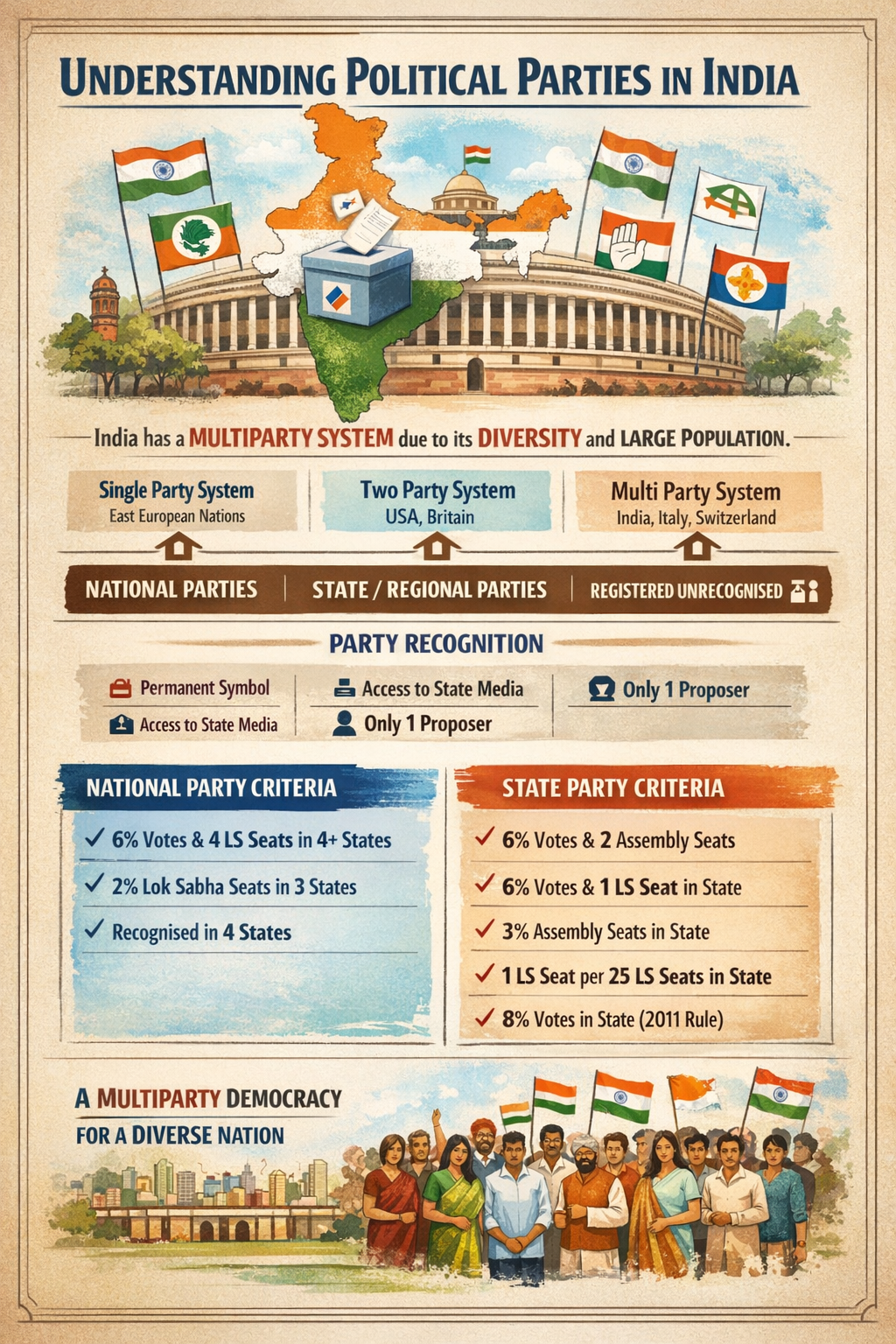
image created using AI
Today I will be posting some more content regarding the polity of India, and it will help all of us who go through this post understand how political parties or representatives of the people come to power in India and how our government is chosen. Today I will be talking about political parties that play a major role in running this country effectively and coming to power, thereby becoming the virtual steering holders of our country.
As we know, political parties are voluntary associations of individuals who share the same political ideas and ideology. In India, there are different ways through which people who contest elections can get elected as representatives of the people. They might be involved with a party that has its own ideology and receive support from people who agree with that ideology. These parties can either be national parties or regional parties depending upon the vote share they get in elections, and they also get certain advantages after being given such status.
India has a multiparty system. Considering the fact that our country is highly diverse and populous, and that a large number of people enjoy universal adult franchise, there are many political parties. This large number of parties exists because of the diversity of the country and the presence of local aspirations. Some parties are national, some are regional, and some are even based on linguistic factors, which makes the Indian political scenario a multiparty one.
In the world today, different countries follow different party systems. Some countries have a single-party system, like certain East European countries. Some have a two-party system, such as the United States and Britain. Others, like India, Switzerland, Italy, and France, have a multiparty system.
Talking about national and state parties, national parties contest elections at the national level as well as at the state level, whereas regional or state parties usually contest elections within a particular state or region and not across the entire country. The third category consists of registered but unrecognised parties. The status of a party as a national or state party is determined on the basis of its poll performance.
Parties that receive recognition from the Election Commission of India enjoy certain privileges. These include a permanent party symbol, time for political broadcasts on state-owned media, and access to electoral rolls. Another important feature is that recognised parties need only one proposer when a candidate files nomination papers, whereas candidates from unrecognised parties require ten proposers from the constituency.
Recognised parties can have up to 40 star campaigners, whereas registered but unrecognised parties are allowed only 20 star campaigners. This is significant because the travel expenses of star campaigners are not included in the candidate’s election expenditure, which gives recognised parties an advantage in reaching more voters.
A national party uses the same symbol throughout the country. A recognised state party uses a reserved symbol across that particular state. In the case of a registered unrecognised party, however, a symbol is allotted from the list of free symbols other than the reserved ones.
The important conditions for recognition as a national party are:
1. If a party secures at least 6% of valid votes in any four or more states in a general election to the Lok Sabha or to the Legislative Assembly and wins at least four seats in the Lok Sabha from any state or states.
2. If it wins 2% of the total seats in the Lok Sabha in a general election, and these seats come from at least three different states.
3. If it is recognised as a state party in four different states.
The criteria for recognition as a state party are:
1. If it secures 6% of the valid votes polled in the state in a general election to the Legislative Assembly and wins at least two seats in that assembly.
2. If it secures 6% of the valid votes in the state in the Lok Sabha elections and wins at least one Lok Sabha seat from that state.
3. If it wins 3% of the seats in the Legislative Assembly of the state or at least three seats, whichever is higher.
4. If it wins one Lok Sabha seat for every 25 Lok Sabha seats allotted to that state.
5. A provision added in 2011 states that if a party secures 8% of the votes in either a Lok Sabha election or a State Legislative Assembly election in that state, it will be recognised as a state party.