Knowing the political set up of India. Anti-defection law.
 image generated using AI
Hello dear Steemians, how are you all? I hope you all are doing great.
Today, a new idea popped into my mind. As a student of Polity, I am deeply interested in understanding the administrative setup of large and diverse countries like the USA, India, and Russia. I often wonder how such vast nations, especially a country as diverse as India, are governed and administered so effectively.
In my leisure time, I usually read about the political and administrative structures of these countries, particularly India. I thought, why not share what I read with all of you so that we can learn together? Political systems are truly fascinating, and I believe you will find them interesting as well.
Today, I am beginning with a topic that I studied recently. With time, I will continue posting about different aspects of Indian Polity that play a significant role in ensuring that the country functions smoothly at various levels of governance.
In this post, I will be writing about the Anti-Defection Law, which is an important step toward maintaining political stability in India and preventing corrupt practices related to party switching by elected representatives.
In India, members from different political parties contest elections from various constituencies across the country, either for Parliament or for the State Legislatures. Since India is a federation, we have governments at both the Central and State levels. Representatives are elected from parliamentary constituencies in general elections for Parliament and from assembly constituencies in State elections.
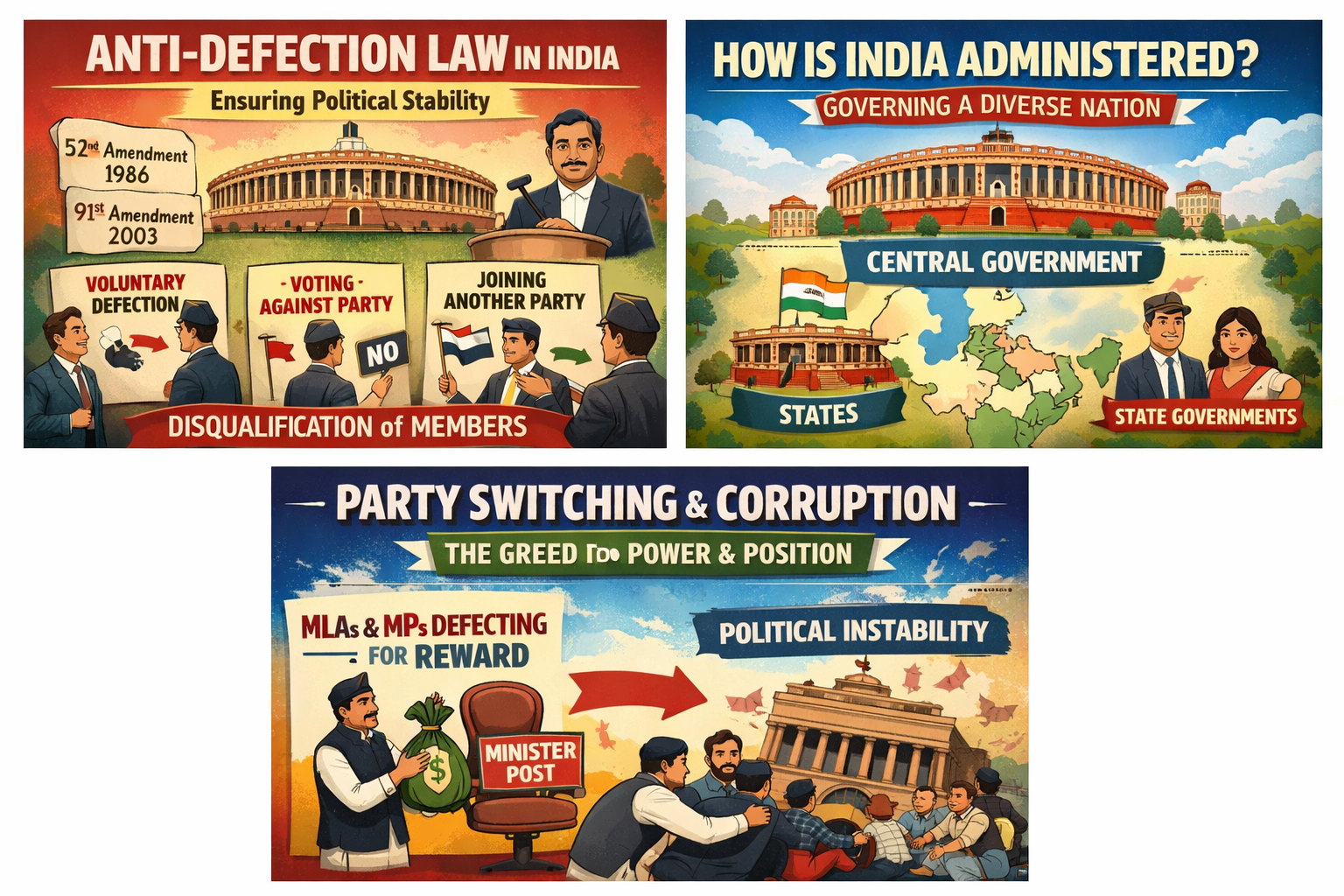
image generated using AI
India follows the First Past the Post system, which means that whichever candidate secures more votes than the other contesting candidates wins the seat and becomes the representative of the people.
After elections, members from different parties enter the legislature. Sometimes, however, an elected member may get influenced by power, position, or material benefits offered by the ruling party. A member may also disagree with the agenda or functioning of their own party and decide to leave it by renouncing membership. To prevent such defections motivated by greed or instability, the Indian Constitution introduced the Anti-Defection Law, which disqualifies a member if they change their party after winning an election during their term.
The need for such a law was felt in 1985, and it was introduced through the 52nd Constitutional Amendment Act. This amendment added the Tenth Schedule to the Constitution and made changes to Articles 101, 102, 190, and 191. Later, the law was strengthened by the 91st Constitutional Amendment Act in 2003.
A member can be disqualified on several grounds. First, if a member voluntarily gives up the membership of their political party, they lose their seat. Second, if a member votes against the party’s direction or abstains from voting without prior permission, and the party does not condone the action within fifteen days, the member can be disqualified. Third, an independent member who is elected without party support will be disqualified if they join any political party after the election. Fourth, a nominated member can join a political party within six months of nomination; if they join after six months, they are liable to be disqualified.
Earlier, if one-third of the members of a party split and formed a new group, they were protected from disqualification. However, this provision was misused. Therefore, the 91st Constitutional Amendment Act removed this protection and now requires at least two-thirds of the members of a legislative party to agree to a merger with another party for it to be considered valid. Only in such cases will members be protected from disqualification.
There is also an exception for the presiding officer of the House. If the Speaker or Chairman resigns from their political party after being elected to that office, it is considered acceptable so that they can function in an impartial and unbiased manner. For example, the Speaker of the Lok Sabha, though elected as a member of a political party, may resign from that party upon becoming Speaker to maintain neutrality.
The authority to decide questions of disqualification under the Anti-Defection Law lies with the presiding officer of the House. However, the Supreme Court has held that the decision of the presiding officer is subject to judicial review, and it can be challenged before the High Court or the Supreme Court. Disqualification is not automatic; a complaint must first be made to the presiding officer, who must give the concerned member an opportunity to explain their position before taking any decision.
The main objective of the Anti-Defection Law is to uphold democratic values and prevent unethical practices motivated by greed for power, position, or material benefits. It provides greater stability to governments, reduces corruption arising from political defections, and gives constitutional recognition to political parties.
However, the law has also faced criticism. It restricts the freedom of legislators to dissent from their party’s decisions, even when disagreement may be based on principle. It focuses mainly on actions within the House and not on conduct outside it. Moreover, since the power to decide disqualification rests with the presiding officer, there are concerns that decisions may sometimes be influenced by political considerations.
The 91st Constitutional Amendment Act also introduced provisions to limit the size of the Council of Ministers to a maximum of 15 percent of the total strength of the Lok Sabha at the Centre and 15 percent of the Legislative Assembly in the States, with a minimum of twelve ministers in a State. This was intended to discourage defections motivated by the lure of ministerial positions. Additionally, a member disqualified under the Anti-Defection Law cannot be appointed as a minister or hold any remunerative political post, though they may receive compensatory allowances such as travel allowances.
Overall, the Anti-Defection Law was introduced to ensure political stability and maintain the integrity of the democratic process, though debates continue regarding its scope and implementation.
Congratulations... I have recommended this post to get support from Steemchiller and Realrobinhood.