What Successful Companies Do When Their Software Project Starts Falling Apart

Starting a new software venture feels a lot like launching a magnificent yacht. You have the blueprints, the talented crew, and the wind of executive enthusiasm at your back. Everything is smooth sailing until, suddenly, the alarm bells start ringing. Deadlines are slipping, the code base is a tangled mess, and the budget is hemorrhaging money. What felt like a dream project has rapidly turned into a sinking ship.
If you are a successful company, you know this feeling is more common than you’d like to admit. Statistics bear this out in shocking detail. According to studies based on the Standish Group’s findings, a surprisingly low percentage of software projects are delivered on time, within budget, and with all the required features. More recent data from sources like Zipdo’s 2023 report painted an even starker picture: over 31% of software projects are canceled before completion, and a majority of those that limp to the finish line exceed their original budgets by nearly 190%. These colossal failures are not just embarrassing; they are financially devastating, with unsuccessful development projects costing the US economy an estimated $260 billion annually, according to the Consortium for IT Software Quality (CISQ).
So, what separates a good company from a truly successful one? The difference isn't avoiding the crisis... it's how you respond to it. Successful companies don't panic. They initiate a highly specialized, structured maneuver designed to stabilize the project, stop the financial and operational bleeding, and deliver on the original business goal. They call in the experts for a formal software project rescue.
Stage 1: The Courage to Stop Digging
The first and arguably hardest step for any successful organization is acknowledging reality. The internal team has likely been working tirelessly, often facing burnout, yet the project continues to slide backward.
Analogy: When you find yourself in a deep hole, the first thing you must do is stop digging.
In the corporate world, 'stopping digging' means pausing development on new features and putting an immediate stop to spending on poorly managed workstreams. This requires tremendous leadership courage. Executives must look beyond the millions already spent, the so-called sunk cost fallacy, and admit that the current trajectory is unsustainable. If you allow a failing project to proceed, you don't just lose the initial investment; you risk losing the market opportunity the software was meant to capture, damaging your reputation, and distracting top-tier talent.
Successful leaders immediately sanction an unbiased, external audit. They know that only a fresh, neutral perspective can accurately assess the damage without political interference. This initial phase shifts the focus from emotional reaction ("Who is to blame?") to strategic intervention ("How do we fix this?"). It is the foundational requirement for launching an effective software project rescue.
Stage 2: The Forensic Audit and Diagnosis
Getting Under the Hood
Once the slide is halted, the rescue team moves in like forensic investigators. They are there not to judge, but to diagnose the illness. If a patient is seriously ill, you don’t just prescribe medication; you run a comprehensive panel of diagnostic tests. Technology projects require the same intensity.
Statistically, project failure rarely stems from a single, catastrophic event; it is usually a compounding issue. Data consistently shows that poor requirements gathering is the leading cause of failure, cited in close to 40% of cases. Was the problem that nobody knew what they were building, or was it the notorious scope creep, where the goalposts moved daily?
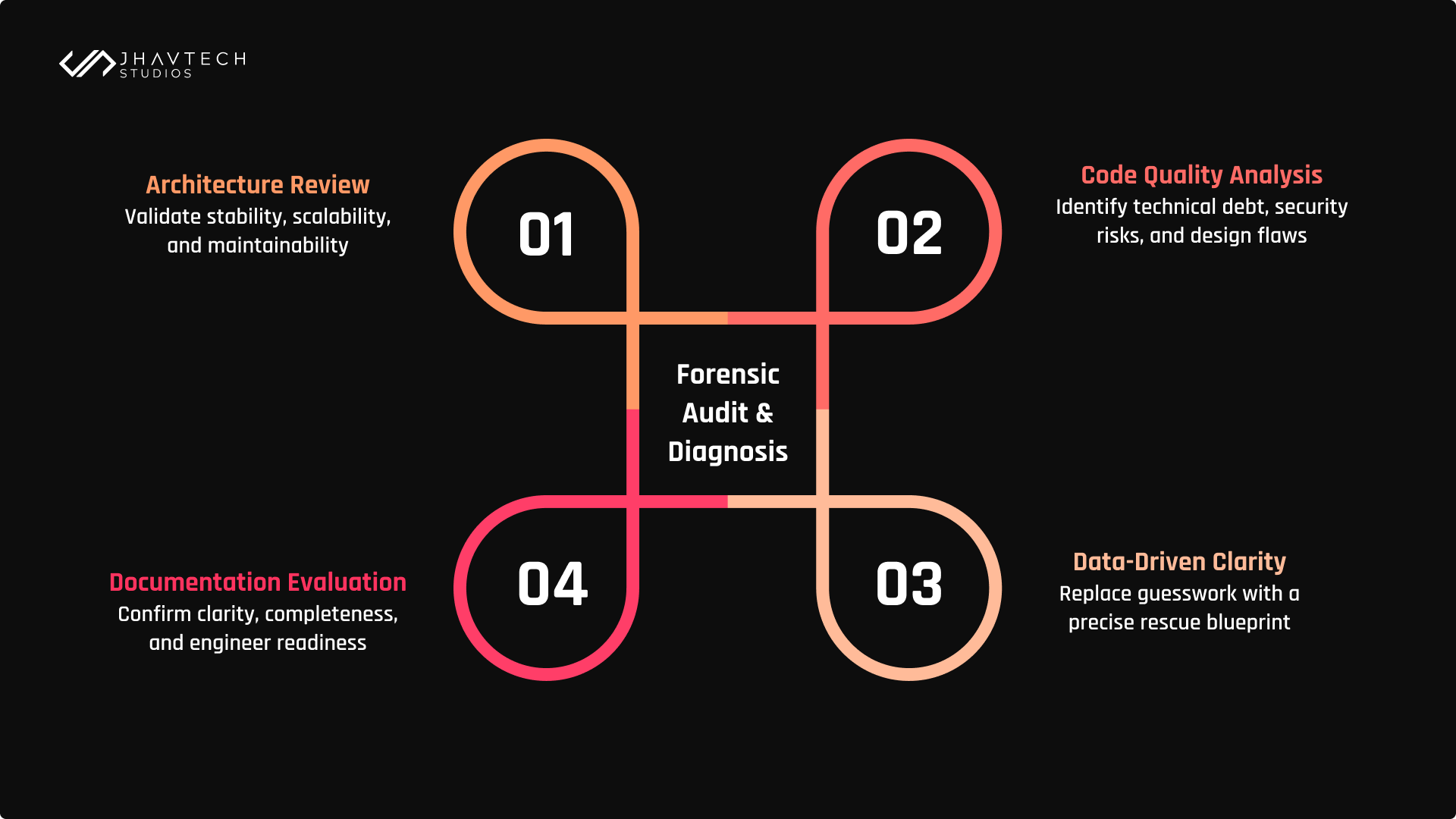
To answer these questions, the rescue team starts with a thorough technical deep dive, focusing heavily on code review. This process is far more than just checking syntax; it’s a systemic assessment of the application’s core health:
Architecture: Is the underlying design scalable and maintainable, or is it a monolithic hairball?
Quality: Is the code riddled with technical debt, security vulnerabilities, or poor design patterns?
Documentation: Is there any reliable documentation for onboarding new engineers?
This forensic review provides the clarity and data needed to transition from panic mode to planning mode. Without this technical truth, any subsequent effort is just guesswork. The results of the audit become the definitive blueprint, defining the scope and objectives for the entire software project rescue effort.
Stage 3: Partnering for Project Turnaround Solutions
When a project is failing, internal teams are often exhausted, demoralized, and too close to the complex problems they created (even unintentionally). This is the moment successful organizations leverage external expertise offering software recovery services.
Bringing in a specialized firm introduces objective leadership and a proven methodology. These external experts are accustomed to walking into highly complex and volatile environments. Companies like Jhavtech Studios, for instance, emphasize a structured, staged approach to software project rescue. Their process highlights the critical importance of transparent communication and a clear roadmap, noting that poor communication is often the number one reason projects fail in the first place.
The initial engagement involves a Comprehensive Project Evaluation, followed by creating a clear roadmap and action plan, then moving into methodical implementation. The key is that the provider of project turnaround solutions brings technical mastery but also a disciplined governance structure. They don't just fix the code; they establish the processes necessary to rebuild trust and momentum.
This specialized partnership is essential. It provides the fresh perspective and the high-velocity, objective focus necessary to successfully execute a software project rescue, ensuring the solution is robust, scalable, and aligned with the original business vision.
Stage 4: Implementing the Stabilization and Velocity Plan
Once the roadmap is approved, the project shifts from diagnosis to surgical intervention and eventual recovery. This phase is less about heroic, late-night coding sessions and more about disciplined, automated engineering practices.
Analogy: You aren't just putting a band-aid on a broken bone; you are setting the bone, applying a cast, and starting physical therapy.
A critical component of stabilizing a failing project is implementing modern DevOps solutions. The chaos of a failing project often stems from manual, error-prone deployment processes. The rescue team installs continuous integration and continuous delivery (CI/CD) pipelines to automate testing, build artifacts, and deployment. This immediately reduces human error, forces disciplined integration and transforms a fear of deployment into a routine activity. Velocity is restored not by working harder, but by making the system more predictable.
This stabilization is vital for all development, but especially when dealing with high-visibility projects like mobile app development. If an application has frequent bugs or performance issues, the team must prioritize quick, visible wins to restore user and stakeholder trust while simultaneously tackling the deeper architectural flaws.
This holistic approach of fixing the code and fixing the process s the trademark of a quality software project rescue. The outcome is a project that is not only working but is structurally sound and ready for future growth.
Stage 5: Scaling Success and Institutionalizing Learning
Best Practices for Rescuing Unstable Applications
The most successful companies understand that a software project rescue is a learning opportunity, not just a cleanup job. The goal isn't merely to ship the product; it's to ensure the project doesn't fall apart again six months later. The lessons learned during the rescue process must be institutionalized into the organization’s DNA.
Here are the key tenets that define the longevity of a successful turnaround:
Strict Quality Assurance: The rescue team enforces a culture of rigorous testing. This involves not only unit and integration tests but also mandatory user acceptance testing (UAT) to ensure the features delivered actually meet the user’s needs, which was a core failing in the first place.
Robust Documentation: The team ensures all critical components, architecture decisions, and operational procedures are thoroughly documented. This is how successful companies prevent the loss of institutional knowledge, a common symptom when initial developers depart.
Process Governance: Clear, non-negotiable processes are established to manage scope change and budget allocation. The days of "just adding one small feature" are over.
Skills Transfer and Mentorship: Crucially, the external team mentors the remaining internal staff, transferring the high-level engineering and disciplined practices required to maintain the stabilized application.
By adopting these best practices for rescuing unstable applications, the company ensures the investment in software project rescue delivers long-term organizational value. The project transitions from a crisis state back into a predictable, stable, and valuable asset.
Ultimately, the most successful companies don't eliminate failure; they manage it. They know that when a project starts falling apart, denial is the true catastrophe. By having the courage to halt work, the objectivity to diagnose the root cause through forensic code review, and the strategic foresight to engage specialized software recovery services, they turn a crisis into a strategic win. Investing in a systematic software project rescue isn't a cost. It is the soundest strategic investment in your organization's future technological success.