The Ultimate Guide to Code Reviews for Modern Software Teams
Opening a pull request can feel like handing over a tiny mystery to a teammate. If you want fewer surprises in production and a healthier, happier engineering culture, mastering code analysis is one of the highest ROI practices your team can adopt. In this friendly guide we will walk through why code review matters, how to do it well, and practical workflow tips you can start using today.
Why code review still matters
In general, code review is not just gatekeeping. It is a learning mechanism, a quality checkpoint, and a cultural glue. Industry reports and academic studies consistently show that tool-supported reviews improve maintainability and reduce defects. For example, the Codacy “State of Software Quality 2024 Report” found that over half of developers surveyed now treat code quality checks as a mandatory part of their workflow.
Beyond the statistics, there is a hard-dollar reason to invest in reviews. Studies going back decades show that defects caught late in the lifecycle cost many times more than those caught early. That makes early review a critical step for avoiding expensive rework.
What good reviews actually accomplish
Find defects earlier
A thorough review can catch logic errors, missing edge-case handling, and potential security missteps before code reaches QA. Some studies report that reviews can catch a substantial portion of defects, making them more effective when combined with automated testing. A general review of code-review benefits across multiple studies underlines how review practices contribute to quality assurance.
Reduce code smell and improve maintainability
Regular reviews promote consistency and reduce code smell by nudging teams toward clearer abstractions and smaller functions. Recent empirical work specifically examines the relationship between review practices and the presence of code smell. For instance, the 2024 journal article “Do code reviews lead to fewer code smells?” investigates whether review quality correlates with code-smell density, though interestingly the study finds “the level of code smells neither increases nor decreases in 8 out of 10 code reviews,” suggesting that reviews alone are not a silver bullet.
On the other hand, other research suggests that well-reviewed code tends to be more maintainable and less fault-prone. A large-scale empirical investigation covering many open-source projects found that classes with code smells are more likely to be change- or fault-prone than smell-free classes.
Share knowledge and flatten bus factors
When senior and junior engineers review each other, knowledge spreads. That helps prevent single-person dependencies and speeds up onboarding. This is one of the core collaborative coding practices that moves teams from hero-mode to reliable delivery.
How to run effective code reviews: practical steps
Keep pull requests small
Smaller changes are easier and faster to review. Aim for PRs that are focused on one problem or one feature. That reduces cognitive load and increases the chance the reviewer will understand the change end to end.
Use a checklist
A lightweight checklist ensures common issues are not missed. Typical items include tests added or updated, sensitive data handling, performance considerations, and UI/UX design conformance for front end changes. Add company-specific items like compliance or accessibility as needed.
Blend automation with human judgment
Automated linters, static analysis, and unit tests should run before humans review. Automation handles formatting, basic style, and some security checks, leaving reviewers to focus on architecture, correctness, and user impact. Many in the industry use this blend to support efficient reviews, especially when balancing speed and quality.
Establish service level objectives for reviews
Long review cycles are a common bottleneck. According to the Codacy 2024 survey, time constraints are among the top obstacles teams face during reviews. Set goals such as "initial review within one business day" and track average wait time. This kind of metric helps prioritize review work and prevents delivery delays.
Workflow best practices for effective code reviews
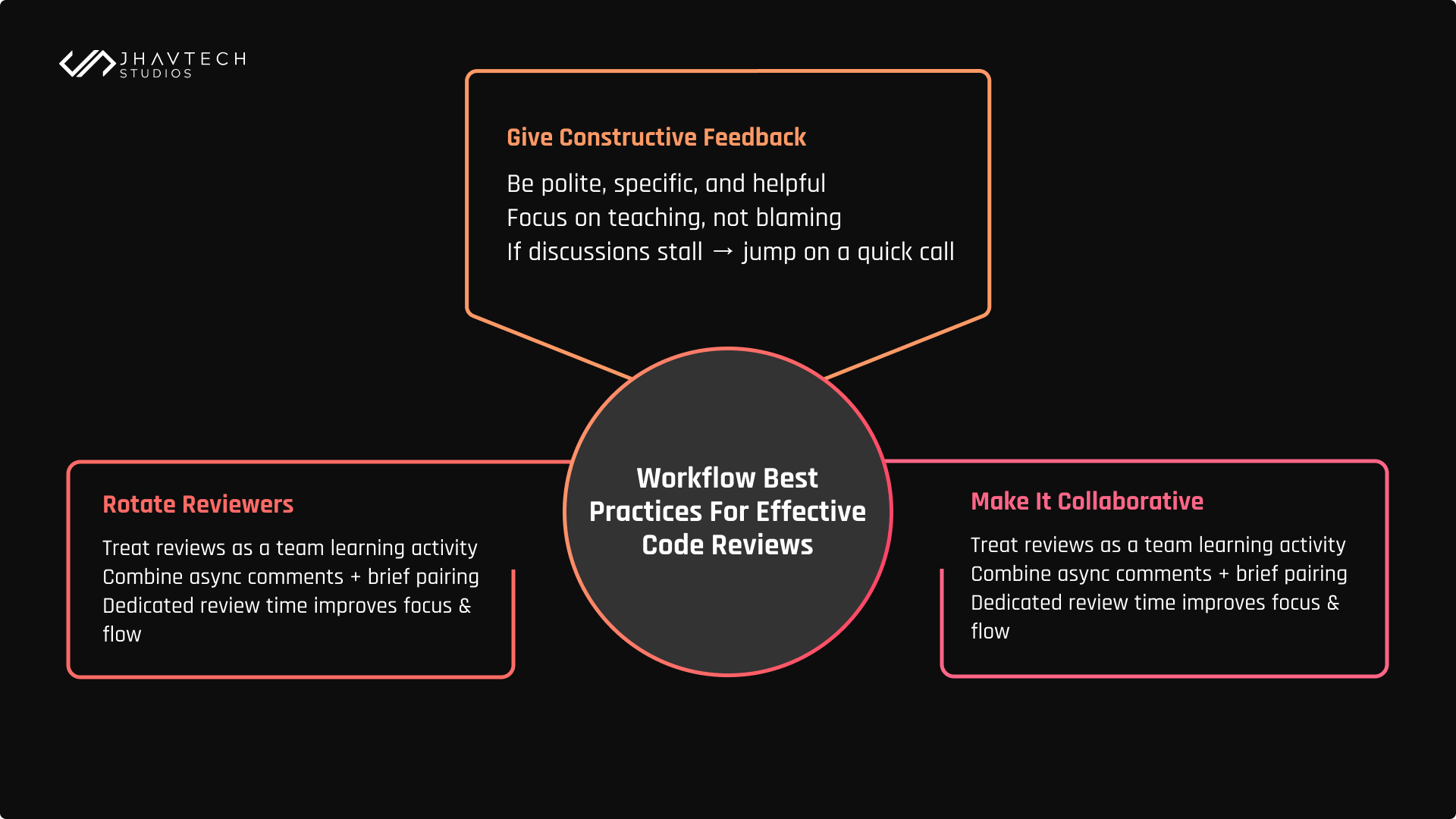
Rotate reviewers and limit reviewer load
Assign a primary reviewer but rotate responsibilities so knowledge spreads. Avoid overloading a single reviewer. Teams that spread review work see better throughput and fewer missed concerns.
Encourage constructive feedback
Feedback should be polite and specific. Use code review to teach, not to shame. When discussion digresses into bikeshedding, call for a short synchronous session to resolve it quickly.
Make reviews a collaborative effort
Treat reviews as an opportunity for pair learning. Schedule dedicated review hours or use asynchronous comments plus brief pairing sessions for complex changes. This blends the best of collaborative coding practices with individual focus time.
Metrics that matter
Track metrics that help you improve, not metrics that punish. Useful signals include average review time, number of review cycles per PR, and percentage of PRs merged without follow-up fixes. Combine these with quality metrics such as escaped defects and frequency of code-smell regressions to get a full picture. Industry data gives context for benchmark targets if you need a starting point. For example, the Codacy report provides context on how teams currently handle quality and review workloads.
Examples and studies worth knowing
If you want evidence to share with leadership, point to empirical studies that measure the effectiveness of reviews on quality and maintainability. For example:
The 2019 study “On The Effect Of Code Review On Code Smells” analyzed over 21,000 code reviews in open-source Java projects. It found that active reviews significantly influence the likelihood of reducing the severity of code smells.
The 2022 study “Code Smells Detection via Modern Code Review: A Study of the OpenStack and Qt Communities” examined 25,415 review comments and identified thousands of smell-related issues; many were followed by refactorings within a week.
These analyses show both the potential and the limits of reviews: while they sometimes catch smells and lead to improvements, a code audit alone cannot eliminate structural quality problems, but combined with other practices, they help a lot
Special considerations for different domains
Mobile and UI changes
When reviewing changes related to mobile app development, ask for screenshots, device matrix notes, and reproduction steps for UI bugs. Front end reviews must include UI/UX design checks as well as accessibility.
Legacy and rescue work
When bringing a legacy system back to life during a software project rescue, prioritize a staged review approach. First, do a lightweight code audit to identify immediate risks. Then break the rescue work into small, reviewable increments so improvements are visible and reversible.
Quick templates you can copy
Reviewer checklist sample
Does this change include tests and documentation?
Are there obvious code smell patterns or duplicated logic?
Does the change follow agreed architecture and UI/UX design standards?
Are any security or privacy issues introduced?
Is the change small and focused enough to merge easily?
Final tips: cultivate the right culture
Make reviews part of your team rituals, not an afterthought. Celebrate great review feedback and show how a thoughtful review prevented a bug or improved a user flow. Consider integrating occasional external audits or an occasional deep-dive code audit to keep technical debt in check. If your company offers IT consulting or external code health services, an outside pair of eyes can be an excellent investment.
Closing thoughts
Code review is a simple concept with layered benefits. When teams commit to regular, thoughtful reviews they not only reduce defects and technical debt but also build the collaborative habits that make software delivery predictable and enjoyable. Whether you are improving code quality in modern software teams or building smoother workflow best practices for effective code audits, start small, automate where it helps, and keep the human conversation constructive. For practical examples and consulting help you can check resources from agencies that specialize in development and UI/UX design like Jhavtech Studios.