DeFi Doesn’t Remove Trust — It Engineers It
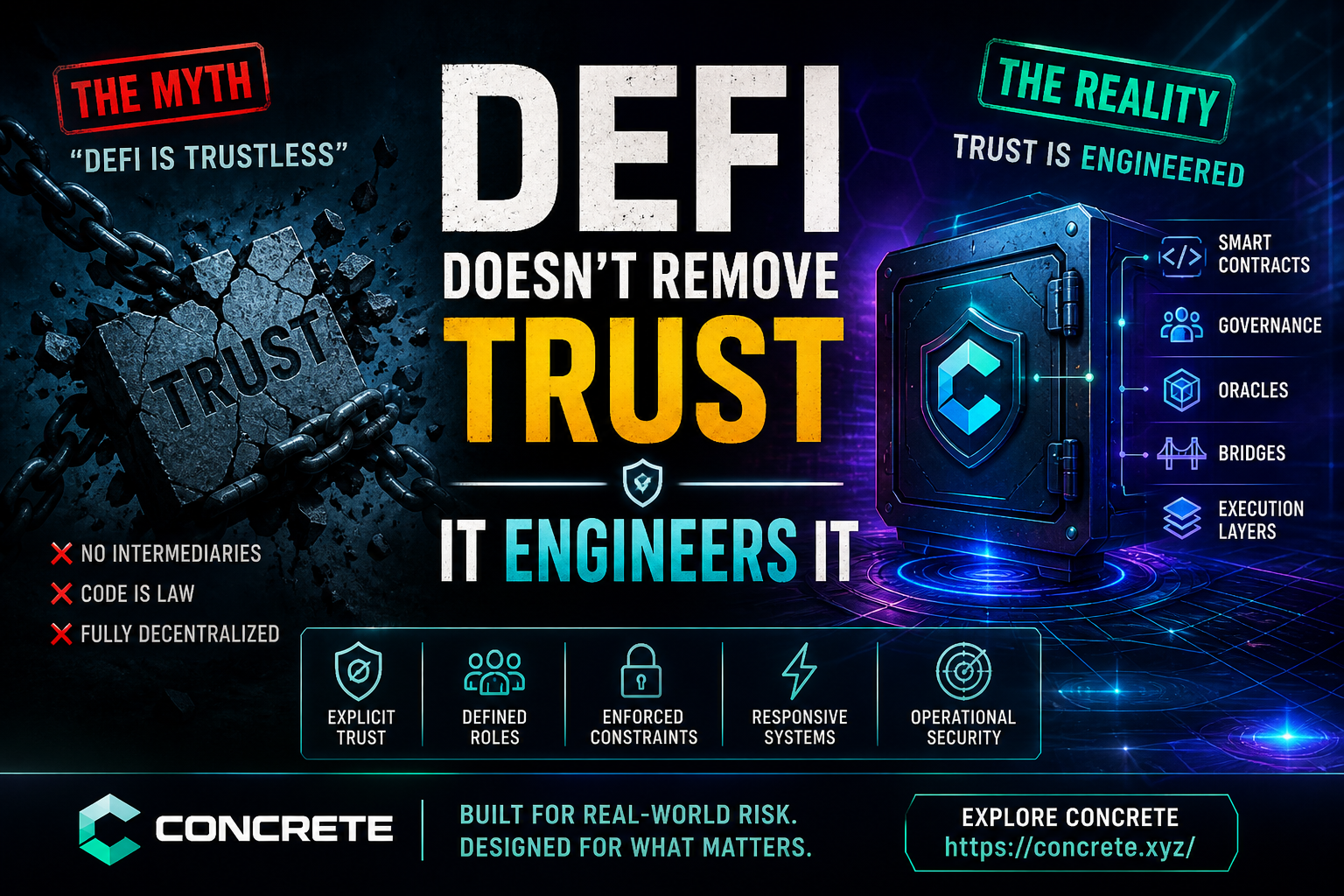
Why DeFi’s Future Depends on Engineered Trust
For years, the crypto industry promoted one powerful idea:
“DeFi is trustless.”
It sounded revolutionary.
No banks. No middlemen. No centralized control.
Just smart contracts, immutable code, and decentralized systems operating independently of human influence.
But as the DeFi ecosystem matured, reality exposed a deeper truth:
Trust never disappeared from DeFi.
It simply changed form.
Today, the biggest challenge facing decentralized finance is no longer removing trust — it is engineering it correctly.
The Illusion of Trustless Systems
The phrase “code is law” became one of the defining slogans of early DeFi.
The belief was simple:
If smart contracts execute automatically, users no longer need to trust institutions or people.
But this assumption ignores a critical fact:
Smart contracts are written by humans.
And every layer surrounding those contracts introduces new trust assumptions.
Users still trust:
- developers who deploy protocols
- auditors who review contracts
- governance systems making decisions
- oracles providing external data
- bridges moving assets between chains
- validators and execution infrastructure
The system may be decentralized in appearance, but trust still exists beneath the surface.
The difference is that most users cannot clearly see where it exists.
When Decentralization Becomes Theatre
One of the most dangerous trends in modern DeFi is what many now call:
“Decentralization Theatre”
This happens when protocols market themselves as decentralized while relying on fragile operational structures behind the scenes.
A DAO may technically exist, but governance participation could be extremely low.
A protocol may use multisigs, yet only a handful of people actually control the system.
Timelocks may delay malicious actions, but they often fail to prevent catastrophic exploits.
In some cases, systems become so rigid that they cannot respond quickly during emergencies.
This creates a dangerous contradiction:
Protocols optimize for the appearance of decentralization instead of real resilience.
And when stress arrives, the weaknesses become visible immediately.
The Rise of Engineered Trust
The next evolution of DeFi is not about pretending trust can be eliminated.
It is about designing trust intentionally.
This concept can be described as:
Engineered Trust
Engineered trust means systems are built with:
- explicit responsibilities
- controlled permissions
- enforceable constraints
- operational safeguards
- rapid response capabilities
Instead of hiding trust assumptions, mature infrastructure exposes them clearly.
This approach does not weaken decentralization.
It strengthens reliability.
Traditional financial systems already operate this way. Responsibilities are defined. Risk controls are layered. Emergency mechanisms exist.
DeFi is now moving toward the same level of operational maturity.
Why Operational Security Matters More Than Ideology
Markets are unpredictable.
Smart contracts cannot anticipate every possible edge case, exploit, or economic attack.
That is why operational security has become one of the most important pillars of institutional DeFi.
Real systems require:
- active monitoring
- anomaly detection
- layered defenses
- incident response mechanisms
- human judgment during critical failures
Pure automation without adaptive security can become extremely dangerous under pressure.
The future winners in DeFi will not be the protocols claiming to remove humans entirely.
They will be the systems capable of surviving real-world stress.
How Concrete Approaches Trust Differently
This is where projects like Concrete are introducing a more mature infrastructure model.
Concrete recognizes a reality many protocols still avoid:
Trust is unavoidable.
The goal is to structure and enforce it intelligently.
Instead of relying on decentralization theatre, Concrete focuses on operational security and controlled execution environments.
Its architecture emphasizes:
- explicit trust assumptions
- role-based systems
- onchain enforcement
- off-chain intelligence
- response-oriented infrastructure
- controlled operational design
This creates systems that are not only decentralized, but also resilient.
Rather than asking users to blindly believe in “trustless” narratives, Concrete aims to make trust visible, measurable, and enforceable.
That shift may define the future of institutional-grade DeFi infrastructure.
The Future of DeFi
The industry is entering a new phase.
Early DeFi focused on ideology.
The next generation will focus on resilience.
Infrastructure will no longer be judged by how aggressively it claims decentralization.
It will be judged by:
- how securely it operates
- how transparently it manages trust
- how effectively it handles failure
- how well it performs under stress
Because ultimately:
DeFi doesn’t remove trust.
It engineers it.
And the protocols that engineer trust best will shape the future of finance.