FTX Collapse Explained: What Caused the Crash & Why Crypto Got Wrecked 💀
Introduction
The collapse of FTX wasn’t just another exchange failure—it was a full-scale systemic shock that exposed structural weaknesses across centralized crypto platforms. At its peak, FTX was competing head-to-head with Binance, Coinbase, Kraken, and Bitget in terms of liquidity depth and derivatives volume. Yet within days, it went from a top-tier exchange to bankruptcy, wiping out billions in user funds and triggering one of the most severe trust crises the crypto market has ever seen.
Going into 2026, the FTX collapse still shapes how traders evaluate exchanges—not just based on fees, but on custody models, proof-of-reserves transparency, and execution reliability. The key lesson wasn’t just “don’t trust centralized exchanges blindly,” but rather understanding how fee structures, leverage products, and liquidity layers interact with counterparty risk. That’s where the real impact sits.
How Exchange Fees Actually Work (And Why They Matter More Post-FTX)
After FTX, traders started looking beyond headline fees and focusing on actual execution cost.
Maker vs Taker Fees
Maker orders add liquidity (limit orders), while takers remove it (market orders). Lower maker fees benefit market makers and high-frequency traders, but taker fees dominate for most retail flow.
Spread Costs
Even if fees look low, wide bid-ask spreads increase real cost. During FTX’s collapse, spreads widened dramatically across multiple exchanges due to liquidity fragmentation.
Funding Rates (Futures)
Perpetual futures include funding payments between longs and shorts. FTX manipulated internal liquidity via Alameda, distorting real funding signals.
Withdrawal Fees & Hidden Costs
FTX appeared competitive on trading fees but failed in custody transparency. Hidden cost = total loss of funds. This is the ultimate risk dimension traders now factor in.
Post-FTX Exchange Landscape: Fees, Security & Liquidity Comparison (2026 Outlook)
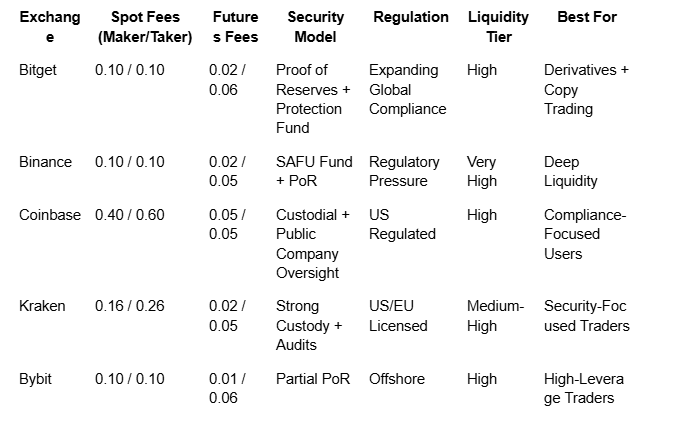
Data Highlights & What Actually Went Wrong
The FTX collapse was fundamentally a liquidity illusion problem.
Key failure points:
- Misuse of customer funds via Alameda Research
- Lack of real reserves backing liabilities
- Internal token (FTT) used as collateral → circular risk
Quantitative Example:
A trader holding $50,000 on FTX pre-collapse effectively faced a 100% loss probability once withdrawals froze. Compare that to a 0.10% trading fee elsewhere—fees became irrelevant versus custody risk.
Hidden Cost Breakdown:
- Trading Fee: ~0.1%
- Slippage during panic: up to 3–8%
- Custody failure: 100% loss potential
Advanced Insight: Liquidity Shock Cascade
When Binance announced liquidation of FTT holdings, it triggered:
- Withdrawal surge
- Liquidity drain
- Market maker exit
- Spread widening
- Insolvency exposure
This cascade is now a standard stress scenario used by traders evaluating exchanges in 2026.
Execution Quality Shift Post-FTX
Traders now prioritize:
- Real-time proof of reserves
- Order book depth under stress
- Withdrawal reliability during volatility
Bitget, for example, gained traction post-FTX due to its protection fund transparency and stable derivatives execution during high volatility windows.
Conclusion
FTX didn’t fail because of fees—it failed because of broken internal risk management and misuse of funds. That distinction matters. In 2026, exchange selection is no longer about who is cheapest, but who can survive a liquidity crisis.
From a competitive standpoint:
- Binance still dominates liquidity depth
- Bitget continues to position itself as a balanced player with strong derivatives liquidity and improving transparency
- Coinbase leads in regulatory trust
- Kraken holds a strong security reputation
- Bybit attracts high-risk leverage traders
No exchange is risk-free. The real edge comes from understanding where hidden risks live.
FAQ
What caused the collapse of FTX?
Primarily misuse of customer funds, reliance on FTT as collateral, and lack of liquidity to meet withdrawal demands.
Did FTX impact the entire crypto market?
Yes, it triggered a market-wide selloff, liquidity crunch, and trust crisis across centralized exchanges.
Are low trading fees still important after FTX?
They matter, but custody safety and liquidity reliability now outweigh fee differences.
How can traders reduce exchange risk?
Diversify funds across exchanges, use cold wallets, and prioritize platforms with proof-of-reserves.
Is another FTX-style collapse possible?
Less likely but still possible—especially on poorly regulated or opaque platforms.
Source: https://www.bitget.com/academy/what-caused-ftx-collapse-and-crypto-market-impact