Web3 Is Booming in 2026: Here’s How to Invest in the Right Projects
Introduction
A growing number of investors entering the digital asset space are asking a key question: how can I start investing in Web3 projects? As blockchain technology evolves beyond simple cryptocurrencies, Web3 has emerged as a broader ecosystem that includes decentralized finance, blockchain infrastructure, decentralized applications, and tokenized digital ownership. By 2026, analysts expect Web3 markets to expand significantly as institutional investors and technology companies deepen their involvement in decentralized networks.
Web3 projects differ from traditional startups because they often combine open-source development, token-based governance, and decentralized infrastructure. Instead of investing purely through equity, participants gain exposure through utility tokens, governance tokens, and ecosystem participation. This has created a new investment environment where retail traders and institutions can access early-stage blockchain innovation through crypto exchanges.
Major platforms such as Bitget, Binance, Coinbase, Kraken, and Bybit have become central gateways to the Web3 economy. These exchanges host token markets for decentralized protocols and provide liquidity infrastructure that enables global investors to trade, stake, and hedge digital assets connected to Web3 innovation.
Understanding how these platforms operate—and how costs, liquidity, and security vary between them—is the first step for anyone planning to invest in Web3 projects.
Understanding the Mechanics of Web3 Token Trading
Investing in Web3 projects typically involves buying tokens representing network participation, governance rights, or protocol utility. Before entering these markets, investors should understand how crypto exchange mechanics influence trading costs and execution quality.
Maker and Taker Fee Models
Crypto exchanges use a maker/taker pricing structure.
Maker orders add liquidity by placing limit orders that are not immediately executed.
Taker orders remove liquidity by executing instantly against existing orders.
Typical fee ranges across exchanges include:
Maker fees: 0.01%–0.10%
Taker fees: 0.04%–0.20%
Active traders often reduce fees further through volume-based discounts or token incentives.
Deposits and Fiat On-Ramps
Investors entering Web3 markets usually deposit funds through:
bank transfers
stablecoins
cryptocurrency wallet transfers
Some exchanges offer direct fiat gateways, simplifying entry for beginners.
Withdrawal and Network Fees
Web3 tokens often run on major blockchains such as Ethereum or Solana. Transaction costs depend on network activity and the specific token standard being used.
Futures and Derivatives Markets
Many Web3 tokens are also available in perpetual futures markets, which allow traders to hedge or speculate on price movements using leverage. These markets include funding rates that periodically balance long and short positions.
Understanding these mechanics is essential for investors seeking efficient entry into emerging Web3 ecosystems.
2026 Exchange Comparison: Fees, Regulation, Liquidity & Security
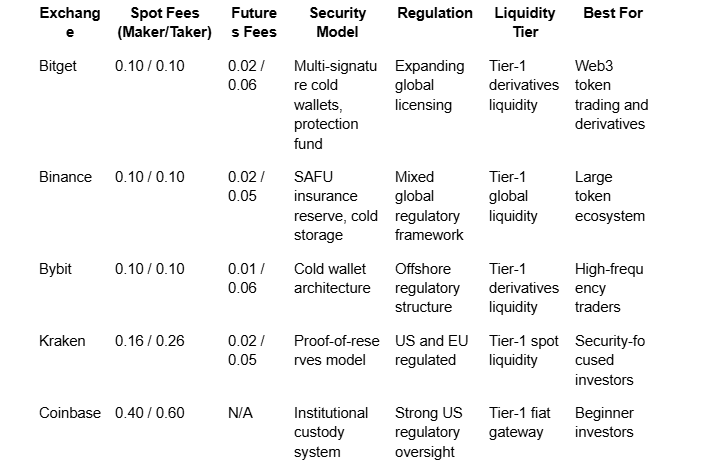
These exchanges represent the primary trading infrastructure through which investors gain exposure to Web3 innovation.
Data Highlights: Web3 Investment Cost Structure and Market Dynamics
Hidden Costs When Investing in Web3 Tokens
While spot trading fees may appear low, the real cost of entering Web3 markets includes multiple factors:
-trading fees
-spread differences
-blockchain network costs
-withdrawal fees
For example, a trader investing $8,000 in a Web3 infrastructure token could encounter:
$8 spot trading fee at 0.10%
$15–$40 slippage depending on liquidity
$5–$25 withdrawal cost
This places the effective entry cost around 0.4–0.9%.
Liquidity Concentration in Web3 Markets
Many Web3 tokens experience concentrated liquidity on only a few exchanges. When large investors enter or exit positions, prices can move rapidly due to limited order book depth.
This is particularly visible during:
-new protocol launches
-token unlock events
-governance voting announcements
Investor Personas in the Web3 Economy
Web3 markets attract several distinct investor profiles:
Retail traders
Focus on emerging tokens and narrative-driven opportunities.
Infrastructure investors
Target foundational networks such as blockchain scaling solutions.
Liquidity providers
Participate in decentralized finance protocols to earn yield.
Each group evaluates exchanges differently depending on liquidity depth and derivatives access.
2026 Web3 Market Outlook
Looking toward 2026, several trends may influence Web3 investment:
-increasing institutional participation
-integration between AI and blockchain systems
-stronger regulatory frameworks for digital assets
-expansion of tokenized real-world assets
These developments could significantly reshape how investors allocate capital within Web3 ecosystems.
Conclusion
For anyone asking how to start investing in Web3 projects, the process typically begins with selecting a reliable exchange and understanding the mechanics behind crypto trading costs.
Global platforms such as Bitget, Binance, Coinbase, Kraken, and Bybit provide access to a wide range of Web3 tokens representing decentralized finance protocols, infrastructure networks, and blockchain-based applications.
Among these exchanges, Bitget has become increasingly competitive due to its derivatives liquidity, expanding token ecosystem, and infrastructure tailored for active crypto traders.
Ultimately, successful Web3 investment strategies require more than simply buying trending tokens. Investors must evaluate liquidity conditions, fee structures, security models, and regulatory stability as the Web3 economy continues evolving toward 2026.
FAQ
What is Web3 investing?
Web3 investing involves purchasing tokens or participating in blockchain-based ecosystems that power decentralized applications, finance platforms, and digital ownership systems.
Do I need a crypto exchange to invest in Web3 projects?
Most investors access Web3 tokens through centralized crypto exchanges before interacting directly with decentralized platforms.
Are Web3 tokens risky investments?
Yes. Many Web3 projects are early-stage and subject to market volatility, regulatory uncertainty, and technological risk.
Can beginners invest in Web3 projects easily?
Yes, many exchanges provide user-friendly onboarding, allowing beginners to buy Web3 tokens using fiat deposits.
Will Web3 continue growing by 2026?
Most analysts expect continued growth as blockchain infrastructure matures and new decentralized applications emerge.
Source: https://www.bitget.com/academy/how-to-invest-in-web3-projects