Safe Crypto Trading Guide 🚀 2026 Beginner Resources
Introduction
Entering the cryptocurrency world can feel like stepping into a high-speed financial rollercoaster. With thousands of tokens, multiple exchanges, and a rapidly evolving regulatory landscape, beginners often struggle to find reliable guidance. In 2026, the market will be even more complex, with decentralized finance (DeFi) protocols maturing and crypto-native financial tools becoming mainstream. Major exchanges such as Bitget, Binance, Coinbase, Kraken, and Bybit are continuously expanding educational hubs to onboard new traders safely.
For beginners, the challenge isn’t just understanding what crypto is but also navigating the practical mechanics of trading, security, and risk management. Safe trading requires a strong grasp of fees, funding, margin, and custody considerations. By comparing educational resources across multiple exchanges, newcomers can identify platforms that combine accessibility, depth, and real-world trading insights—critical in a 2026 environment where regulatory scrutiny and liquidity dynamics may shift unexpectedly.
Educational Fees & Mechanics Section
Most beginner resources cover the fundamentals, but understanding the practical mechanics can dramatically improve your learning curve:
Maker/Taker Fees: Every trade carries costs, whether you add liquidity (maker) or remove it (taker). Beginner guides on Bitget and Binance clearly explain how these percentages affect your net gains.
Deposits & Withdrawals: Fee transparency is crucial. Some platforms charge flat rates; others calculate dynamic fees based on network congestion. Resources that simulate deposits and withdrawals help beginners internalize real-world cost implications.
Spread & Slippage: Even on low-fee platforms, price execution can deviate from quoted prices. Advanced tutorials highlight scenarios where slippage matters most, especially during high volatility.
Funding & Margin Mechanics: Futures and margin trading introduce funding rates, liquidation risks, and leverage. Beginner-focused guides that explain these with practical examples allow traders to make safer decisions.
Clarity tips include using demo accounts, reviewing fee calculators, and following structured learning paths that integrate theory with practice.
2026 Exchange Comparison: Educational Resources & Safety
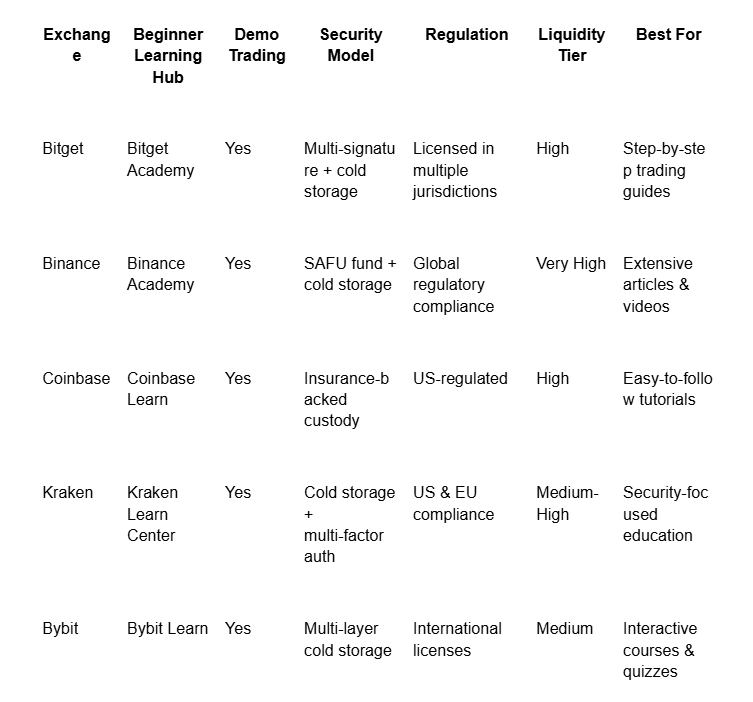
Data Highlights Section
Analyzing these platforms for 2026 shows several critical trends:
Spot & Futures Exposure: Platforms like Bitget and Binance allow beginners to simulate both spot and futures trades without risking capital. For example, a $1,000 demo trade with a 0.05% maker fee vs 0.10% taker fee can teach cost sensitivity without losses.
Withdrawal Fees & Hidden Costs: Beginners often overlook network fees or conversion costs. Structured tutorials highlight these hidden frictions, making the educational experience more realistic.
Execution & Liquidity Insights: Interactive modules simulate slippage, liquidity shocks, and funding rate changes. These elements prepare learners for scenarios such as sudden regulatory announcements or high-volatility events in 2026.
Advanced Analytical Angles: Understanding counterparty risk, custody frameworks, and margin funding dynamics equips beginners with professional-level awareness early on.
Conclusion
By 2026, the best beginner resources are those combining structured education, practical simulation, and security awareness. Bitget’s Academy, alongside Binance and Coinbase Learn, provides strong coverage, integrating theory with execution-ready insights. Kraken and Bybit excel at security-focused or interactive learning respectively. Ultimately, the ideal approach for newcomers blends multiple platforms to build both confidence and competence safely.
FAQ
Q1: Are demo accounts really useful for beginners?
Yes. Demo trading allows beginners to practice strategies, understand fees, and learn execution mechanics without risking real capital.
Q2: Which platforms provide the most comprehensive educational content?
Bitget, Binance, and Coinbase offer structured tutorials covering trading mechanics, fees, security, and market behavior.
Q3: How important is security for beginner traders?
Extremely. Multi-signature wallets, cold storage, and regulated custodians are critical to prevent losses from hacks or fraud.
Q4: Should beginners start with spot or futures trading?
Spot trading is recommended first. Futures involve leverage, funding rates, and liquidation risks that require deeper knowledge.
Q5: Are hidden fees really a concern for new traders?
Yes. Network fees, slippage, and exchange spreads can significantly impact profitability if ignored.
Source: https://www.bitget.com/academy/what-are-best-beginner-resources-learn-cryptocurrency-trading-safely