A USD Card Without a Bank Account: How the Model Actually Works
The problem this addresses
A substantial population can't access traditional banking — for documentation reasons, geographic reasons, prior account closures, or institutional risk screening. For these users, modern commerce becomes hard because most online payment requires card access that depends on a bank account. The traditional answer has been to argue for expanding banking access, but that moves slowly. A crypto-funded card provides a different path: payment access without the banking dependency in the middle.
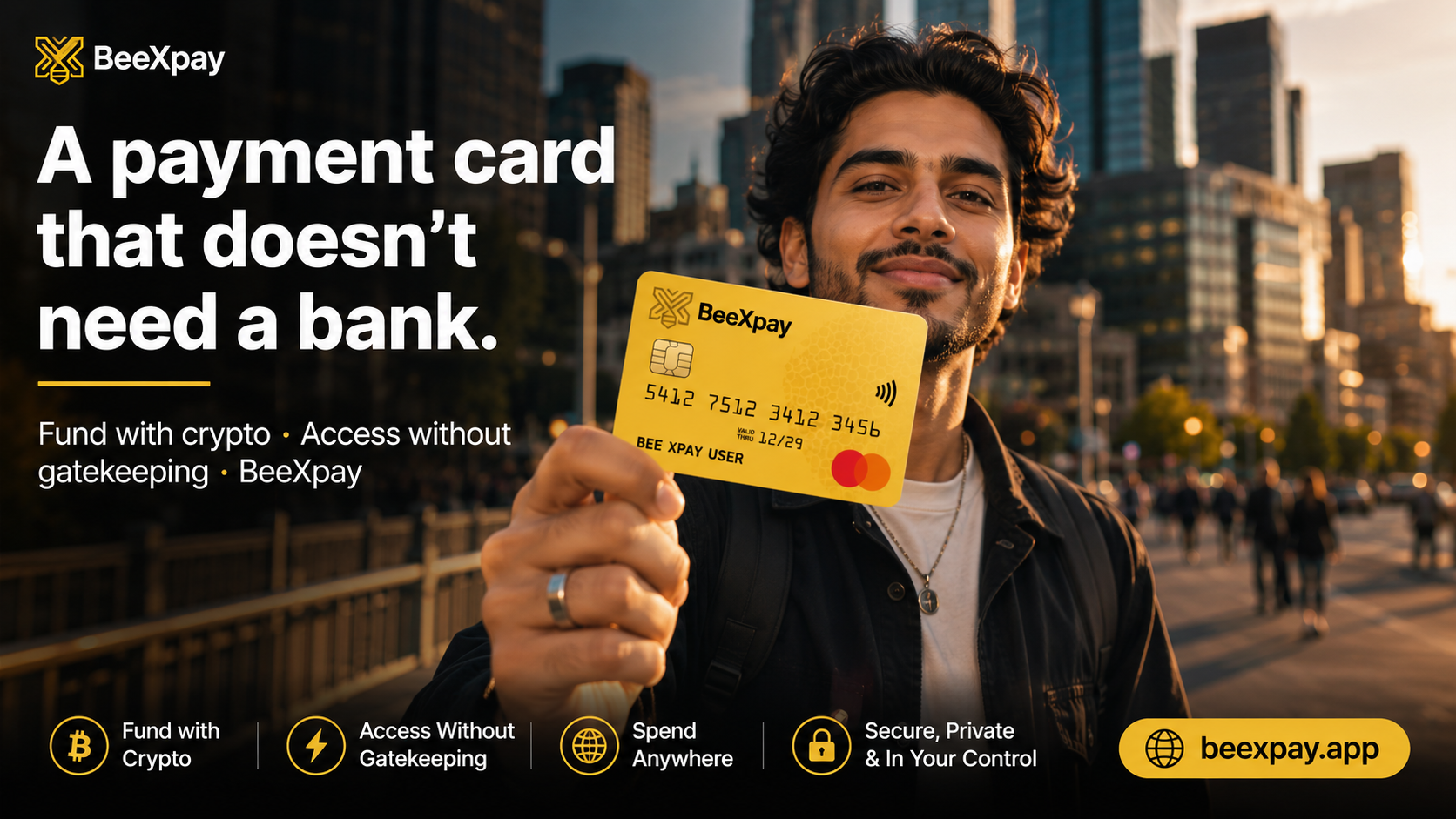
How the model bypasses the bank requirement
A crypto-funded card replaces the bank-account funding link with a crypto-wallet funding link. The wallet itself doesn't require bank approval to set up. The platform issuing the card requires KYC but not banking history. The card converts crypto to USD at the moment of payment, behaving like any other USD card from the merchant's perspective. The dependency chain runs from identification (KYC) to crypto wallet to platform to card to payment — no bank in the middle. For users who can hold crypto and pass KYC, payment access becomes possible without ever opening a bank account.
What's still required
The model removes the bank dependency but keeps other requirements. KYC is mandatory — BeeXpay applies Light KYC for virtual cards and Full KYC for physical cards. This is regulatory and not negotiable. Some way to acquire and hold crypto is needed, which requires basic crypto literacy. Geographic availability matters — BeeXpay isn't available in the US, UK, Russia, and several other jurisdictions. The model isn't universal access; it's access for users who fit the specific requirements.
How the Light KYC tier fits this use case
The Light KYC tier is particularly relevant for the bankless use case because it lowers the documentation barrier compared to traditional banking KYC. Users can complete Light KYC through the Telegram Mini App in minutes rather than requiring the multi-day document review that banks typically require. The virtual card at $10 represents a low-commitment entry point for users who haven't had card access before. Reload fees at the Light KYC tier are 4% versus 2.5% at Full KYC, and limits are lower, but the access barrier is meaningfully lower as well. Users who find the model fits can upgrade to Full KYC for the physical card and the better economics.
Cost comparison against bankless alternatives
For users without bank access, the comparison isn't to a free banking option — it's to the alternatives actually available. Money transfer services charge 4–8% effective on small transactions. Non-bank prepaid cards have monthly fees, complex reload requirements, and acceptance issues. Cash works only in-person and increasingly less effectively. Against these alternatives, BeeXpay's structure — 4% reload (Light KYC) or 2.5% (Full KYC), $0.25–$0.50 flat per USD transaction, 1.5–2% bank FX on non-USD — represents a specific cost profile that competes against the alternatives, not against traditional banking.
What this enables in practice
For users who fit the model, the bankless card opens up most of modern e-commerce. International SaaS subscriptions, online retailers, digital service providers, streaming, learning platforms, software vendors, marketplaces. In-person payment requires the physical card ($100 with Full KYC, around two weeks delivery), but for online use the virtual card covers the use case at $10. The honest framing: this isn't a substitute for banking in all functions, but it's a genuine alternative for payment access specifically.
Closing CTA
For users navigating modern commerce without a bank account, a crypto-funded card represents a working option within its regulatory boundaries.
Explore payment access → https://beexpay.app