B2B Supplier Payments for Crypto-Native Businesses
The structural mismatch
Crypto-native businesses — exchanges, DeFi protocols, NFT platforms, Web3 service providers — hold treasury and operating capital in crypto. Their suppliers — hosting providers, SaaS vendors, professional services, contractors — usually want fiat. This creates a recurring operational task: converting crypto to fiat for supplier payments. The traditional approach consumes time that doesn't add value.
The conventional offramp workflow's cost
Monthly offramp for B2B supplier payments typically involves: deposit company crypto to a centralized exchange, sell to USD, withdraw to corporate bank account, initiate wires to suppliers, wait for settlement, reconcile bank statements with payment records. Each step has fees and operational overhead. For a company paying 20 suppliers monthly, this is recurring work absorbed by finance staff who could be doing other things.
The card-based workflow alternative
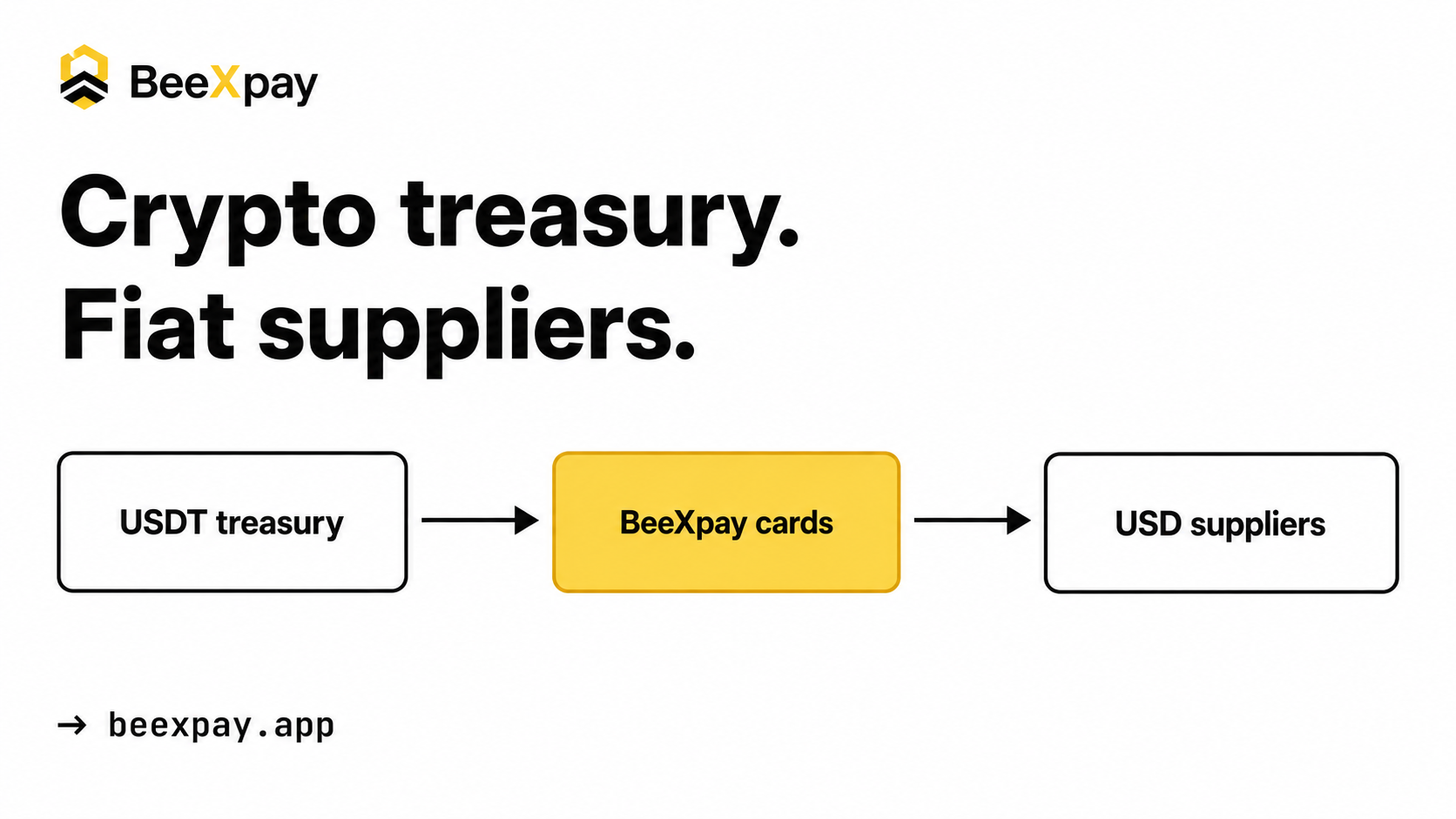
Fund corporate BeeXpay cards from company USDT. Pay each supplier through a dedicated card or compartment. The card converts to USD at the moment of payment. From the supplier's side, it's a normal USD card payment. From the business's side, the offramp distributes across actual supplier payments rather than concentrating in a monthly batch.
Per-supplier cards keep books clean
A dedicated card per supplier means each card's transaction history is that supplier's payment log. No reconciliation of mixed bank wire statements against multiple invoices. Per-project cards work for project-based cost accounting. Per-department cards work for department-level budgeting. The $10 virtual card issuance makes this granularity economical.
Bookkeeping advantages
Card-based supplier payments produce records pre-organized by supplier. Transaction history exports straight to accounting software. Conversion rates at each transaction are documented for tax purposes. The manual reconciliation work of matching bank wires to supplier invoices is replaced by transaction history already attributed correctly through the card structure.
Where the model fits
The card model fits distributed recurring B2B payments — SaaS subscriptions, contractor payments, infrastructure costs, professional services, smaller vendor invoices. For companies with portfolios of recurring small payments, the distributed conversion fits naturally.
Where wire transfers stay better
Large lump-sum payments to single vendors. Vendors who specifically need wire confirmation for their own accounting. Long-term contractual relationships with specified payment procedures. The card model isn't universally superior.
Cost analysis
For $20K/month supplier volume across 30 suppliers: card-based at 2.5% reload + minimal flat fees = $500-$525/month. Manual offramp at the same volume: roughly comparable in direct cost. The difference is operational time saved.
Setup considerations
Corporate setup requires business-level KYC through Full KYC tier, defining authorized users, and crypto treasury operations to keep USDT available. More involved than personal use but one-time. Worth confirming with the company's auditor before scaling.
→ Explore: https://beexpay.app