Blockchain Confirmations: The Variable That Determines How Fast a Crypto Card Funds
The mechanic most users don't think about until they're waiting
For users new to crypto cards or unfamiliar with the specific network they're using to fund, the moment after sending a deposit is often the most confusing in the workflow. The transaction has left the wallet. The card balance hasn't updated. Nothing is broken, nothing is delayed unreasonably — but the gap between "transaction sent" and "funds available" can stretch from one minute to thirty depending on network conditions and the platform's confirmation policy. Understanding what's happening in that gap is the difference between knowing how to time card funding and being confused every time it doesn't update instantly.
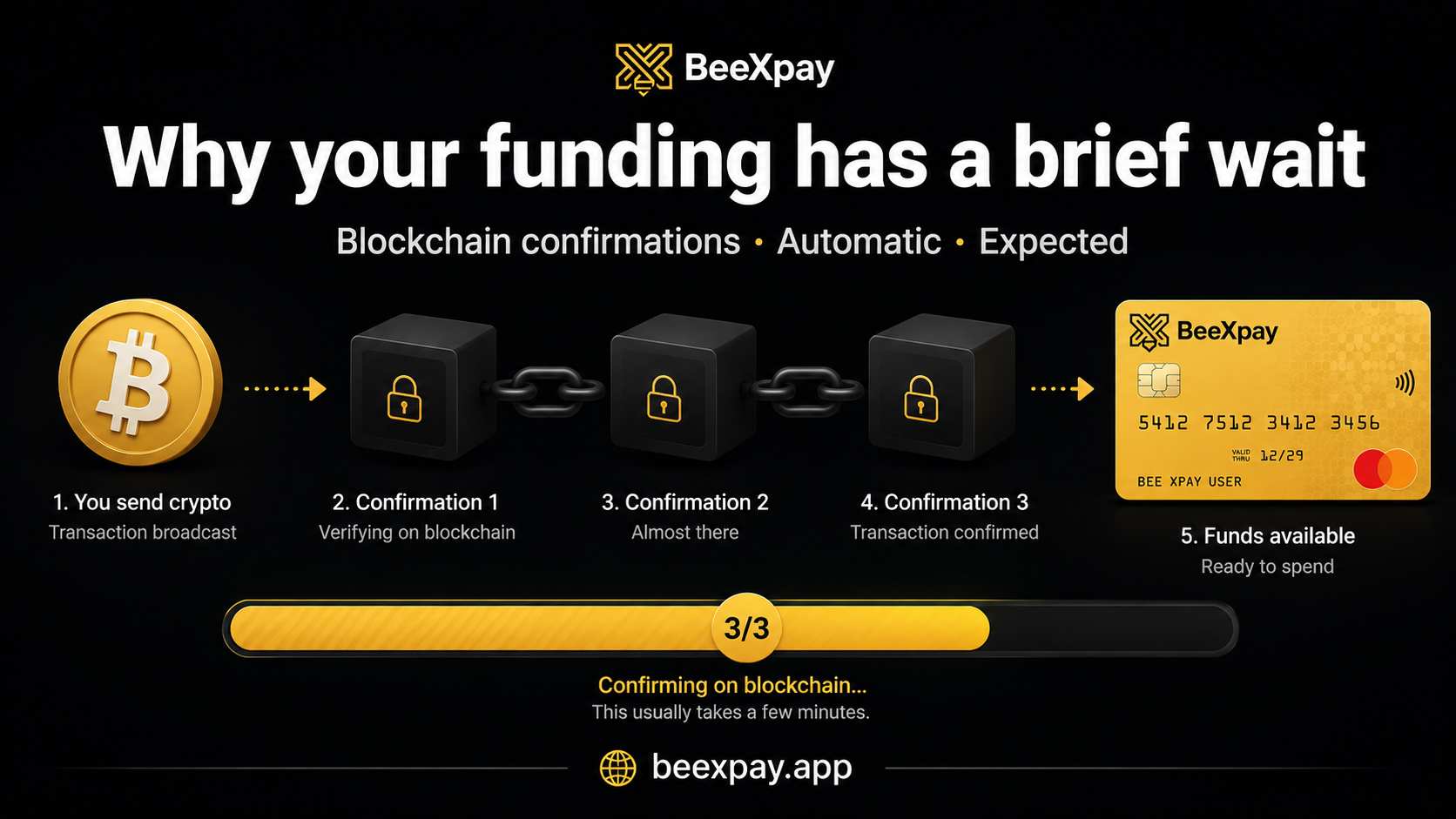
What confirmations actually are and why platforms wait for them
A blockchain confirmation is, conceptually, a vote of confidence by the network that a transaction is permanent. When you send crypto, the transaction is broadcast, enters the network's mempool, and waits to be picked up by a miner or validator. When it's included in a block, it has its first confirmation. Each subsequent block built on top of that block adds another confirmation. The reason platforms wait for multiple confirmations is reorganization risk — early in a transaction's life, there's a small statistical probability that the network could reorganize and remove the transaction from the chain. As more blocks pile on top, that probability drops exponentially. Most platforms set a confirmation threshold based on the network's typical behavior and the amount being credited, balancing speed against security.
Tron USDT: usually fastest, sometimes for reasons that matter
Tron's block time is 3 seconds, and confirmation requirements for USDT are typically low. Most platforms credit USDT on Tron after 1–2 minutes, sometimes faster. The network is high-throughput, transactions usually get included in the next block, and reorgs are rare. For users prioritizing speed in card funding — particularly in the urgency case where the card is needed within the hour — USDT on Tron is the default best choice. Fees are also low, typically under $1 per transaction, which makes it suitable for small funding amounts. The trade-off is that Tron is more centralized than some alternatives, with a smaller validator set and different governance characteristics. For short-duration card funding, this is not usually a significant concern, but for users with strong decentralization preferences, it's worth knowing.
Ethereum USDT: variable, gas-dependent, sometimes painful
Ethereum's block time is 12 seconds, and most platforms credit USDT after a few blocks — typically 1–2 minutes under calm conditions. However, Ethereum's mempool behavior under load changes the effective timing significantly. During high-activity periods — major DeFi events, NFT mints, market volatility — gas prices spike. Lower-fee transactions can sit in the mempool for many minutes or even hours before being picked up. A user sending USDT with a default-priority fee during congestion might wait 15–30 minutes for first confirmation. The fee itself is also variable — typically $3–$15 per transaction but spiking to $30+ in extreme conditions. For users funding card transactions on Ethereum, the variability is the main consideration. In calm conditions it's fine; in congested conditions it's slower than Tron and more expensive.
Bitcoin: the longest wait by design
Bitcoin's block time is around 10 minutes. Most platforms wait for 3–6 confirmations before crediting funds, putting total time at 30–60 minutes. This isn't inefficiency — Bitcoin's longer block time is part of its security model. Each block represents more computational work, and each confirmation represents stronger finality. The trade-off is that Bitcoin is structurally slower than newer networks for any time-sensitive use case. For users in no hurry, this doesn't matter. For users funding a card with a deadline, Bitcoin adds the most waiting time of the common options. Fees on Bitcoin vary with mempool size, typically $1–$10 per transaction in normal conditions.
How fee economics interact with funding amount
Confirmation time isn't the only factor — network fees scale differently depending on the funding amount. A $10 Ethereum fee on a $50 funding is 20% of the deposit, which is steep. The same fee on a $500 funding is 2%, which is more bearable. Tron fees of under $1 don't change this math much across amounts. Bitcoin fees in the $1–$10 range similarly scale with amount. For small funding amounts (under $100), Tron is almost always the right choice because the fee overhead is minimized. For larger amounts, the network choice depends more on user preference and existing crypto holdings than on fee minimization.
What platforms can and cannot do about confirmation time
A common question is whether platforms can speed up confirmations by holding more risk. The answer is yes, but at a cost: platforms that credit faster than the network's typical confirmation time take on reorganization risk that can result in losses if reorgs do occur. Most reputable platforms apply consistent confirmation policies based on the network's behavior, and the wait times are what they are. Users can speed up their side by choosing faster networks or by paying higher fees on networks where higher fees prioritize inclusion (Ethereum, Bitcoin). The platform-side wait is mostly fixed by network characteristics.
Practical guidance for funding decisions
The summary: if you need the card funded within minutes, send USDT on Tron. If you already hold USDT on Ethereum and the timing isn't tight, that works too but expect variability. If you hold BTC, plan for 30–60 minutes. If you're funding a small amount and care about fee economics, Tron is almost always the right choice. If you're funding a larger amount and have flexibility, any supported network works. The variables are predictable once you know what's affecting them, which is the goal of understanding the mechanic in the first place.
Closing CTA
Blockchain confirmation time is a structural feature of public chains, not a platform delay. Different networks have different characteristics, and knowing which to choose for which timing requirement is part of using crypto cards effectively.
Explore payment access → https://beexpay.app