Fee comparisons in fintech are almost always done wrong — they compare percentages without doing the actual math at real purchase sizes
Most fintech fee comparisons focus on percentages because percentages sound intuitive. A platform advertising “only 1.5% per transaction” may initially appear inexpensive, especially when users are not calculating how that percentage scales across larger purchases. In practice, however, transaction costs become meaningful only when converted into actual dollar amounts.
This is where many crypto card users misunderstand pricing structures. Comparing a flat fee to a percentage fee without considering transaction size creates distorted assumptions about cost efficiency. A fixed transaction fee behaves very differently from a percentage-based structure because the relative impact changes as payment volume increases.
Understanding this math is important because payment behavior varies significantly between users. Someone making repeated $20 purchases experiences fees differently from someone spending $500 on flights, software, or recurring operational expenses.
Flat fees vs percentage fees: the structural difference
A flat fee remains fixed regardless of transaction size. Whether the user spends $20 or $500, the transaction cost remains the same within the defined fee range. BeeXpay’s USD transaction fee structure operates within this model, ranging between approximately $0.25 and $0.50 per transaction.
Percentage-based fees behave differently because they scale upward alongside the purchase amount. The larger the transaction becomes, the larger the fee becomes proportionally. For foreign currency transactions, BeeXpay applies percentage-based conversion costs generally ranging between 1.5% and 2%.
Neither model is universally better in every situation. The advantage depends heavily on transaction size. Flat fees generally become more efficient as purchase value increases because the fixed cost represents a smaller percentage of the total transaction over time.
The key difference is therefore structural rather than cosmetic.
When flat fees are cheaper (and when they're not)
Flat fees are most advantageous during medium-sized and larger transactions. As purchase value increases, the fixed fee becomes proportionally smaller relative to the total amount spent.
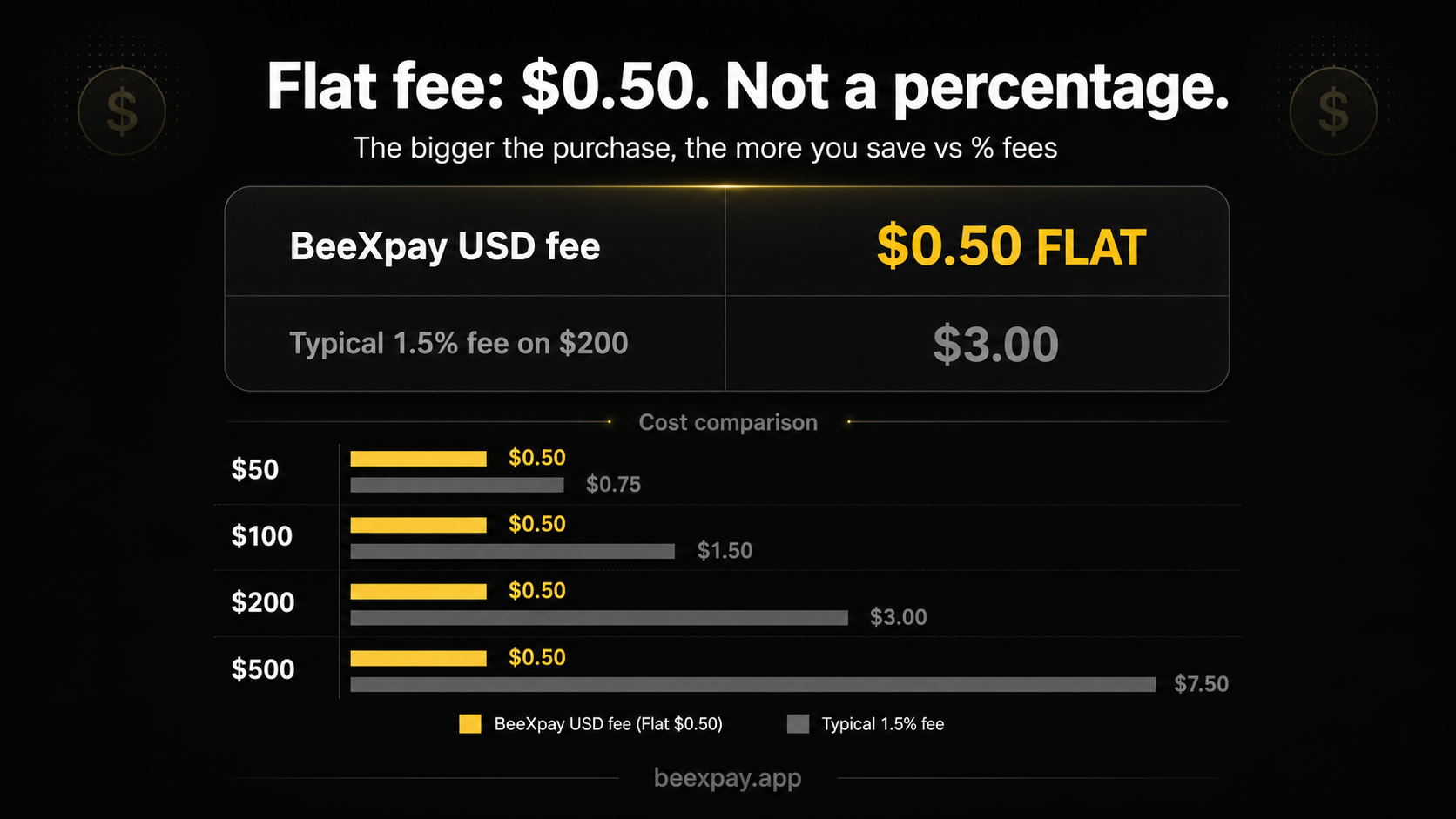
For example, a $0.50 fee on a $500 transaction represents only 0.10% of the transaction value. Under a 1.5% fee structure, that same $500 transaction would cost $7.50. The difference becomes increasingly noticeable as spending volume grows.
However, smaller transactions behave differently. A $0.50 fee on a $10 purchase represents 5% of the transaction value. In that situation, a percentage-based structure might actually cost less depending on the exact rate applied.
This demonstrates why fee efficiency depends on transaction behavior rather than marketing language alone. Users making larger recurring purchases generally benefit more from flat transaction structures, while extremely small payments may not produce the same advantage.
Real math: $50, $200, and $500 purchase level comparisons
At a $50 purchase level, a flat $0.50 transaction fee equals approximately 1% of the transaction value. Under a 1.5% fee structure, the same purchase would cost $0.75. The flat structure remains slightly cheaper, but the difference is relatively small.
At a $200 purchase level, the difference becomes more visible. A flat $0.50 transaction fee equals approximately 0.25% of the purchase amount. Under a 1.5% percentage fee structure, the transaction cost would equal $3.00.
At a $500 purchase level, the flat fee becomes proportionally even smaller. A $0.50 transaction fee equals approximately 0.10% of the total purchase value, while a 1.5% fee structure would cost $7.50.
The larger the transaction becomes, the more the fixed structure benefits the user relative to percentage-based pricing.
What USD vs foreign currency transactions cost differently
BeeXpay separates transaction pricing between USD payments and foreign currency conversions.
USD transactions operate primarily under the flat fee structure, generally ranging between approximately $0.25 and $0.50 per payment. This creates predictable transaction costs that do not scale directly with purchase size.
Foreign currency transactions behave differently because they involve conversion costs tied to banking infrastructure and exchange rate processing. These transactions generally carry fees between approximately 1.5% and 2% depending on the banking rate applied during conversion.
As a result, the pricing structure changes depending on where and how the user spends. USD transactions may become increasingly efficient at higher purchase sizes under the flat fee model, while foreign currency transactions still depend more heavily on percentage-based conversion structures.
Understanding this distinction helps users estimate realistic operational costs more accurately.
How reload fees and transaction fees combine into total cost
Transaction fees represent only one part of the total payment cost structure. Reload fees also contribute significantly to the final operational expense.
BeeXpay’s Light KYC structure applies a 4% reload fee, while the Full KYC structure reduces reload costs to 2.5%.
For example, a user reloading $500 under Light KYC would pay approximately $20 in reload fees before transaction costs are added. Under Full KYC, the same reload amount would cost approximately $12.50.
If the user then completes 20 USD transactions averaging $0.35 each, transaction costs would total approximately $7. This means total operational cost depends on both reload structure and spending behavior combined.
Users therefore benefit most from evaluating the entire fee system rather than focusing only on isolated transaction percentages.
Closing CTA: https://beexpay.app
Fee structures in fintech often appear simpler than they actually are. Percentage-based pricing may initially sound inexpensive, while flat fee structures can seem less intuitive until the real transaction math is calculated at realistic purchase sizes.
The actual cost difference depends heavily on transaction value, monthly spending behavior, currency usage, and reload structure.
BeeXpay’s fee system separates flat USD transaction pricing from percentage-based foreign currency conversion while also providing different reload structures under Light and Full KYC access models.
More information: https://beexpay.app
feescomparison cryptocard flatfee beexpay fintech transactionfee math cryptopayments