Funding Patterns Snapshot: What Users Actually Pick Each Week
A useful data point worth knowing
For users new to crypto cards, the first deposit screen presents a stablecoin and network choice that can be confusing without context. Marketing materials describe the options abstractly. Looking at the actual distribution of funding sources across BeeXpay deposits this week gives a more useful starting point than theoretical comparison. The pattern: USDT on Tron dominates, USDC on Solana follows, Ethereum-based options sit in the minority, and everything else is rare.
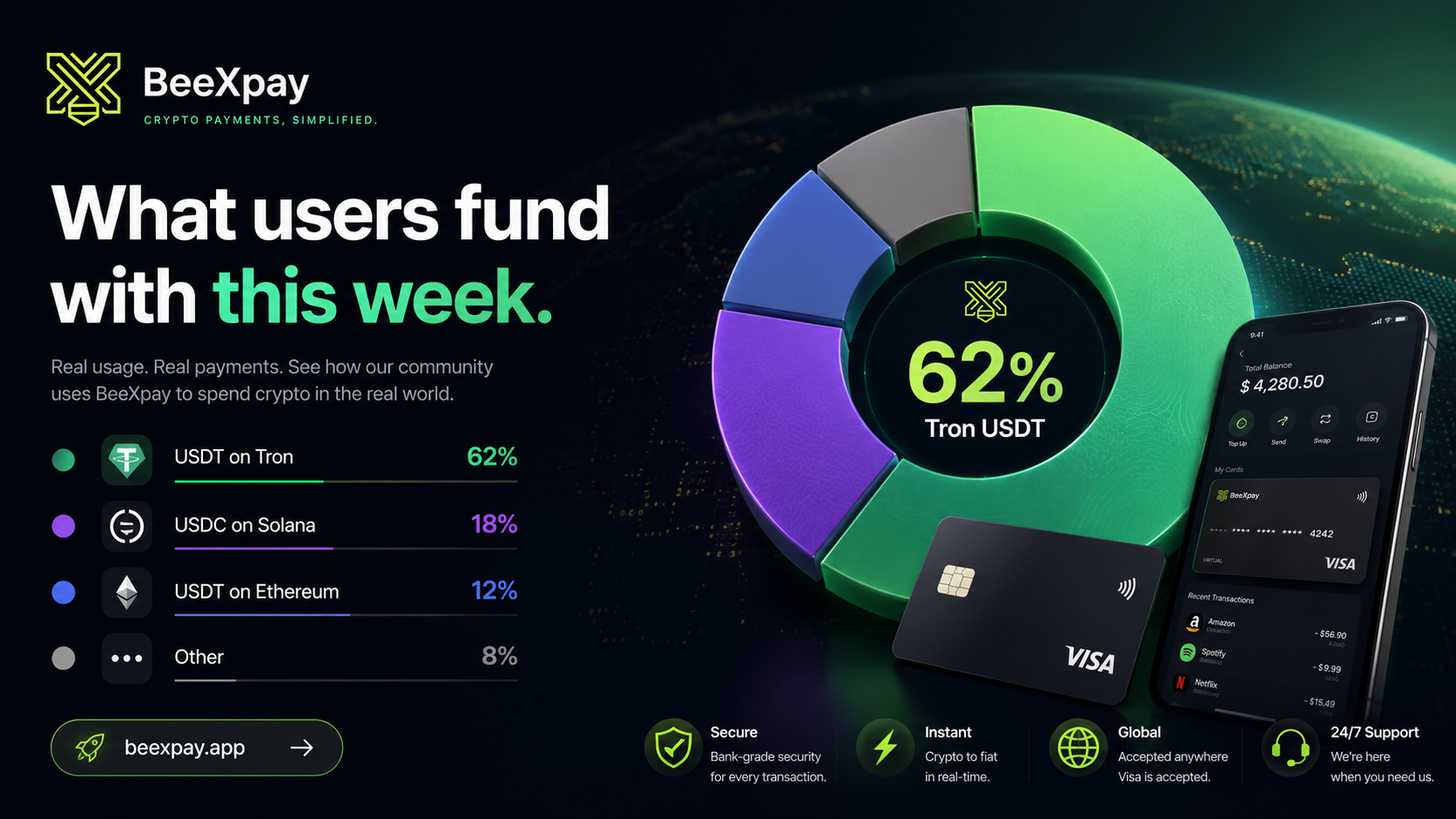
Why USDT on Tron leads
The dominance isn't sentimental — it reflects three concrete advantages. First, USDT has the deepest liquidity globally, so users in most markets acquire it easily through whatever local channel they use. Second, Tron has the cheapest network fees among major stablecoin networks, typically under $1, which matters for small funding amounts where Ethereum's $3–$15 fees represent a significant portion. Third, Tron's 3-second block time and low confirmation requirements make it the fastest practical option. The combination is what makes it the default for users who've evaluated their options.
Why USDC on Solana is the second tier
USDC on Solana represents users who prioritize regulatory framework without giving up speed and cost. Solana's confirmation is comparable to Tron — often faster in raw seconds — and fees are similarly low. USDC's monthly attestations and US Treasury-backed reserves appeal to users who weight that. The smaller share reflects lower global liquidity for USDC and the fact that many users acquire USDT first through their initial onramp and stick with it.
Why Ethereum-based options are in the minority
USDT and USDC on Ethereum represent users who already hold their stablecoins there and don't want to bridge. The 12% share is meaningful but smaller because network fees and confirmation times are less favorable than Tron or Solana for funding. Users who explicitly choose Ethereum are typically holding existing positions or have specific reasons to prefer it.
What this means for new users
There's a well-trodden default path: USDT on Tron. It's what most users have converged on for good reasons. New users don't need to overthink the choice; using what experienced users use is usually the right starting point. Users with existing holdings can use what they have. Users with strong regulatory preferences can choose USDC on Solana.
Network choice patterns by user profile
Active traders typically use USDT on Tron — already operating multi-network workflows, cost-conscious. Yield farmers and DeFi users often have Ethereum holdings and fund from there. Emerging-market users default to whatever local P2P platforms offer most readily, usually USDT on Tron or BSC. Regulated-market users sometimes prefer USDC on Solana or Base. The distribution reflects user segments rather than random preference.
What the data doesn't show
The pattern shows which networks users send from, not why or whether they evaluated alternatives. Some default to whatever their first onramp gave them. Some evaluated carefully. The distribution is informative as a starting point but doesn't substitute for thinking about your own situation.
How the funding choice affects card behavior
The funding choice affects funding speed and cost but not card behavior. Once funds are on the card, they behave identically regardless of source. The reload fee, flat per-transaction fees, and FX handling all apply the same way. You're not choosing a USDT card or a USDC card — you're choosing a funding source for a USD-denominated card.
A note on platform-level data
This snapshot reflects current patterns and may shift over time as user composition changes, network fees evolve, or new networks gain traction. Solana USDC has been gaining share. Base USDC is emerging. The category is dynamic; checking periodically is more useful than treating any snapshot as permanent.
Practical takeaway
New to the workflow and asking what to pick? USDT on Tron is the most-chosen, fastest, and cheapest for most users. Have specific preferences? Use what fits them. Either way, the card behaves the same once funded.
→ Try it: https://beexpay.app