How FX Works on a USD-Denominated Crypto Card
The structure: USD card, two conversion steps:
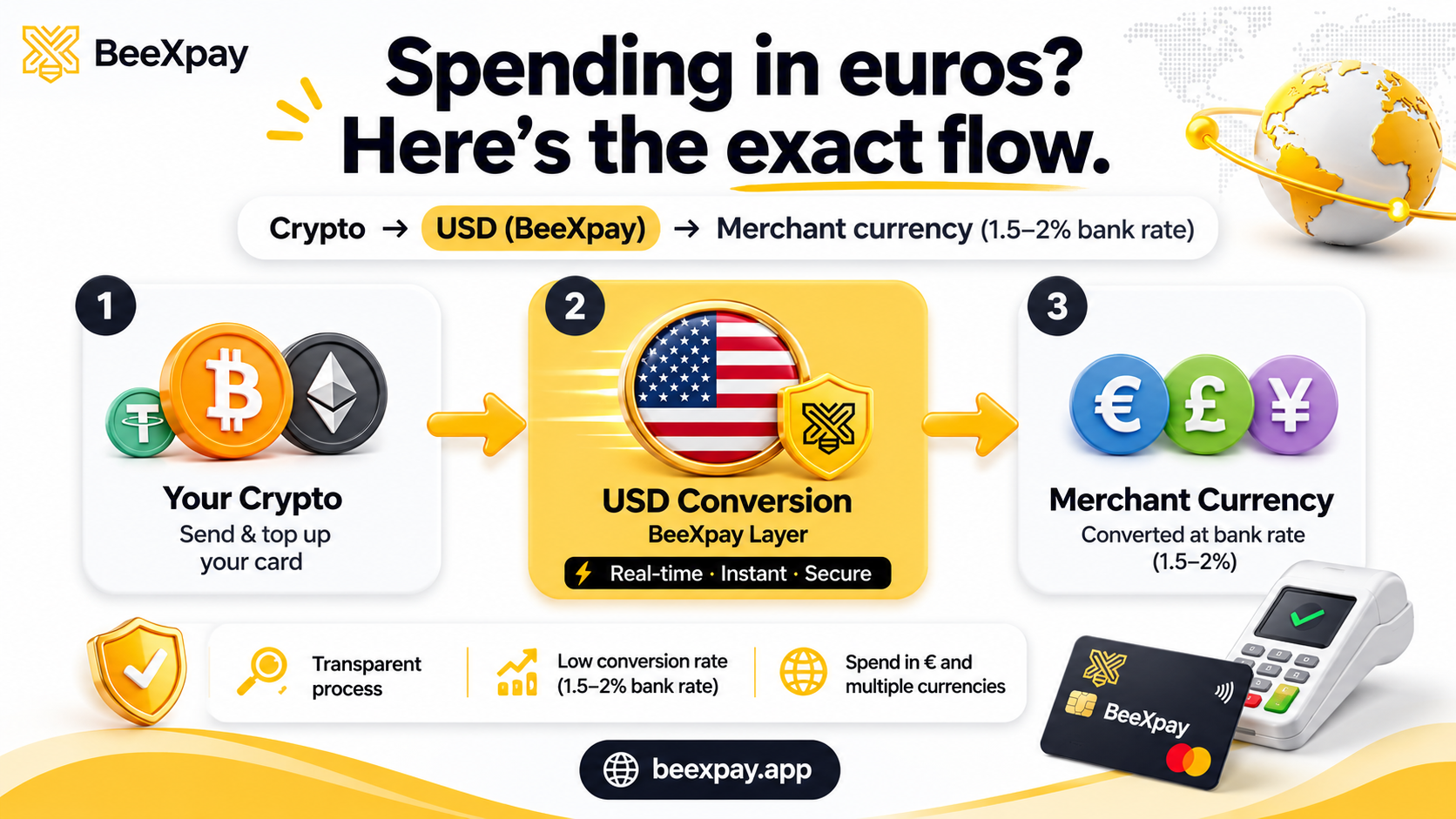
BeeXpay issues USD-denominated payment cards funded by crypto. Every transaction on the card involves at least one conversion — crypto to USD — and potentially a second, if the merchant settles in a non-USD currency. The first step is handled by BeeXpay at the moment of payment, taking around five seconds and locking the rate at that instant. The second step is handled by the card network, converting USD to the merchant's settlement currency at the bank's prevailing FX rate. The two steps operate independently and carry separate costs, which is the source of the most common confusion about crypto card fees.
What the flat fee covers
For USD transactions — payments to US merchants, USD-priced online services, USD-denominated subscriptions — the second step does not apply. The card behaves as a USD card with a $0.25–$0.50 flat transaction fee. This is the simplest case and the most cost-predictable. Users with significant USD-priced spending — international SaaS users, software subscribers, US-based online shoppers — see this fee structure on most of their transactions. The flat fee is set by BeeXpay and applies regardless of transaction amount, which makes the effective rate very low on larger transactions and slightly higher on smaller ones.
What the FX spread adds for non-USD
For non-USD transactions — EUR purchases, GBP retail, PKR everyday spending, AED or any other non-USD merchant currency — the second conversion step applies. The card network takes the USD off the card and converts it to the merchant's settlement currency at the bank's prevailing FX rate, adding 1.5–2% on top of the flat transaction fee. This spread is set by the card network and the bank rails, not by BeeXpay, and it reflects the FX cost that any USD-denominated card pays for non-USD transactions. For users spending mostly in a single non-USD currency, this becomes the dominant cost line item over time.
Comparison: traditional cross-border versus this model
Traditional cross-border payment methods carry costs that make the crypto card model competitive for low-to-medium value spending. International wires charge $25–$50 flat plus 2–4% FX. Money transfer services often charge 4–8% effective when fees and FX are combined. SWIFT transfers carry correspondent bank fees that often emerge at settlement. A flat $0.25–$0.50 plus 1.5–2% bank FX is competitive for everyday cross-border spending in the $5–$500 range, with the advantage greatest at smaller amounts. For large transfers, dedicated FX services may offer better rates; the crypto card model is built for spending rather than wire-style transfers.
Practical use patterns for international users
The fee structure rewards specific usage patterns. Users with predominantly USD spending see flat fees only. Users with mixed currency exposure can route USD-pricing-available services through the card without FX cost, and accept the FX on local-currency spending. Users in countries where most spending is in a local non-USD currency see the FX line item on nearly every transaction. None of these patterns is hidden; the published fee structure allows users to model expected costs before activation. For a $500 spending pattern split 70/30 USD/non-USD, total monthly fees fall in a predictable range that can be calculated up front rather than discovered after the fact.
Closing CTA
The FX mechanics on a USD-denominated crypto card are two conversion steps with separate costs. Published fee structure makes the math doable.
Explore payment access → https://beexpay.app