Nomad arriving in new country — two immediate problems: no card, no data SIM
For digital nomads, arriving in a new country usually triggers the same operational checklist within the first few hours. The traveler needs mobile connectivity immediately, and at the same time needs reliable access to spending infrastructure. Without internet access, maps, communication apps, ride-sharing services, and work platforms become difficult to use. Without a functional payment method, transportation, food, accommodation, and local purchases become equally complicated.
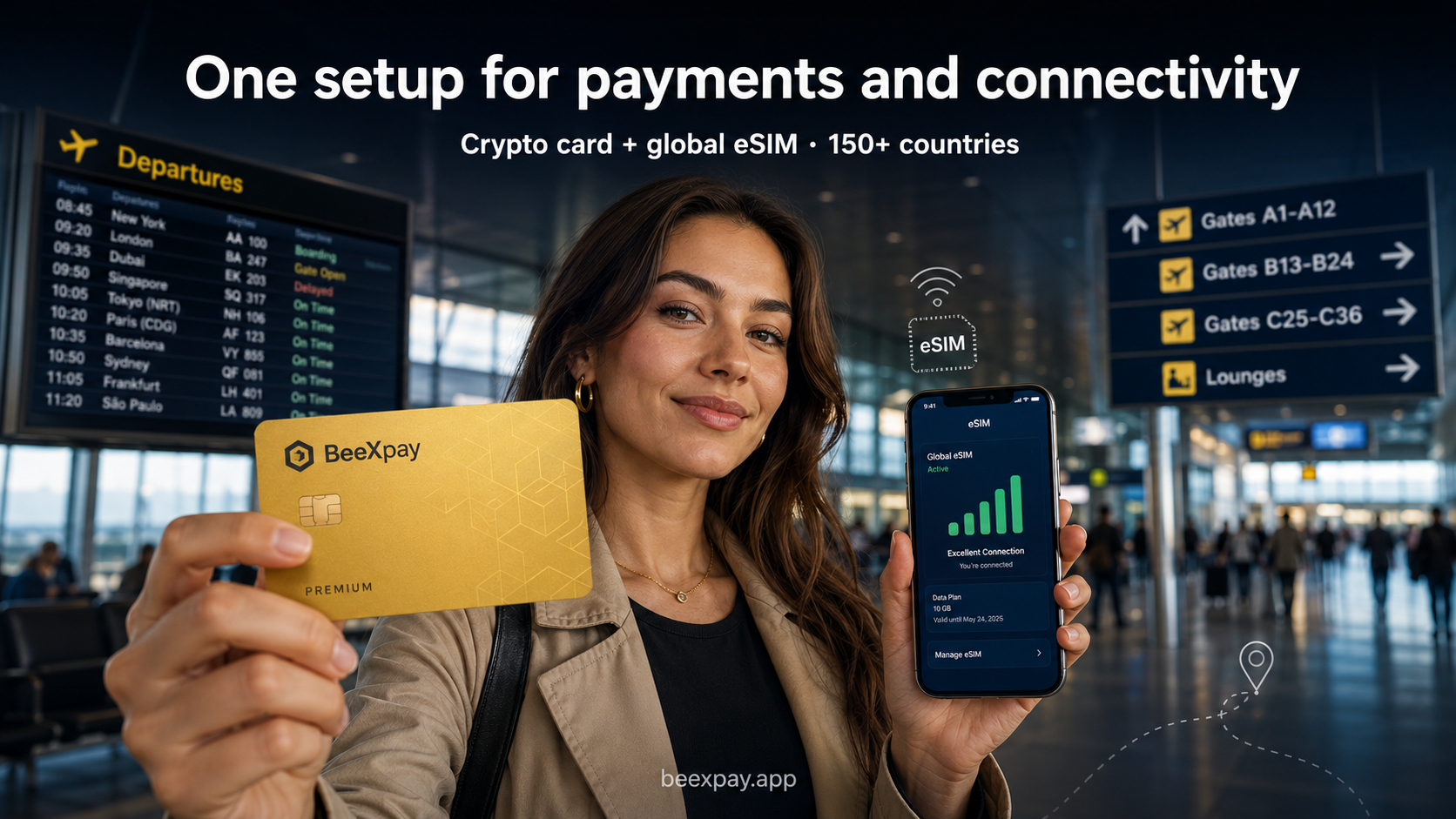
Traditionally, these two problems are solved separately. The traveler searches for a local SIM provider while also depending on local bank cards, prepaid travel cards, exchange withdrawals, or cash conversions. While each individual step appears manageable, repeating this process across multiple countries quickly becomes inefficient.
As remote work becomes more location-independent, the infrastructure supporting nomadic lifestyles is gradually evolving as well.
The traditional solution and why it's expensive and slow
Historically, international travelers relied on a mix of prepaid travel cards, cash exchange services, local SIM vendors, and international banking products. This toolkit was designed around temporary tourism rather than long-term distributed work.
For digital nomads moving frequently between countries, the process becomes repetitive. Local SIM registration may require identification documents, language navigation, physical store visits, or waiting periods. Banking products designed for domestic spending may introduce foreign transaction fees, exchange spreads, ATM charges, or regional restrictions.
Crypto users face an additional challenge. Even when receiving income in Bitcoin or USDT, they often still need to repeatedly off-ramp through exchanges and local banks before spending funds practically. This creates multiple dependency layers across banking, telecom, and exchange infrastructure.
Over time, the issue becomes less about one individual transaction and more about operational friction repeated across every border crossing.
What global eSIM actually means for connectivity
Global eSIM infrastructure attempts to simplify the connectivity side of this problem. Instead of purchasing physical SIM cards in each country, users can activate mobile data plans digitally through compatible devices.
BeeXpay’s eSIM support extends across more than 150 countries, allowing users to maintain connectivity without constantly replacing physical SIM hardware. This changes how digital nomads manage movement between regions because internet access becomes more portable and immediate.
For remote workers, stable connectivity is not simply convenience. Video meetings, project delivery, messaging systems, cloud platforms, authentication apps, and remote collaboration all depend on reliable internet access. Delays in connectivity can directly interrupt work continuity.
Global eSIM systems therefore function as part of the remote work infrastructure layer itself rather than simply a telecom product.
What a crypto-funded card replaces in the nomad toolkit
Crypto-funded cards solve a parallel problem on the payment side. Instead of repeatedly converting crypto into local fiat balances before every expense, users fund a payment card directly with cryptocurrency and allow conversion to occur automatically during transactions.
BeeXpay’s virtual card is available for $10 through the Light KYC Telegram Mini App structure, while the physical card costs $100 and operates under Full KYC through the BeeXpay application itself. Crypto converts into fiat at the moment of use, generally within approximately five seconds.
This reduces dependence on repeated exchange withdrawals and international bank settlement cycles. The card structure also centralizes spending into one operational layer rather than requiring multiple prepaid cards or region-specific payment methods.
For nomads receiving income in crypto, this creates a more continuous relationship between earnings and practical spending.
BeeXpay: one setup for payments and connectivity
The combination of crypto-funded payment cards and global eSIM access creates a more integrated toolkit for remote workers. Instead of solving connectivity and spending separately, BeeXpay attempts to consolidate both functions into one environment.
This matters because digital nomads increasingly operate as distributed workers rather than temporary travelers. Their operational needs include payments, internet access, subscriptions, transportation, and recurring cross-border activity.
The virtual card structure may suit users prioritizing speed and online spending, while the physical card may fit travelers relying more heavily on in-store retail environments. Google Pay and Apple Pay support on compatible devices also expand payment flexibility in supported regions.
At the same time, territorial restrictions remain important. BeeXpay services are unavailable in the United States, United Kingdom, Russia, Iran, North Korea, Afghanistan, Syria, Cuba, Libya, Somalia, Sudan, and Crimea.
Realistic cost breakdown: nomad spending $500/month
Operational cost transparency is important for remote workers managing monthly travel budgets.
Under BeeXpay’s Light KYC structure, reload fees are 4%. A digital nomad spending approximately $500 monthly would therefore pay around $20 in reload costs. Under Full KYC, reload fees decrease to 2.5%, reducing the same monthly reload cost to approximately $12.50.
USD transaction fees range between $0.25 and $0.50 per payment. Assuming 20 transactions monthly averaging $0.35 each, transaction fees would total roughly $7.
For payments in currencies outside USD, conversion costs generally range between 1.5% and 2% depending on the banking rate applied.
Compared to repeated international ATM withdrawals, prepaid travel card fees, telecom roaming charges, and exchange withdrawal cycles, many nomads may view the combined structure as operationally simpler over time.
Closing CTA: https://beexpay.app
As remote work continues shifting toward location-independent structures, the infrastructure supporting digital nomads is also changing. Connectivity and payment access are becoming integrated operational requirements rather than separate travel concerns.
Crypto-funded cards and global eSIM systems attempt to reduce the friction created by repeated border crossings, fragmented payment systems, and local telecom dependencies.
BeeXpay combines both payment access and global connectivity into a single ecosystem designed around distributed work and international movement.
More information: https://beexpay.app
digitalnomad esim cryptocard beexpay globaleSIM travel cryptopayments fintech virtualcard remotework