Opening: real user problem — crypto in wallet, can't pay at checkout
A common situation continues to repeat across the crypto space. A user holds Bitcoin, USDT, or another digital asset. The value is there. The balance is visible. But when it comes time to pay for something simple—an online subscription, a flight, or even a digital service—the process breaks down.
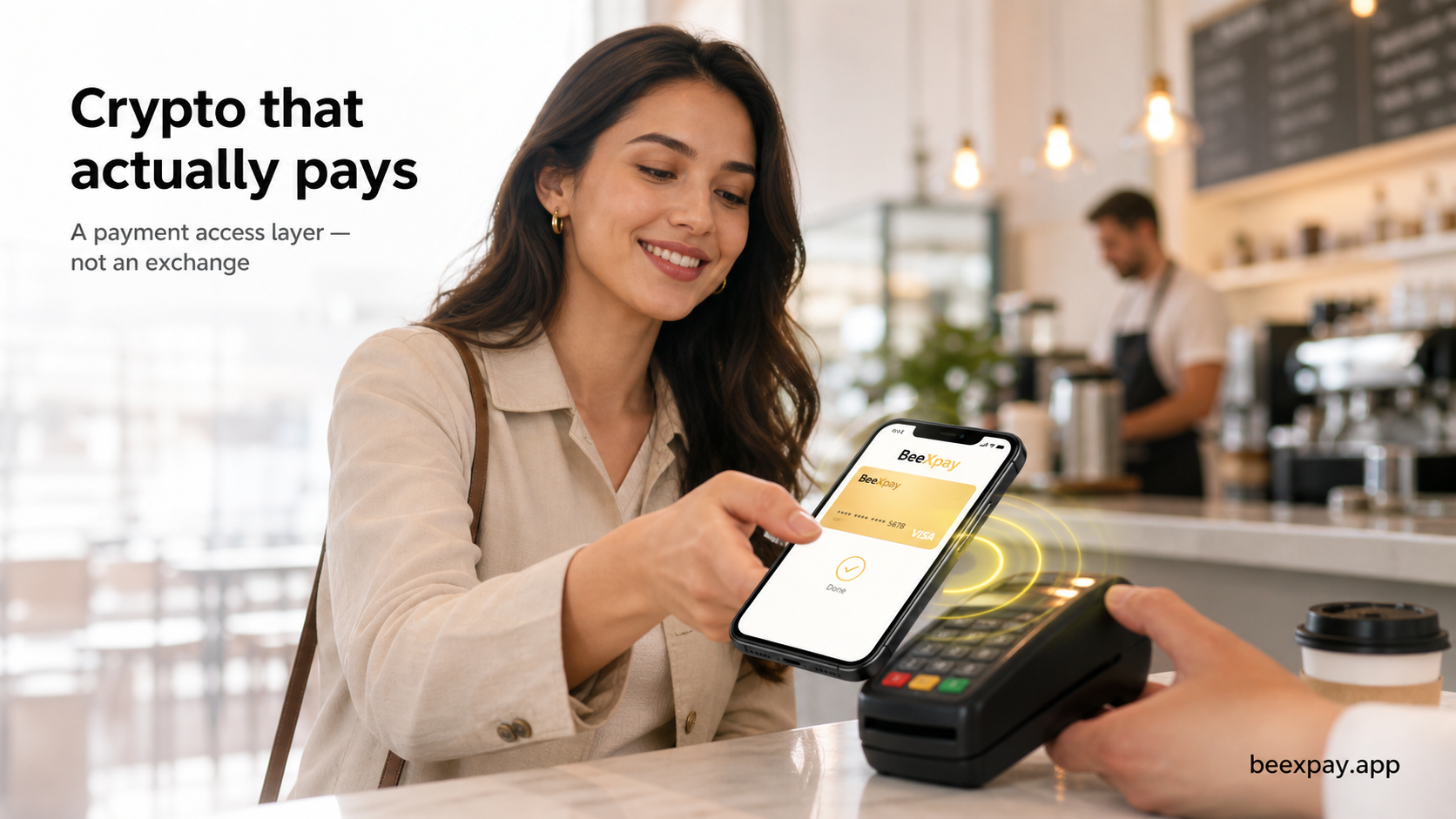
Traditional checkout systems do not accept crypto directly. The user is forced to move funds to an exchange, sell into fiat, withdraw to a bank, and then finally complete the payment. What should be a simple transaction becomes a multi-step process with delays, fees, and friction.
This gap between holding crypto and actually using it is where confusion about crypto products begins.
What most people confuse about crypto products
The ecosystem often groups very different tools under the same umbrella. Exchanges, wallets, and payment tools are frequently treated as interchangeable, even though they serve entirely different purposes.
An exchange is designed for trading. Its core function is to convert assets through market activity. A wallet is designed for storage. It holds digital assets and provides access to them.
Neither of these is built for direct, real-world payments. Yet many users attempt to use them for that purpose, which leads to unnecessary steps and complexity.
The assumption that “holding crypto means being able to spend it” is not always accurate. There is a missing layer between ownership and usability.
What a payment access layer actually does
A crypto payment access layer exists to solve this exact problem. It does not replace exchanges or wallets. Instead, it connects them to real-world payment systems.
The function is straightforward. The user funds a payment card with crypto. At the moment of purchase, the crypto is converted into fiat currency automatically. This conversion happens in a short timeframe, typically around a few seconds, enabling the transaction to proceed like a standard card payment.
The key point is timing. Conversion does not happen in advance, and it does not require manual trading. It occurs only when needed, at the point of use.
This allows crypto to function as a practical payment source rather than a static holding.
Why this distinction matters for daily users
For everyday users, the distinction between a payment layer and other crypto tools directly affects usability.
Without a payment access layer, users must rely on external steps such as transferring funds, executing trades, and managing withdrawals. Each step introduces additional fees, time delays, and potential errors.
With a payment access layer, the process is simplified into a single interaction. The user selects a payment method and completes the transaction. The system handles the conversion in the background.
This structure also introduces cost clarity. Instead of variable trading fees and withdrawal charges, users interact with defined transaction costs. For example, USD transactions may be charged as a flat fee rather than a percentage, making expenses more predictable.
In practical terms, the distinction reduces friction and makes crypto usable in real-world scenarios.
How BeeXpay fits this model
BeeXpay is structured specifically as a crypto-funded payment access layer, developed by Beextech Limited in Hong Kong. It is not designed as a bank, an exchange, or a standalone wallet.
Access is provided through two environments: a Telegram Mini App with Light KYC and a mobile application with Full KYC. This allows users to choose between faster onboarding or extended functionality.
The service offers both virtual and physical cards, priced at $10 and $100 respectively. Once funded with cryptocurrency, these cards enable payments where standard card systems are accepted.
At the moment of transaction, crypto is converted into fiat in approximately five seconds. This removes the need for manual trading before each purchase.
The fee structure is defined in advance. Reload fees are set at 4% for Light KYC and 2.5% for Full KYC. USD transactions are charged between $0.25 and $0.50, while other currencies follow a 1.5% to 2% range.
Beyond payments, BeeXpay also includes global eSIM support across more than 150 countries, extending its utility for users who operate internationally.
The design reflects a focused objective: enable spending, not trading.
Closing CTA
BeeXpay presents a practical approach to bridging crypto and everyday payments without redefining itself as a financial institution or trading platform.
Generate your crypto card: https://beexpay.app
cryptocard fintech cryptopayments virtualcard paymentaccess beexpay spending blockchain