PayPal vs Crypto Card: When Each Makes Sense for International Spending
Comparing tools optimized for different things
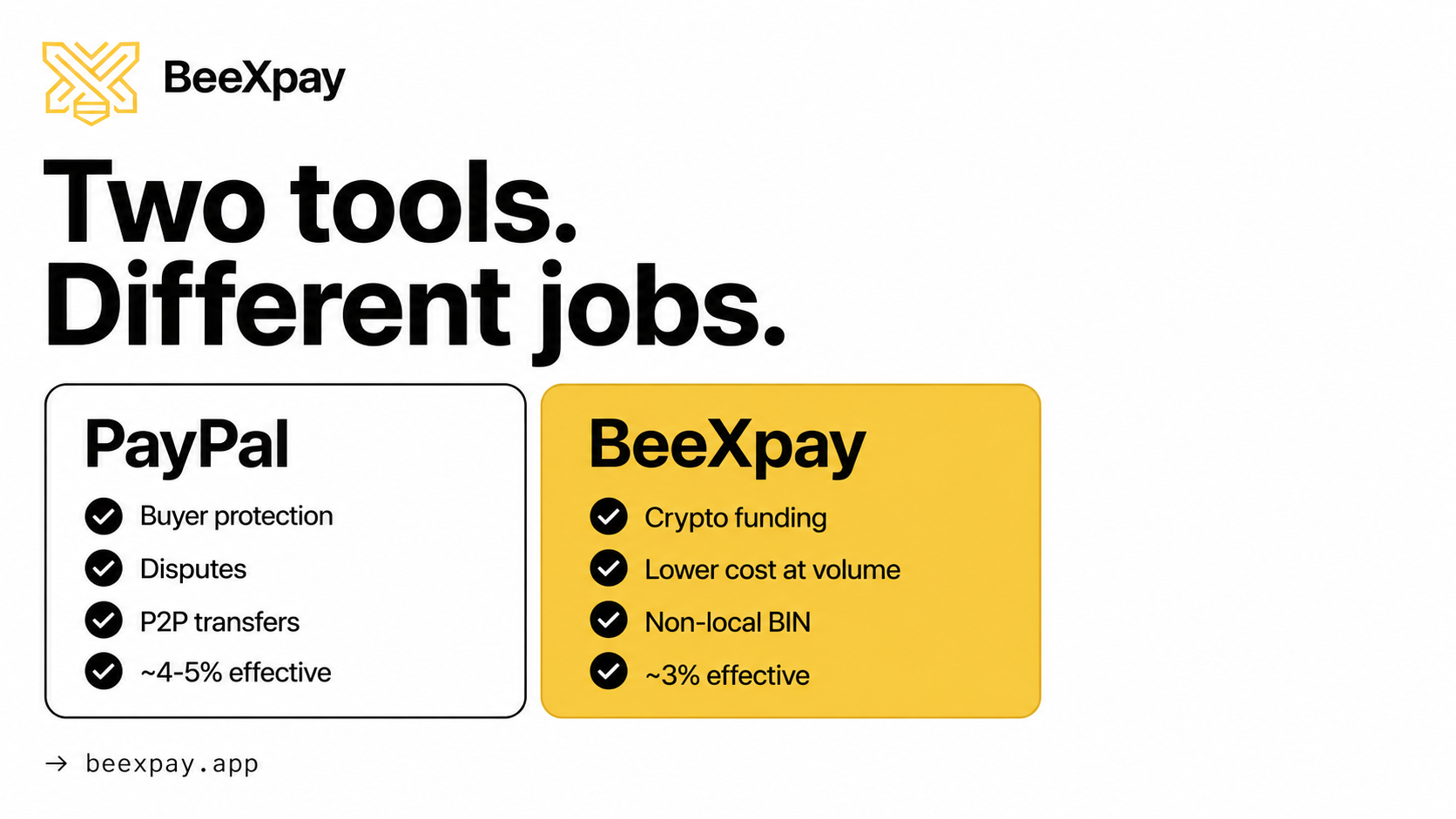
PayPal and crypto-funded cards both handle international online payments, which makes them seem like direct competitors. They're not, exactly. PayPal is a payment ecosystem with dispute resolution, buyer protection, and peer-to-peer capabilities; a crypto card is a payment instrument optimized for online spending with crypto funding. Comparing them as if they're the same product type produces misleading conclusions. This piece walks through what each actually does and when each makes sense.
What PayPal does well
PayPal's strengths are ecosystem features beyond payment processing. Buyer protection covers a wide range of dispute scenarios — items not received, items significantly different from description, unauthorized transactions. The dispute resolution infrastructure is mature, with documented processes and broad merchant participation. Account-to-account transfers let users send money to friends and family without sharing card details. Merchant acceptance is broad, including some merchants who don't accept cards directly but accept PayPal. For users whose payment needs include any of these capabilities, PayPal is structurally better positioned than a crypto card.
What PayPal costs
PayPal's fee structure is layered. Cross-border transactions carry a fee on top of standard processing. Currency conversion uses PayPal's FX rate, typically including a 3-4% spread above mid-market. Receiving international payments has its own fees. For typical cross-border online spending — say a $100 purchase from an international retailer — the effective cost lands around $4-5 when fees and FX stack up, or roughly 4-5%. For a user spending $2,000/month on cross-border online services, that's roughly $80-100/month in PayPal costs.
What crypto cards do well
Crypto cards optimize for different things. Funding source flexibility for users who hold crypto and don't want to manually offramp through exchanges and bank withdrawals. Cost at volume for users with predictable monthly spending. Access in regions where PayPal availability is limited, restricted, or unreliable. Payment-method discretion since the funding source (crypto wallet) isn't a personal bank account visible to merchants. For users with these specific needs, a crypto card offers structural advantages.
What crypto cards cost
BeeXpay's fee structure: 2.5% reload (Full KYC) on funded amount, flat $0.25-$0.50 per USD merchant transaction, 1.5-2% bank FX on non-USD merchant transactions. For USD-heavy spending, the effective rate runs around 3%. For mixed USD/non-USD, closer to 4%. For a user spending $2,000/month with mostly USD merchants: about $55-65 in card costs. Compared to PayPal's $80-100, a $25-35/month difference, or $300-420/year.
The dispute and protection gap
The biggest functional difference is dispute resolution and buyer protection. PayPal's buyer protection program covers scenarios where you didn't get what you paid for, the item was significantly different, or the transaction was unauthorized. The protection isn't free — it's funded by merchant fees — but it provides real value for users who buy from unfamiliar merchants or in higher-risk categories. Crypto cards have standard card network chargeback rights but no equivalent platform-level buyer protection. For high-trust merchants (established subscriptions, known retailers), this gap matters less. For exploratory purchases or higher-risk categories, it matters more.
When the two overlap
The overlap is online cross-border USD spending — international SaaS subscriptions, US-based online retailers, USD-priced services. Both can handle these. At small volumes, the cost difference is modest. At larger volumes, the cost differential accumulates. A user with $500/month in USD-priced subscriptions sees roughly $20/month with PayPal vs $13-15 with a crypto card — a small monthly difference but meaningful annually. The choice at this overlap depends on whether the dispute and protection features justify PayPal's higher cost.
What each doesn't do
Honest framing matters. PayPal doesn't fund from crypto natively. Crypto cards don't have PayPal's dispute infrastructure. PayPal isn't great for in-person spending. Crypto cards (virtual with mobile wallet) handle in-person via NFC. PayPal is restricted in some regions where crypto cards work. Crypto cards are restricted in regions where PayPal works. Each fills gaps the other has, which is why many users end up using both for different purposes.
Practical recommendation
For users who buy frequently from unfamiliar merchants, in higher-risk categories, or who value buyer protection: PayPal is structurally the right tool. For users with predictable recurring international spending, mostly USD-priced services, and existing crypto holdings: a crypto card is cost-competitive and operationally simpler for that pattern. For most users with mixed needs, using both makes sense — PayPal for transactions where protection matters, crypto card for routine high-confidence spending.
What the comparison signals about category positioning
The category positioning matters because both services are evolving. PayPal has been adding crypto features. Crypto card platforms have been improving merchant acceptance and adding dispute infrastructure. The gap between them may narrow over time. For now, the optimization differences are real enough that comparing the tools on a single axis (cost, acceptance, protection) misses the structural differences. Use-case-fit beats single-axis comparison.
Discussion
For users running international online spending: do you use PayPal, a crypto card, or both? Worth thinking about whether you're using the right tool for each transaction type, or defaulting to one because it's familiar.
→ Try it: https://beexpay.app