Reading Crypto Card Transaction History as a Financial Tool
An underused data source
Transaction history is universal and underused. Most people glance at it to confirm charges and never engage with it as a tool. For crypto card users, this is a missed opportunity — the history contains data valuable for tax tracking, cost optimization, and security that, for crypto cards specifically, is hard to reconstruct after the fact. Learning to use it turns a passive record into an active financial tool.
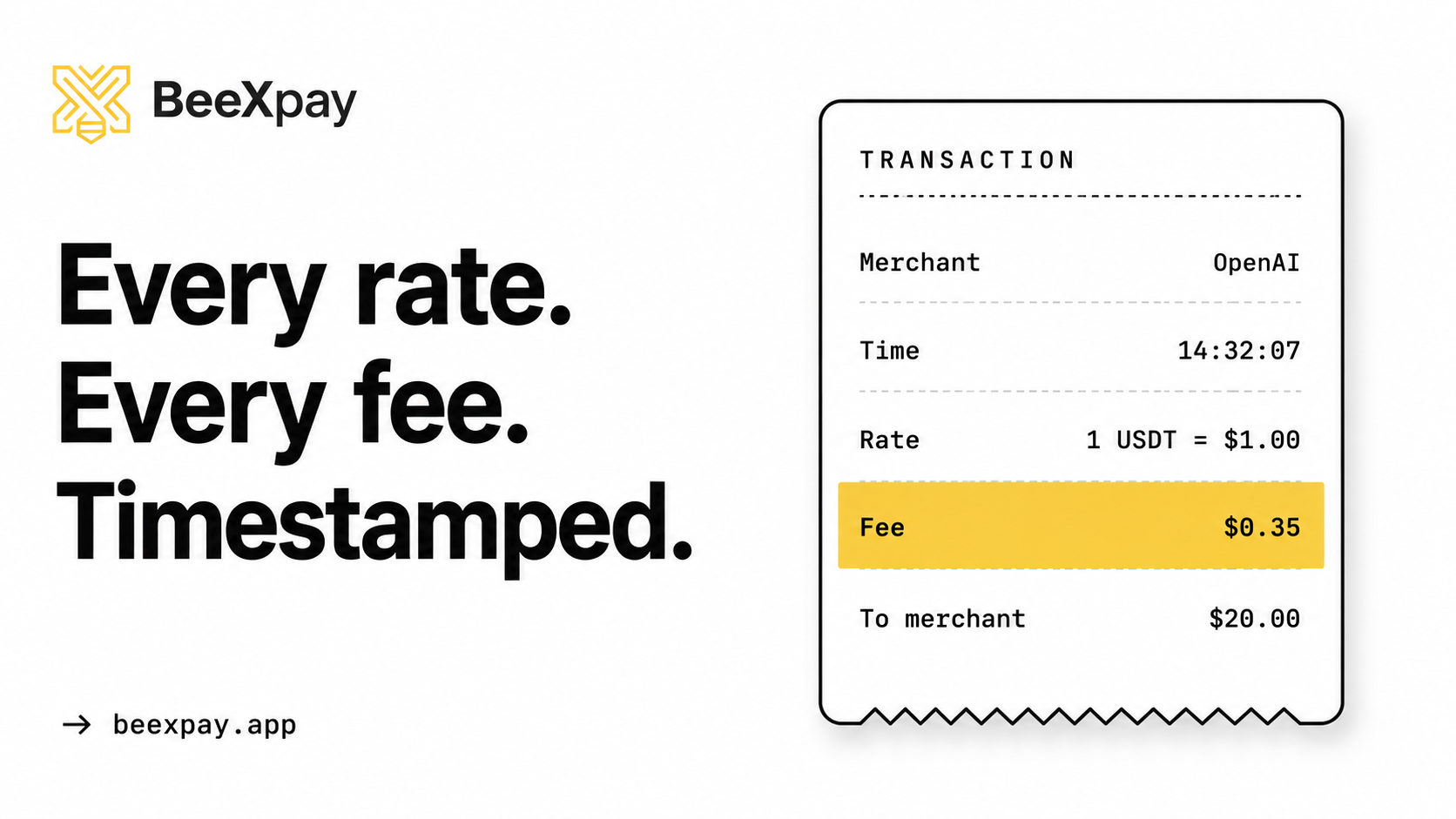
The data each record contains
A crypto card transaction record contains more than a traditional one: merchant and category, timestamp to the second, crypto-to-USD conversion rate at the moment of transaction, crypto amount debited, USD amount to merchant, fee breakdown (flat for USD merchants, FX percentage for non-USD), and for non-USD transactions the merchant currency amount and applied FX rate. This granularity exists because the crypto-to-fiat conversion at payment generates data that fiat-to-fiat transactions don't.
Conversion rates as the critical tax data point
For users in jurisdictions where crypto disposal is taxable, the conversion rate at each transaction is critical. Every card transaction disposes of crypto at a specific rate, and tax calculation requires it. BeeXpay records the rate at transaction time, eliminating the need to reconstruct historical rates — a significant simplification for tax tracking. Export the history and the disposals are documented with their rates, ready for tax software.
Fee data and cost optimization
The fee breakdown makes cost optimization concrete. Users can see how much they paid in flat fees (USD merchants) versus FX fees (non-USD). If FX fees dominate, that's a signal to route more spending through USD-priced merchants. Without the breakdown, this optimization is invisible; with it, users can see and adjust their fee structure.
Anomaly detection and security
The detailed history supports anomaly detection — unfamiliar merchants, odd timestamps, fees that don't match patterns. Periodic review catches unauthorized transactions early and accounting errors before they compound. The granularity enables this; coarse records wouldn't.
Export and accounting integration
The export function connects card data to broader financial workflows. For freelancers and business operators, exporting and importing into accounting software creates the documentation needed for expense tracking and tax prep. The export includes conversion rates, fees, and USD amounts, eliminating the need to reconstruct data. For users with serious accounting needs, this is the bridge between card and financial system.
What it doesn't do
The history records card activity, not the complete financial picture. It doesn't capture the crypto's cost basis (upstream of the card), calculate tax liability (requires cost basis plus jurisdiction rules), or track other spending. It's a complete record of card activity but one input among several for full tracking.
Closing observation
The richness and exportability of crypto card transaction history is a marker of category maturity — the boring infrastructure of detailed records that serious users need. Worth using as an active tool rather than ignoring.
→ Explore: https://beexpay.app