The phrase that means almost nothing
"Privacy-first" appears in most fintech marketing pages and means almost nothing through overuse. The useful question isn't whether an operator claims privacy-first — every operator does — but what specific design choices they made that produce privacy outcomes.
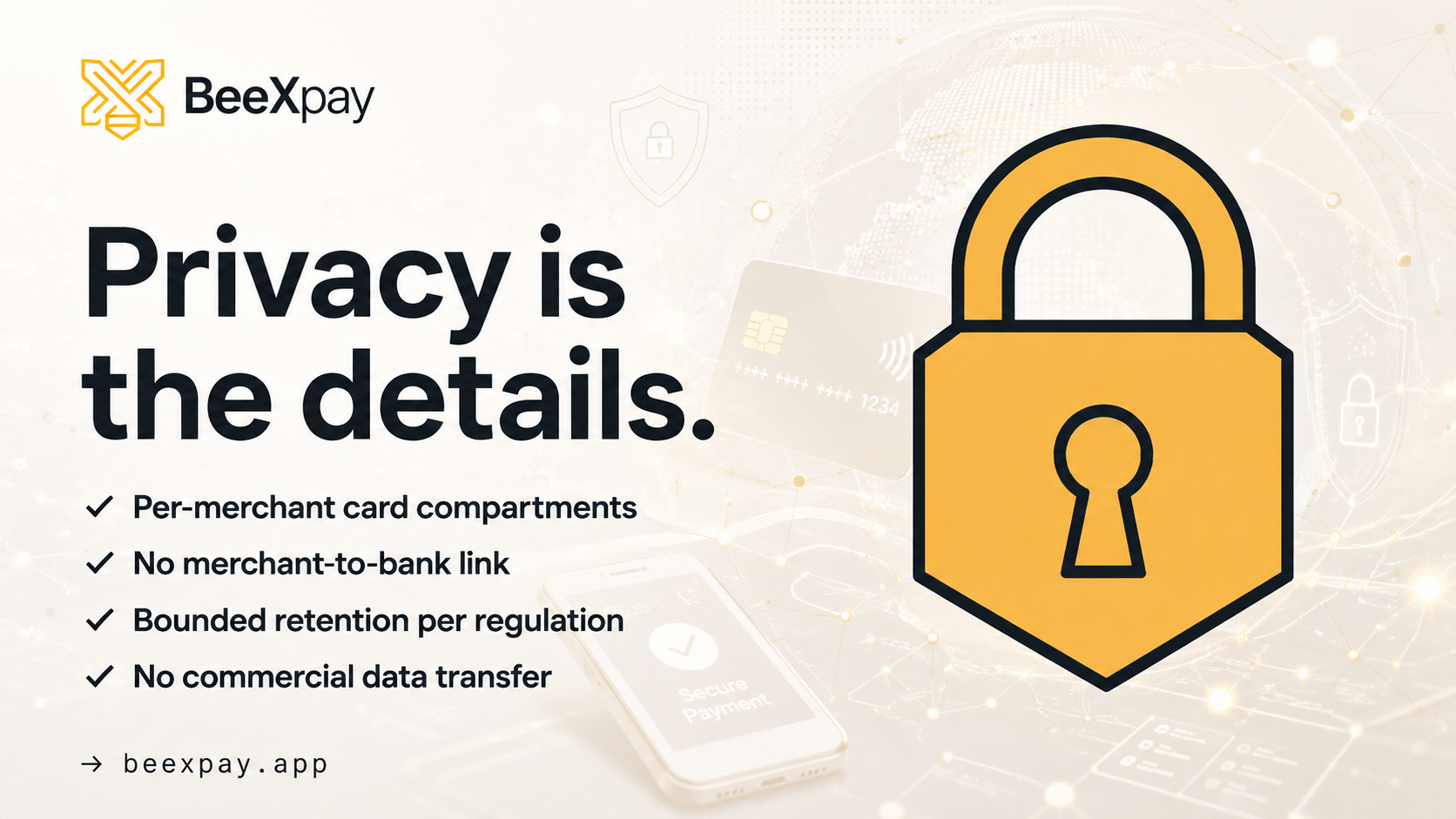
Five concrete design choices
BeeXpay's privacy posture rests on five specific design choices. None individually unique; together they form a structural posture.
Compartmentalization through cheap virtual cards
Making multiple virtual cards economically reasonable ($10 each, instant generation) enables users to issue separate cards per purpose. Each card limits what any merchant learns about the broader user. Merchants see card-level activity, not cross-merchant correlation. This is structural compartmentalization that depends on the cheap-issuance design choice.
Crypto funding eliminates merchant-to-bank link
Traditional cards link merchant → card → bank → user. Merchant data breaches expose the banking information. Crypto-funded cards eliminate this link — the funding source is a wallet, structurally separate from banking relationships. Structural benefit independent of operator policy.
KYC retention proportional to regulation, not indefinitely
KYC data retained for five years after account closure (standard regulatory requirement for identity records). Inactive accounts deleted after three years. Active account data retained while active. Retention bounded by regulation rather than maintained indefinitely.
No commercial data transfer
Explicit policy against transferring or selling user data to third parties for commercial purposes. User transaction history and identity data don't become inputs to advertising profiles, credit scoring, or data broker products. Removes data monetization incentives.
GDPR rights cleanly implemented
Access, rectification, erasure within legal limits, objection, restriction, data portability. Legal requirements for European users, but implementation quality varies. Clean implementation reflects operator philosophy.
What this doesn't claim
BeeXpay isn't anonymous. KYC is required. The platform knows its users. Privacy positioning is about structural choices limiting data exposure to merchants, preventing inappropriate use, and bounding retention.
How this differs from typical fintech
Regulatory minimums apply to all operators. Variation is in what they do beyond. Some retain permanently for analytics. Some share with affiliates and data brokers. Some build behavioral profiles. BeeXpay's posture is constrained.
Practical user-side privacy practices
Use multiple virtual cards for different purposes — per-merchant for sensitive purchases, per-category for general spending. Avoid linking the same card to many unrelated accounts. Periodically rotate cards used for subscriptions. Use Light KYC for routine use; reserve Full KYC for when needed.
When the choices matter more vs less
Privacy weighting varies by user. Sensitive purchases, purchases from less-trusted merchants, activities the user wants separated from their main financial profile benefit most. Simple high-trust spending benefits less.
What the broader privacy conversation needs
The fintech privacy conversation often gets stuck between marketing claims and absolute positions. The middle — practical privacy within a regulated framework through specific design choices — is where most users live. Operators that occupy this position through concrete choices address a real user need.
→ Explore: https://beexpay.app