Time-to-Usable-Card Comparison — Typical Exchange Card Onboarding vs BeeXpay Light KYC
Most crypto card reviews compare fees — almost none compare how long it takes to get started
Crypto card reviews tend to focus on fees: reload fees, transaction fees, foreign exchange fees, cashback percentages. The metric they rarely measure is time-to-usable-card — the elapsed time between starting the onboarding flow and being able to make a purchase. This is a strange omission, because for most users the activation time is the friction that determines whether they actually complete onboarding. A card with great fees that takes a week to activate loses to a card with reasonable fees that activates in an hour, for users with immediate spending needs. The time-to-card comparison deserves its own examination.
Why onboarding speed matters more than most users realize.
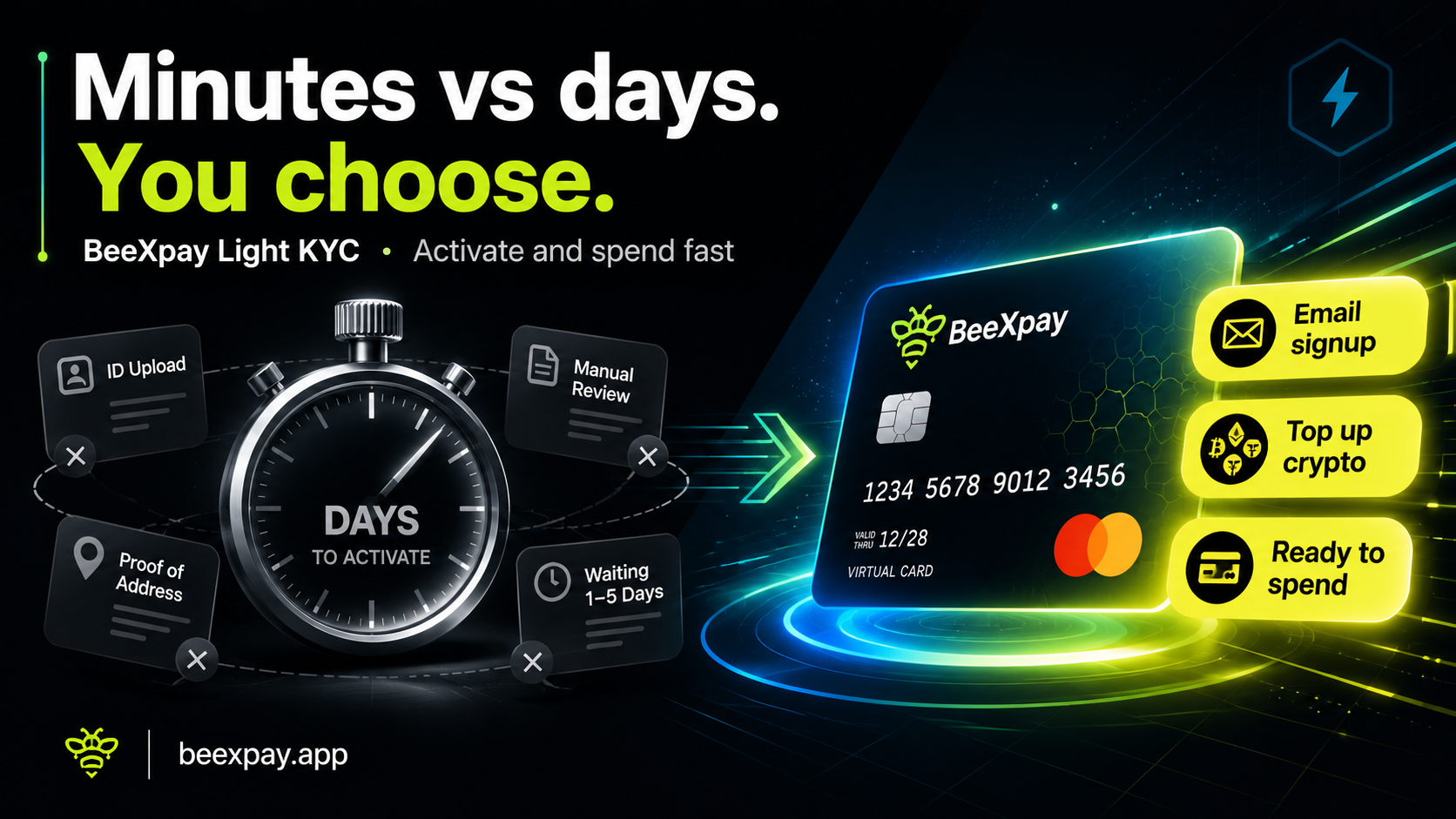
Onboarding speed shapes user behavior in measurable ways. Users who decide they want a crypto card tend to want it for a specific use case — paying for software due tomorrow, booking a flight tonight, sending a payment to a freelancer this week. The decision point is the immediate need. If activation takes a week, the original need is solved by other means before the card is ready, and the card becomes optional rather than essential. If activation takes an hour, the card meets the original need directly, and usage continues from there. The compression of activation time is not just a UX improvement — it determines whether the card gets used at all.
What typical exchange card onboarding involves (without naming competitors)
The standard exchange card onboarding flow involves multiple steps over multiple days. The user downloads the exchange app. Creates an account. Verifies email. Submits identity documents (passport or ID card scan, sometimes both sides). Submits proof of address (utility bill, bank statement). Submits a selfie or video for liveness verification. Waits for document review. Receives approval (or request for resubmission, often). Funds the exchange account. Orders the card. Receives the physical card by post in one to four weeks, or activates the virtual card with additional verification. Each step has its own potential delay. The total elapsed time runs from several days to several weeks depending on the operator and the user's documentation.
The Light KYC model — what it trades for speed
Light KYC compresses the verification side of onboarding by accepting reduced documentation in exchange for limited card capabilities. The model is proportional: less verification, less product capability. BeeXpay's Light KYC enables instant virtual card activation through the Telegram Mini App. The user provides basic identification rather than full document submission. The card issued is virtual ($10), works at online merchants, and applies a 4% reload fee. Users wanting physical cards, higher limits, or lower reload fees can go through Full KYC via the Beexpay mobile app for those features. The two-tier model gives users the choice between speed and feature access.
Step count and time estimate for BeeXpay Telegram path
The Telegram Mini App path runs through four user-facing steps: open https://t.me/Beexpay_bot in Telegram, launch the Mini App, complete Light KYC and select virtual card, fund with crypto. The first three steps complete in minutes for users with crypto ready to send. The funding step depends on blockchain confirmation time — minutes for fast networks like Tron, longer for Bitcoin mainnet. Once funding confirms, the card balance updates automatically and the card is ready for use. Total elapsed time from start to spending-ready: roughly 10–30 minutes depending on network speed. No app store visit, no document review delay, no postal wait.
Who benefits most from fast onboarding and who should use Full KYC
Fast onboarding suits specific user profiles. First-time users evaluating a crypto card service. Users with immediate spending needs (a software renewal today, a booking tonight). Users in regions where traditional fintech onboarding faces app store restrictions. Users testing the service before committing to higher KYC. Users whose monthly spending fits within Light KYC's economics (the 4% reload fee favors lower volume; the 2.5% Full KYC fee favors higher volume). Full KYC suits users wanting physical cards for in-store spending, users planning higher monthly volume where the reload fee differential matters, and users wanting access to broader features. The two paths serve different needs.
Closing CTA
Start using BeeXpay → https://beexpay.app