Understanding Your GDPR Rights When Using a Crypto Payment Card — Access, Rectification, Erasure, Portability Explained
Most crypto card users never read the privacy policy — and what they're missing
Privacy policies are among the least-read documents in fintech. Most users scroll to the bottom, click accept, and never return. The gap between what users could exercise under GDPR and what they actually do is wide. For crypto card users specifically, the gap is consequential because the data being processed includes sensitive identity verification records — passport scans, proof of address, selfies. Knowing what rights exist, what data is held, and how to act on those rights is the difference between informed and uninformed consent. BeeXpay's published privacy framework is documented enough to walk through in plain terms.
What GDPR actually is and who it protects
The General Data Protection Regulation came into force in 2018, applying to organizations processing personal data of individuals in the European Union and European Economic Area. The scope is intentionally broad: any company that handles EU residents' data must comply, regardless of where the company is incorporated. The regulation establishes user rights, defines lawful bases for processing, sets obligations on data controllers and processors, and creates regulatory enforcement mechanisms with significant penalties for breaches. For fintech operators, GDPR is the operational baseline. BeeXpay applies it for European users; some operators apply it globally as a baseline practice.
Your 6 key rights under GDPR explained simply
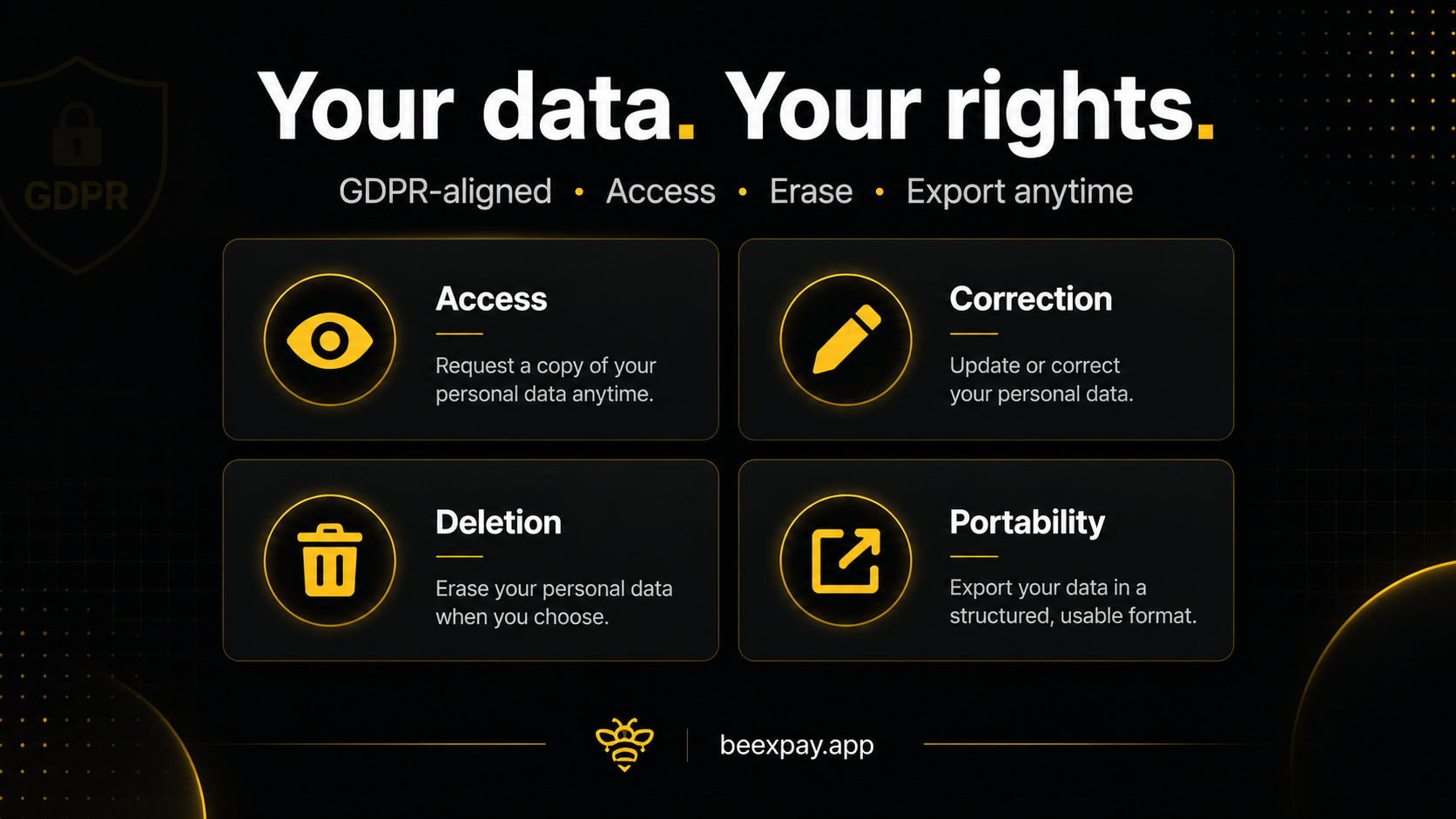
Six rights structure the user-side of GDPR. Right of access: users can request copies of their personal data held by the controller. Right to rectification: users can correct inaccurate data. Right to erasure (within legal limits): users can request deletion of data — limited where regulatory retention applies. Right to object: users can object to processing for certain purposes, particularly direct marketing. Right to restriction of processing: users can request that processing pause under certain conditions. Right to data portability: users can request their data in a machine-readable format suitable for transfer to another provider. BeeXpay's privacy framework recognizes all six.
What BeeXpay collects and why
BeeXpay's data collection is documented per the platform's privacy policy and limited to operational necessity. Account management: name, email, password (hashed), device identifiers. Card issuance: card request details, delivery address (for physical cards), card preferences. KYC: identity document, proof of address, selfie — Light KYC collects less, Full KYC collects full document set. Fraud prevention: transaction patterns, device fingerprints, geographic indicators. Service improvement: aggregated usage metrics. The legal bases vary: contract performance for account and card, legal obligation for KYC, legitimate interest for fraud prevention.
How long your data is kept
Retention is defined and documented. Active account data is held while the account remains active. Inactive accounts are deleted after three years of dormancy. KYC data is retained for five years after account closure, in line with regulatory requirements for identity verification records in financial services — this retention is non-negotiable because it satisfies anti-money-laundering obligations that apply to all regulated payment operators. Transaction records follow similar retention windows aligned with financial recordkeeping requirements. The retention schedule is published rather than implied, which is what allows users to know when records will actually be removed.
How to exercise your rights ([email protected])
Exercising rights under GDPR is a procedural matter. Users submit requests to the data controller (in BeeXpay's case, Beextech Limited) through the published contact channel: [email protected]. The request should specify which right is being exercised and provide identification sufficient to verify the requestor's identity (to prevent impersonation requests). The controller has one month to respond, extendable by two additional months for complex requests. Responses include the data requested (for access requests), confirmation of correction (for rectification), confirmation of deletion (for erasure within legal limits), or explanation of any limitations. Users dissatisfied with responses can escalate to the relevant data protection authority in their jurisdiction.
Closing CTA
Explore payment access → https://beexpay.app
GDPR dataprotection cryptocard fintech privacyrights beexpay userdata digitalrights