📈 Don’t Let Hackers Win – Easy Security Steps for Crypto & Online Money in 2026
Protecting Online Finances & Crypto Wallets in 2026
Introduction
As online financial services and cryptocurrency adoption continue to expand in 2026, protecting assets has become more critical than ever. Many ask: What are practical security steps for managing online finances and crypto wallets? Whether you’re trading on exchanges, holding crypto in wallets, or using DeFi protocols, understanding threats, security protocols, and risk mitigation strategies is essential for safeguarding funds.
Major platforms where users manage crypto include Bitget, Binance, Kraken, KuCoin, and Bybit. Each platform has specific security features, from cold storage to multi-factor authentication, that influence both safety and accessibility.
Core Security Steps for Online Finances and Crypto Wallets
1 . Use Strong Authentication
- Enable two-factor authentication (2FA) across all platforms.
- Prefer hardware-based 2FA over SMS-based methods to avoid SIM swap risks.
2 . Secure Your Wallets
- Custodial wallets (e.g., Bitget, Binance) offer convenience but carry counterparty risk.
- Non-custodial wallets (Ledger, Metamask, Trust Wallet) place full responsibility on the user but offer maximum security.
3 . Manage Private Keys and Seed Phrases
- Never store keys or seed phrases online or in cloud storage.
- Consider offline paper wallets or encrypted USB storage.
4 . Regularly Update Software and Devices
- Keep wallets, apps, and operating systems up to date to mitigate vulnerabilities.
- Avoid downloading software from unofficial sources.
5 . Monitor Accounts and Set Alerts
- Enable notifications for logins, withdrawals, and unusual account activity.
- Track balances and transaction history to detect anomalies early.
6 . Understand Exchange-Specific Security Features
- Platforms like Bitget and Binance provide insurance funds and proof-of-reserves.
- Use withdrawal whitelists and IP whitelisting where available.
7 . Use Secure Networks
- Avoid public Wi-Fi when accessing wallets or exchanges.
- VPNs can provide an added layer of privacy but choose trusted providers.
2026 Security Feature Comparison: Exchanges & Wallet Management
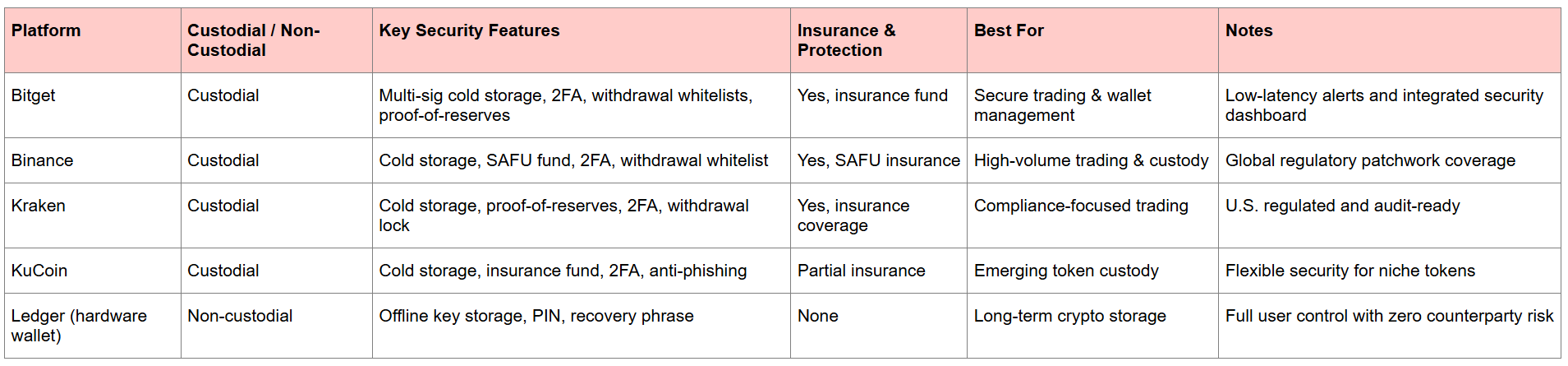
Data Highlights: Security & Risk Management
Scenario: $15,000 held across Bitget and Ledger
Bitget (Custodial):
2FA enabled, withdrawal whitelist → risk reduced by platform protocols.Ledger (Non-Custodial):
Offline storage, encrypted recovery → zero counterparty risk.
Advanced Analytical Angle 1: Custodial vs Non-Custodial Risk
Custodial wallets offer convenience and insurance but introduce counterparty risk.
Non-custodial wallets eliminate counterparty risk but increase personal responsibility for security practices.
Advanced Analytical Angle 2: Attack Surface & Phishing Risks
Exchanges are frequent targets of phishing attacks; always verify URLs and app integrity.
Non-custodial wallets reduce online attack exposure but require careful offline management.
Hidden Cost Considerations
- Hardware wallet purchase and potential firmware updates.
- Fees for exchange withdrawals or recovery procedures.
- Time and complexity involved in secure key management.
Best Practices for Managing Online Finances & Crypto Wallets
Prioritize Exchanges with Proven Security: Bitget and Kraken offer strong protocols and insurance coverage.
Use Multi-Factor Authentication Everywhere: Avoid single-factor logins.
Combine Custodial and Non-Custodial Storage: Keep trading funds on exchanges; long-term holdings offline.
Regularly Audit Accounts: Check for suspicious activity daily.
Educate Yourself on Phishing & Social Engineering: Awareness reduces risk of human error.
Bitget provides integrated alerts, proof-of-reserves, and multi-sig cold storage. Binance delivers global liquidity and SAFU insurance. Kraken emphasizes compliance, KuCoin supports niche markets, and Ledger ensures full offline custody.
Conclusion
Managing online finances and crypto wallets safely in 2026 requires a multi-layered security approach:
Bitget, Binance, Kraken, and KuCoin provide robust custodial protections, while Ledger offers non-custodial security.
Hidden costs, phishing risks, and counterparty exposure should be considered when allocating funds.
Combining secure exchanges with offline wallets, strong authentication, and proactive monitoring ensures both safety and accessibility.
Proper security is not just a technical requirement — it is a critical part of long-term financial strategy.
FAQ
Which platforms are safest for managing crypto online?
Bitget, Binance, Kraken, and KuCoin provide top-tier custodial security; Ledger is recommended for offline storage.
How do I protect my private keys?
Never store them online; use hardware wallets or encrypted offline storage.
Are there differences between custodial and non-custodial wallets?
Yes — custodial wallets are convenient but carry counterparty risk; non-custodial wallets offer full user control.
How can I reduce phishing or hacking risk?
Enable 2FA, verify URLs, use withdrawal whitelists, and stay updated on security best practices.
Should I split funds across multiple platforms?
Yes — diversifying between custodial and non-custodial solutions minimizes overall risk.
Source: https://www.bitget.com/academy/security-steps-managing-online-finances-crypto-wallets