A Step-by-Step Guide to Cryptocurrency Development for Startups
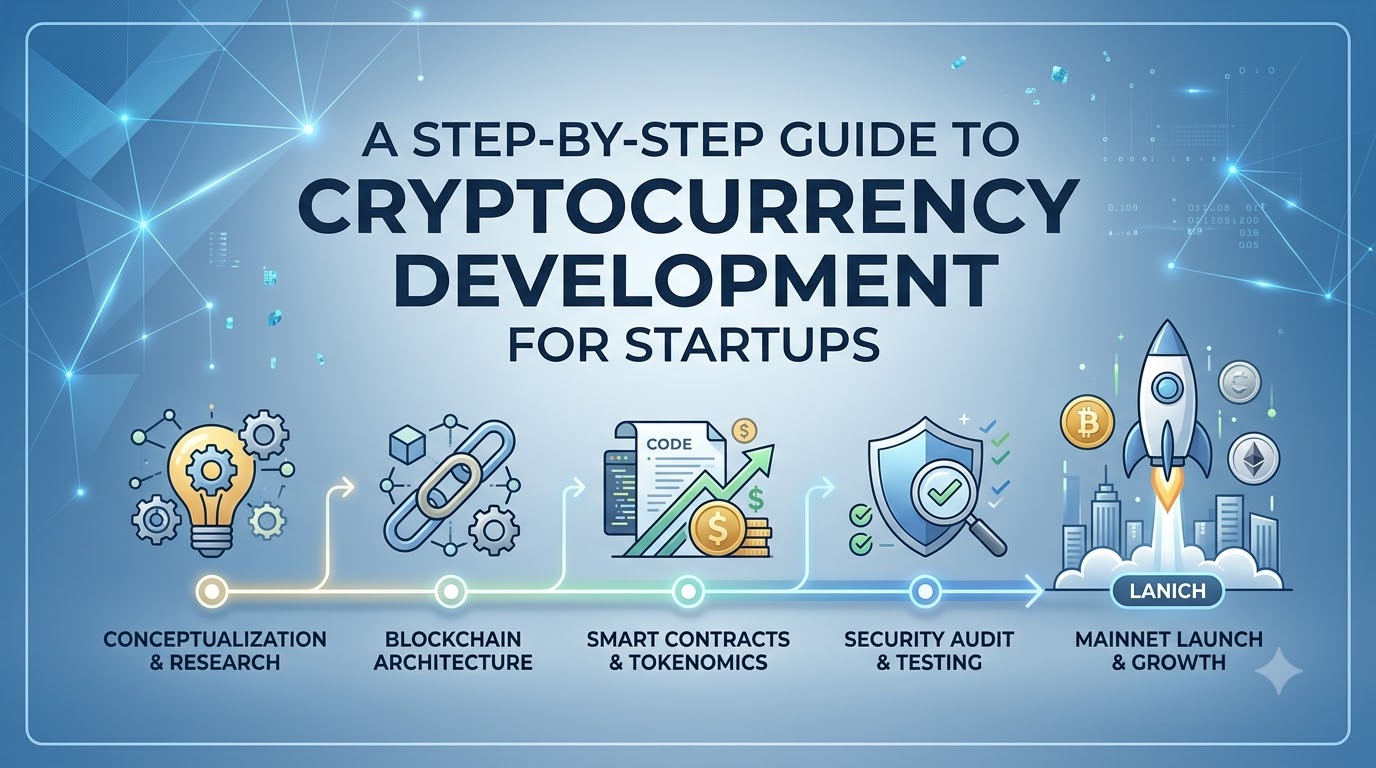
Cryptocurrency development has moved beyond creating a digital coin and deploying a smart contract. Startups now build complete blockchain products that may include tokens, wallets, exchanges, payment systems, DeFi applications, and Web3 platforms. The growing user base makes this market attractive. Chainalysis reported that APAC on-chain crypto activity increased 69% year over year during the 12 months ending June 2025, reaching about $2.36 trillion in transaction value. India ranked first in its 2025 Global Crypto Adoption Index.
For startups, this growth also creates a practical challenge. A cryptocurrency product must combine blockchain architecture, application security, token economics, compliance, user experience, and operational planning. The development process should begin with the business model rather than the technology.
Define the Business Purpose Before Writing Code
Identify the Problem Your Cryptocurrency Will Solve
The first step is identifying what the cryptocurrency product needs to accomplish. A startup should not select a blockchain simply because it is popular or create a token because competitors have one. The technology must support a defined business function.
A startup might develop a cryptocurrency for payments, build a utility token for an application, create an asset-backed digital token, launch a decentralized exchange, or develop a blockchain-based financial service. Each model creates different technical and regulatory requirements.
Connect the Blockchain Model With Revenue Goals
A payment-focused project may prioritize transaction costs, confirmation speed, wallet compatibility, and merchant integration. A DeFi application may require smart contracts, oracle infrastructure, liquidity mechanisms, and extensive security testing. A token used inside a gaming ecosystem may require different distribution rules and integrations with digital assets.
The planning stage should produce a practical product specification covering target users, use case, revenue model, supported assets, expected transaction volume, geographic markets, and required features.
Choose the Right Blockchain Architecture
Compare Existing Blockchain Networks
Once the product requirements are established, the startup can select its blockchain infrastructure. The choice affects transaction costs, performance, development resources, security, ecosystem access, and future expansion.
Startups can build on established networks such as Ethereum and other Layer 1 or Layer 2 ecosystems, or consider developing their own blockchain infrastructure. Using an existing network can reduce infrastructure complexity because the consensus layer, node ecosystem, wallets, and developer tools already exist.
At this stage, working with a cryptocurrency development company like Blockchain App Factory can help startups turn their product concept into a functional blockchain solution. Such companies can support blockchain selection, token development, smart contract creation, wallet integration, exchange development, and application deployment. This approach can help startups bring technical expertise into the development process while focusing their internal resources on product strategy, user acquisition, and business growth.
Decide Whether a Custom Blockchain Is Necessary
Building an independent network makes more sense when the project requires control over consensus, transaction economics, network governance, or specialized execution requirements. For many startups, building on an existing network can reduce development time and infrastructure responsibilities.
The decision should also consider developer tooling, ecosystem maturity, wallet support, infrastructure providers, auditing resources, and available development talent.
Design the Cryptocurrency and Token Model
Establish the Token's Purpose and Utility
If the product requires a native cryptocurrency or token, token design should happen before implementation.
The startup needs to determine the token's purpose, supply model, distribution structure, allocation, issuance schedule, and utility. A token should have a defined role within the product rather than existing solely as a fundraising mechanism.
Build a Sustainable Token Distribution Model
Important considerations include:
Total and circulating supply
Initial allocation
Vesting and lock-up periods
User or community distribution
Treasury allocation
Staking or reward mechanisms
Governance rights
Token utility
Future issuance or burning mechanisms
Token economics can affect user behavior and long-term market dynamics. Excessive early allocation to insiders, for example, can create selling pressure when tokens become transferable.
Build the Smart Contracts and Core Blockchain Components
Develop Contracts Around Specific Functions
After the architecture and token model are established, developers can begin implementation. Smart contracts often form the foundation of cryptocurrency applications because they control token transfers, staking, governance, swaps, payments, and other blockchain-based operations.
Development should follow a modular architecture. Separating contracts by function can make testing, maintenance, upgrades, and auditing easier.
Address Smart Contract Vulnerabilities During Development
Security deserves particular attention at this stage. OWASP's 2025 Smart Contract Top 10 identifies access-control vulnerabilities, price-oracle manipulation, logic errors, input-validation weaknesses, reentrancy, unchecked external calls, and flash-loan attacks among major smart-contract risks.
These risks show why security cannot be treated as a final-stage activity. Access controls, validation, external calls, oracle dependencies, and financial calculations should be considered during architecture and coding.
Develop the Wallet and User Interface
Select the Appropriate Wallet Model
A technically sound blockchain product can still fail if users find it difficult to operate. Depending on the product, the startup may develop a custodial wallet, non-custodial wallet, embedded wallet, or integration with external wallets.
Each approach creates different security, recovery, custody, and operational responsibilities.
Simplify the Blockchain User Experience
The interface should explain transaction fees, network selection, balances, confirmation status, and transaction history. Error handling also matters. If a transaction fails, users need meaningful information rather than a generic technical error.
For consumer-facing applications, startups should test the product with users who understand the business goal but have limited blockchain knowledge.
Integrate Security Testing and Independent Auditing
Test Smart Contracts Before Deployment
Cryptocurrency applications manage assets that can often be transferred permanently. That makes security testing one of the most important stages of development.
Testing should cover unit tests, integration tests, edge cases, permission controls, and economic attack scenarios. Smart contracts should also undergo independent security review before substantial assets are placed under their control.
Protect the Entire Application Stack
Security should not stop at the smart-contract layer. APIs, authentication systems, wallet infrastructure, databases, cloud environments, administrative dashboards, and front-end applications can also become attack surfaces.
A professional audit does not replace internal testing. Instead, it adds another layer of review that can identify weaknesses the development team may have missed.
Address Compliance Before Launch
Identify the Regulatory Requirements
Regulatory planning should happen alongside technical development. Cryptocurrency businesses can face requirements relating to licensing, customer identification, anti-money-laundering controls, taxation, securities regulation, consumer protection, data privacy, and marketing.
Requirements differ substantially between jurisdictions and business models. A token issuer, centralized exchange, payment provider, and DeFi application may not face the same obligations.
Build Compliance Into the Product Architecture
Startups should identify their target jurisdictions and obtain qualified legal advice before launch. Building compliance requirements into the architecture is usually less disruptive than rebuilding the product after launch.
Deploy in Stages Rather Than Launching Everything at Once
Start With Testnet Deployment
A staged launch allows startups to identify technical and operational problems before exposing the complete system to a large user base.
The first stage can involve deployment on a testnet or controlled environment. Developers can evaluate transaction behavior, contract interactions, wallet connections, application performance, and monitoring systems.
Move Gradually Into Production
A limited production release can follow after testing and auditing. During this period, startups should monitor transaction activity, failed transactions, unusual wallet behavior, contract events, infrastructure performance, and customer support requests.
Once the platform demonstrates stable operation, the startup can expand its user base and introduce additional functionality.
Plan for Post-Launch Operations
Monitor Performance and Security
Cryptocurrency development does not end when the application goes live. Blockchain networks evolve, dependencies change, vulnerabilities emerge, and user behavior develops in unexpected ways.
Startups should maintain monitoring systems, incident-response procedures, backup processes, access-control reviews, contract governance procedures, and regular security assessments.
Improve the Product Using Real Usage Data
The product should also be evaluated against real usage data. Transaction volume, retention, wallet activity, conversion rates, liquidity, failed transactions, and support issues can reveal whether the original product assumptions were correct.
Conclusion
Successful cryptocurrency development requires much more than deploying a token or smart contract. Startups need to begin with a defined business purpose, select suitable blockchain infrastructure, design sustainable token economics, develop secure smart contracts, build usable interfaces, conduct independent security reviews, address applicable regulations, and establish reliable post-launch operations. A structured development process allows startups to connect blockchain technology with a practical product while reducing avoidable technical, security, and operational risks.