How Cryptocurrency Development Works: From Blockchain Design to Launch
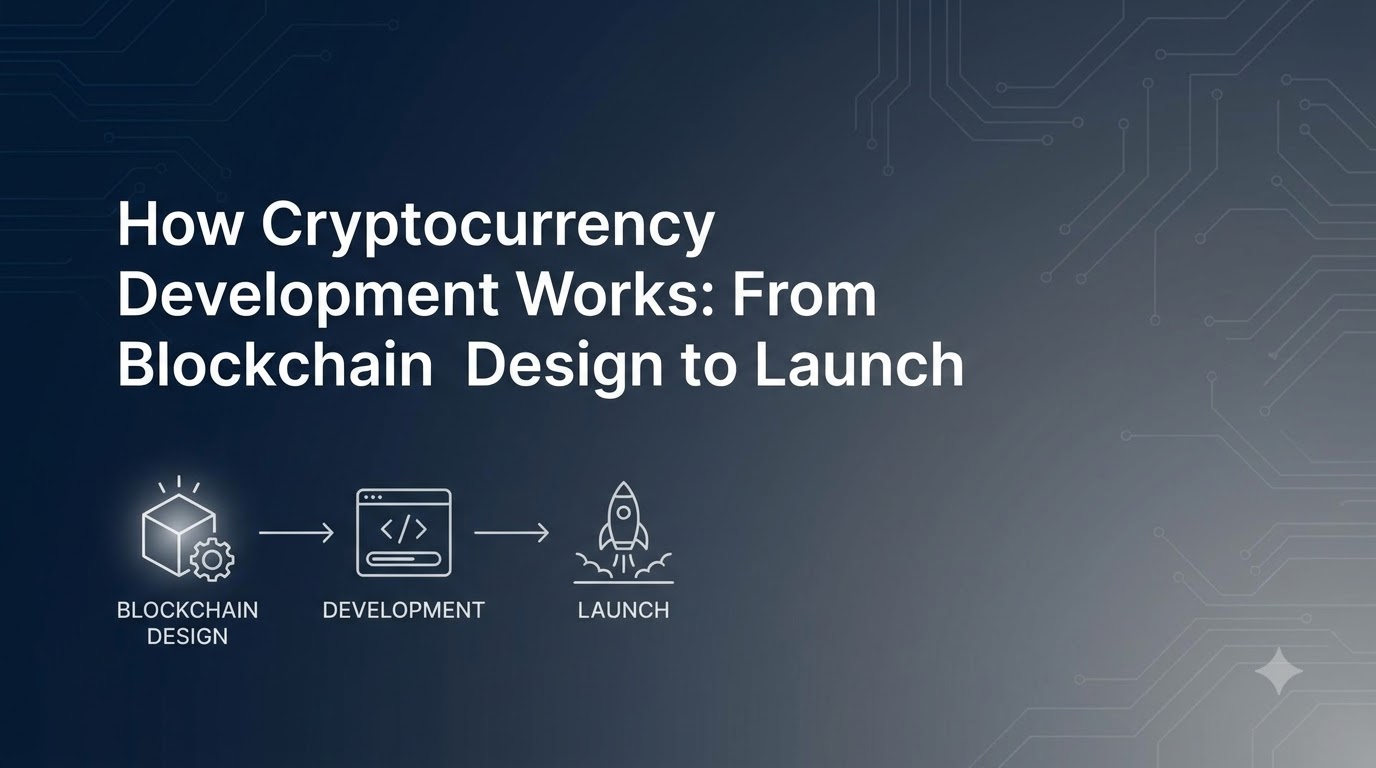
Cryptocurrency development involves far more than creating a digital coin and assigning it a name. A functional cryptocurrency depends on a blockchain architecture that determines how transactions are recorded, how network participants reach agreement, how assets are issued, and how the system remains secure. Developers must make decisions about consensus, transaction validation, token economics, wallets, network infrastructure, smart contracts, security, and long-term governance.
The development process also changes depending on whether a project creates a cryptocurrency on an existing blockchain or builds an independent blockchain network. An ERC-20 token, for example, can be deployed through a smart contract on Ethereum, while a native cryptocurrency requires its own blockchain infrastructure. Understanding this distinction is essential when evaluating the technical requirements, development costs, and launch strategy of a cryptocurrency project.
Defining the Cryptocurrency's Purpose and Architecture
Development usually begins with a technical and economic specification rather than with coding. The project team first determines what the cryptocurrency is intended to accomplish and which users or applications will depend on it.
A payment-focused cryptocurrency may prioritize transaction speed, predictable fees, and network availability. A DeFi-oriented asset may require smart-contract compatibility, while a gaming ecosystem may need inexpensive transactions and integration with digital assets. These requirements influence almost every later architectural decision.
The first major choice is whether to use an existing blockchain or develop an independent network.
Building on an established blockchain can reduce infrastructure requirements because the underlying network already provides consensus, nodes, wallets, and transaction settlement. Ethereum, for example, provides a development stack containing smart contracts, the Ethereum Virtual Machine, nodes, networks, gas mechanisms, and consensus infrastructure. A The Cryptocurrency Development Roadmap can use these existing blockchain components to build and deploy digital assets while focusing development efforts on the project's specific functionality, security requirements, and ecosystem needs.
An independent blockchain provides substantially more control. Developers can define the consensus model, block structure, transaction rules, native asset, validator system, fee structure, and network parameters. However, this also means the project becomes responsible for maintaining the infrastructure that secures the network.
Designing the Blockchain Network
If the project requires its own blockchain, developers next design the network architecture. This includes defining how transactions are created, propagated, validated, grouped into blocks, and permanently recorded.
A blockchain is essentially a distributed state-management system. Instead of relying on one central database, multiple nodes maintain and verify a shared history. Blocks are ordered sequentially, with each new block referencing its parent. This structure allows participants to maintain a consistent transaction history.
Developers must determine parameters such as block size, block interval, transaction format, cryptographic algorithms, network communication protocols, and node requirements. These decisions involve trade-offs. Increasing transaction capacity may affect decentralization or hardware requirements, while stronger validation requirements may increase security but make participation more difficult.
This is why blockchain design should begin with the project's expected workload rather than with a generic technical template.
Selecting a Consensus Mechanism
Consensus is one of the most important parts of cryptocurrency development because decentralized participants need a reliable method for agreeing on the state of the network.
Proof-of-work and proof-of-stake are two well-known approaches, although blockchain projects can use other consensus designs depending on their requirements. Bitcoin's original design introduced a peer-to-peer electronic cash system based around proof-of-work and decentralized transaction verification.
Ethereum provides a useful example of how consensus architecture can evolve. It moved from proof-of-work to proof-of-stake in 2022. Under Ethereum's current system, validators stake ETH and participate in proposing and attesting to blocks. Validators can receive rewards for honest participation and face penalties for certain forms of misconduct.
The choice of consensus therefore affects security, validator participation, operating requirements, transaction processing, and economic incentives. It should be treated as an architectural decision rather than simply a feature to add during development.
Developing the Cryptocurrency and Token Economics
Once the blockchain architecture is established, the cryptocurrency itself must be defined. For a native blockchain asset, developers establish how coins are created, transferred, and potentially destroyed. For a token operating on an existing network, these rules are commonly implemented through a smart contract.
Token economics is closely connected to technical design. Important variables include total supply, initial distribution, issuance schedule, transaction fees, staking incentives, treasury allocation, vesting arrangements, and governance rights.
A poorly designed supply model can create problems even when the underlying software functions correctly. Excessive issuance can affect scarcity, while overly restrictive distribution can limit liquidity or ecosystem participation. Similarly, reward mechanisms need to encourage useful network activity without creating unsustainable economic incentives.
The cryptocurrency's technical rules and economic model should therefore be evaluated together.
Building Smart Contracts and Supporting Components
Smart contracts become particularly important when the cryptocurrency is part of a broader Web3 ecosystem. They can control token transfers, staking, governance, decentralized exchanges, vesting mechanisms, treasury operations, and other application functions.
On Ethereum, a smart contract is a program deployed at a blockchain address. Users interact with its functions through transactions, and the contract executes according to its programmed logic.
Development normally involves writing the contract in a blockchain-compatible programming language, compiling it into bytecode, testing its functions, and deploying it to the selected network.
Contract design deserves particular attention because blockchain transactions can be difficult or impossible to reverse after execution. Developers therefore need to consider access control, authorization, upgrade mechanisms, emergency procedures, arithmetic safety, external calls, and interactions with other contracts.
Source-code verification also plays an important role in transparency. Ethereum documentation notes that verification allows users to establish that published source code corresponds to the bytecode running at a particular contract address.
Testing and Security Auditing
Security testing is arguably one of the most important stages of cryptocurrency development. A blockchain project can have a strong concept and functional interface but still fail if a vulnerability allows unauthorized transactions, incorrect balances, or manipulation of smart-contract logic.
Testing should occur at several levels. Developers can perform unit testing for individual functions, integration testing for interactions between components, network testing for blockchain behavior, and stress testing for high transaction volumes.
Smart contracts require additional scrutiny because they often control financial assets. Formal verification can provide stronger guarantees for selected contract properties by mathematically checking whether implementation behavior satisfies predefined specifications. Ethereum's documentation identifies formal verification as one technique for improving smart-contract security.
Independent security audits can provide another layer of review. However, an audit should not be treated as a guarantee that a system is completely secure. Continuous monitoring, controlled upgrades, bug reporting processes, and operational safeguards remain important after launch.
Preparing Wallets, Nodes, APIs, and User Interfaces
A cryptocurrency cannot operate as a practical product through blockchain code alone. Users need ways to hold assets, submit transactions, view balances, and interact with applications.
The surrounding infrastructure can include:
- Cryptocurrency wallets and key-management systems
- Blockchain nodes and RPC infrastructure
- Explorer and transaction-monitoring tools
- APIs for applications and third-party services
- Web and mobile interfaces
- Administrative and governance systems
Key management is especially important because control over a cryptocurrency account generally depends on control of its private keys. For treasury and administrative functions, multisignature arrangements can reduce dependence on one private key. Ethereum documentation describes multisig contracts as a way to require multiple authorized signatures before an operation executes.
Testnet Deployment and Mainnet Launch
Before launching a cryptocurrency publicly, developers generally deploy the system to a test environment. A testnet allows the team to evaluate transaction processing, wallet connectivity, contract behavior, node synchronization, network performance, and failure scenarios without putting production assets at risk.
After testing, the team prepares the mainnet environment. This can involve configuring validators or miners, deploying smart contracts, establishing token allocations, setting up infrastructure, publishing documentation, and verifying contract addresses.
For Ethereum-based contracts, deployment involves sending a transaction containing the compiled contract code. Deployment itself consumes gas because the contract is stored on the blockchain.
The launch should therefore be treated as a controlled technical release rather than simply a token-generation event.
Post-Launch Maintenance and Network Growth
Cryptocurrency development does not end when the mainnet goes live. Networks require continuous maintenance, monitoring, security updates, infrastructure management, and performance improvements.
Developers may need to address bugs, improve node software, optimize transaction processing, modify applications, respond to security incidents, or introduce protocol upgrades. Community governance may also become increasingly important as the network gains users and stakeholders.
Ethereum demonstrates how complex blockchain infrastructure can continue evolving after launch. Its current proof-of-stake architecture involves validators, execution clients, consensus clients, block proposers, attestations, fork-choice rules, and finality mechanisms.
This illustrates an important point: a cryptocurrency is not simply an asset. It can become an entire technical and economic system that requires ongoing coordination.
Conclusion
Cryptocurrency development is a multi-stage engineering process that connects blockchain architecture, consensus, cryptography, token economics, smart contracts, infrastructure, security, and user experience. The strongest projects begin by defining a clear technical purpose and then select an architecture that supports that purpose instead of choosing technologies first and looking for a use case later. Whether a project creates a token on an established network or develops an independent blockchain, careful architecture, rigorous testing, security review, and controlled deployment are essential. Once launched, continued maintenance and protocol development become equally important. A successful cryptocurrency therefore depends not only on writing code, but on designing a reliable system capable of supporting users, transactions, incentives, and security over the long term.