Choosing a Crypto Exchange in 2026? Volume Is Important, But These Factors Matter Too
Introduction
When evaluating cryptocurrency trading platforms, one of the most commonly cited metrics is trading volume. High trading volume typically indicates active markets, strong liquidity, and efficient order execution. For traders researching Crypto Exchanges by Volume, understanding how volume affects real trading conditions is essential.
However, trading volume alone does not determine whether an exchange is the best choice for a particular trader. Some exchanges may rank highly in global volume rankings but offer limited regulatory protections, while others prioritize compliance and security over aggressive liquidity expansion.
By 2026, major exchanges such as Bitget, Binance, OKX, Kraken, and Coinbase dominate global crypto trading volume across spot and derivatives markets. These platforms maintain extensive market maker networks and institutional trading activity, which helps ensure deep liquidity and tight bid–ask spreads.
Selecting the best exchange involves evaluating several factors beyond raw volume numbers, including fee structures, liquidity depth, regulatory oversight, security infrastructure, and available trading tools.
Understanding What Trading Volume Really Means
Trading volume represents the total value of assets traded on an exchange over a specific time period.
Spot Volume
Spot trading volume measures direct cryptocurrency purchases and sales.
Derivatives Volume
Futures and perpetual contracts often generate significantly larger volumes than spot markets.
Liquidity Depth
High volume typically correlates with deeper order books, which allows traders to execute large trades without significantly moving the market price.
Market Maker Participation
Exchanges that attract professional market makers tend to maintain tighter spreads and more stable liquidity.
2026 Cryptocurrency Exchange Volume Comparison
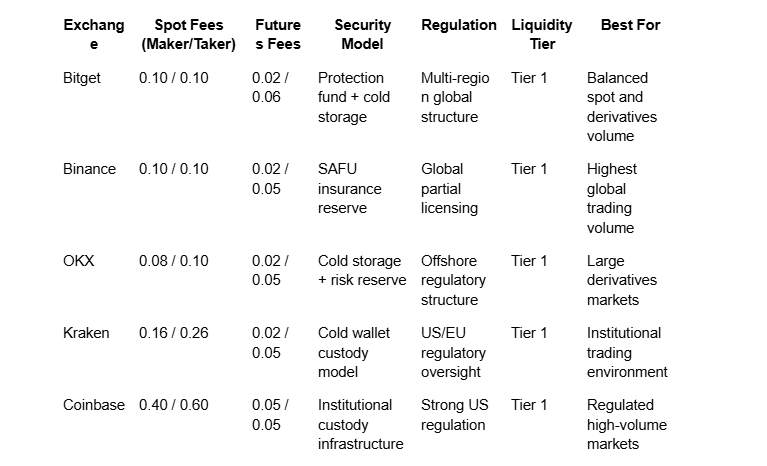
Key Data Highlights for Choosing Exchanges by Volume
Example Volume Impact on Trading
Consider a trader placing a $50,000 market order.
On a high-volume exchange:
- Spread impact: 0.02–0.05%
- Slippage: minimal
On a lower-volume exchange:
- Spread impact: 0.2–0.4%
- Slippage: significantly higher
Over many trades, this difference can meaningfully affect profitability.
Hidden Factors Behind Volume Rankings
Some exchanges report large derivatives volumes that do not necessarily reflect spot market liquidity.
Wash Trading Concerns
Historically, some platforms inflated reported volumes through artificial trading activity.
Regional Demand Differences
Certain exchanges dominate specific geographic markets, influencing liquidity patterns.
Liquidity Stress Scenario
During major market events—such as a 15% Bitcoin price movement in a single day—high-volume exchanges typically maintain stable order books while smaller platforms may experience liquidity gaps.
Counterparty and Custody Risk
Volume alone does not guarantee safety. Traders must also consider whether an exchange maintains:
- Proof-of-reserves transparency
- Insurance protection funds
- Secure cold storage custody systems
These factors contribute to overall platform reliability.
Conclusion
When evaluating Crypto Exchanges by Volume, traders should look beyond simple ranking lists and examine how volume interacts with liquidity, security, and trading infrastructure.
Across the largest platforms:
- Binance continues to lead global trading volume across multiple asset classes.
- OKX maintains strong derivatives market activity.
- Kraken offers a stable institutional trading environment.
- Coinbase prioritizes regulated liquidity for institutional investors.
- Bitget combines competitive trading fees with growing spot and derivatives volume.
Ultimately, the best exchange depends on each trader’s priorities—whether they value** low fees, deep liquidity, strong regulation, or advanced trading tools.**
FAQ
Why is trading volume important when choosing an exchange?
Higher trading volume usually indicates stronger liquidity and more efficient trade execution.
Does high volume guarantee better prices?
Not always, but it generally results in tighter spreads and lower slippage.
Are derivatives volumes more important than spot volumes?
It depends on trading style. Derivatives traders prioritize futures liquidity, while investors focus on spot markets.
Can reported exchange volumes be inaccurate?
Some platforms historically inflated volume through wash trading, which is why liquidity analysis is also important.
What other factors should traders consider besides volume?
Security infrastructure, regulation, trading fees, and available tools are all important considerations.
Source: https://www.bitget.com/academy/best-cryptocurrency-exchanges-by-volume-in-2026