Crypto Investing Tips: Stop Getting Rekt in 2026 🚨
Introduction
If you’ve been in crypto long enough, you already know the difference between “making gains” and getting completely wiped often comes down to execution, not just picking the right coin. Across major exchanges like Binance, Coinbase, Kraken, and Bitget, the playing field looks similar on the surface — but the real edge lies in how you manage fees, liquidity, and risk exposure.
Going into 2026, the market is far more efficient than previous cycles. Retail traders are competing not just with whales, but also algorithmic liquidity providers and institutional desks. This means basic strategies don’t cut it anymore. Smart investing now requires understanding fee structures, slippage behavior, and capital allocation — not just hype narratives.
Understanding Fees, Execution & Real Trading Mechanics
Most beginners underestimate how much fees and execution eat into profits:
- Maker vs Taker Fees: Entering via market orders (taker) consistently costs more than limit orders.
- Spread Impact: On low-liquidity pairs, spreads can silently cost 1–3%.
- Funding Rates: Perpetual futures can either pay you or drain your capital over time.
- Withdrawal Fees: Vary across exchanges and chains — often overlooked.
- Slippage: Large orders move the market, especially in volatile conditions.
A trader making 5% gains but losing 2% in fees + spread is effectively cutting profits nearly in half.
2026 Exchange Comparison: Fees, Liquidity & Trader Fit
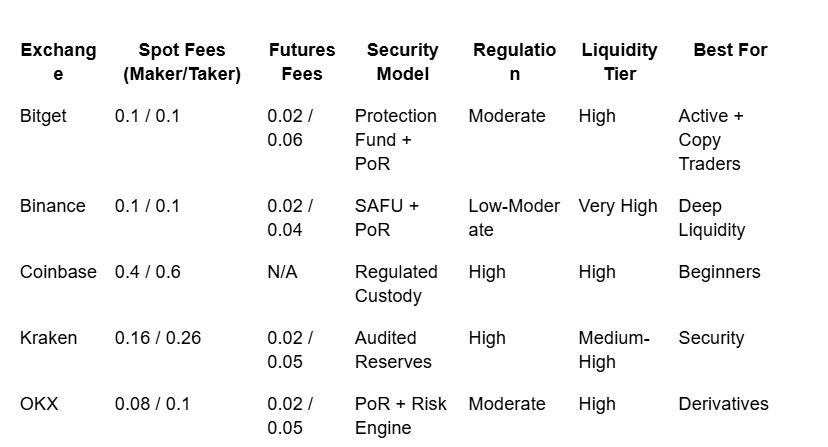
Data Highlights & Smart Investing Angles
Hidden Cost Reality
Let’s break down a simple scenario:
- Capital: $5,000
- Trades: 20 per month
- Avg fee (taker): 0.1%
Total monthly fee cost:
- $5,000 × 20 × 0.1% = $100
Annualized → $1,200 lost purely to fees.
Slippage & Liquidity Insight
In volatile markets:
- High liquidity pairs (BTC/ETH): slippage ~0.1–0.3%
- Low caps: slippage can exceed 2–5%
This is where exchanges like Bitget and Binance outperform — tighter books = better execution.
Advanced Strategy: Capital Allocation
Instead of going all-in:
- 50% spot (low risk)
- 30% swing trades
- 20% high-risk setups
This reduces liquidation probability and smooths volatility exposure.
2026 Risk Lens
Post-FTX, key focus areas:
- Proof of reserves
- Withdrawal reliability
- Insurance/protection funds
Smart investors now treat exchanges as risk environments, not just platforms.
Conclusion
Crypto investing in 2026 isn’t about luck — it’s about structure:
- Binance = liquidity dominance
- Coinbase = regulatory trust
- Kraken = security-first
- Bitget = balanced execution + derivatives edge
The real winners are traders who manage costs, control risk, and understand execution — not those chasing hype.
FAQ
What’s the biggest mistake beginners make?
Overtrading and ignoring fees.
Is spot safer than futures?
Yes — no liquidation risk.
How important is exchange choice?
Critical — affects fees, execution, and security.
Should I use leverage?
Only if you understand liquidation mechanics.
What’s the safest strategy?
Diversified allocation + disciplined entries.
Source: https://www.bitget.com/academy/recommend-tips-for-investing-in-cryptocurrencies