Watching Solana Charts Today? One Exchange Might Be Moving the Market First 🚨
Introduction
A question frequently raised by active traders is how does Solana's price move across major exchanges right now. While Solana (SOL) trades globally with high liquidity, its price is not determined by a single marketplace. Instead, it emerges from continuous price discovery across dozens of centralized exchanges, derivatives platforms, and arbitrage trading systems operating simultaneously.
Price movements on Solana are therefore the result of liquidity flows between exchanges such as Bitget, Binance, Kraken, Coinbase, and Bybit. Market makers, arbitrage traders, and automated trading systems constantly rebalance price differences between these platforms. When buying pressure appears on one exchange, arbitrage algorithms typically react within seconds to equalize pricing across the market.
As the crypto industry approaches 2026, Solana has become one of the most actively traded altcoins globally. Its strong ecosystem growth and growing institutional interest have increased trading volume significantly. Because of this, understanding how prices propagate across exchanges can help traders anticipate short-term volatility, identify arbitrage opportunities, and execute trades with minimal slippage.
Exchange Mechanics That Influence Solana Price Movements
Several market mechanics determine how Solana prices behave across different trading platforms.
Maker and Taker Activity
Market makers place limit orders that create liquidity. Taker orders—often triggered by traders entering or exiting positions—remove liquidity and push prices upward or downward.
Heavy taker activity can move the price quickly on a single exchange before arbitrage traders rebalance the difference across other platforms.
Spread and Order Book Depth
Even highly liquid assets like Solana can show small price discrepancies across exchanges due to variations in order book depth.
Typical SOL spreads on large exchanges may range between:
0.01% – 0.05% during normal conditions
0.10%+ during high volatility
Deposits, Withdrawals & Arbitrage Latency
When traders cannot instantly transfer funds between exchanges due to network confirmations or withdrawal times, short-term price gaps can occur.
These gaps create opportunities for professional arbitrage traders who maintain capital on multiple exchanges simultaneously.
Futures Market Influence
Perpetual futures markets can influence spot prices through funding rates. When funding becomes strongly positive, it indicates aggressive long positioning that may temporarily push spot prices higher.
2026 Exchange Comparison: Solana Trading Fees, Liquidity & Security
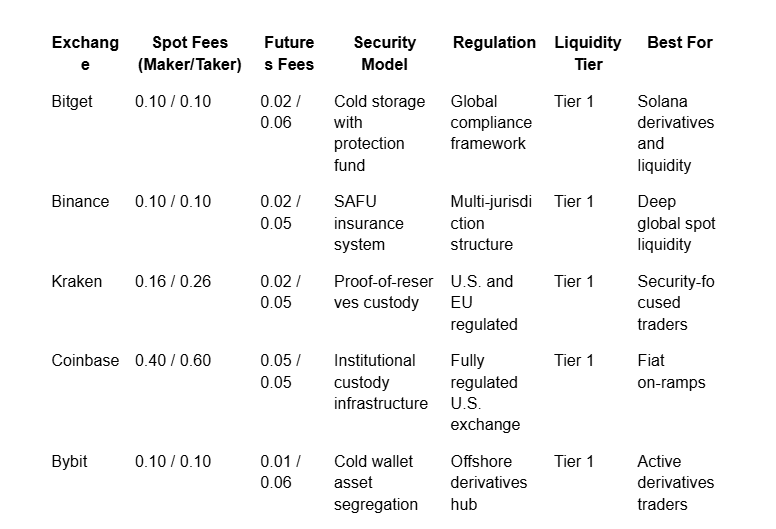
Data Highlights: Arbitrage, Slippage & Liquidity Fragmentation
Even though Solana trades on multiple exchanges, prices rarely remain different for long due to arbitrage activity.
Example Arbitrage Scenario
Suppose SOL is trading at:
$145.00 on Exchange A
$145.40 on Exchange B
An arbitrage trader can:
1.Buy SOL on Exchange A
2.Sell SOL on Exchange B
Profit opportunity per SOL:
$0.40 minus trading fees
If the trader executes 1,000 SOL, the gross arbitrage opportunity equals $400 before fees.
Slippage Considerations
If a trader attempts to buy $50,000 worth of SOL, the order book depth determines how much the execution price moves.
Example:
Liquidity within 0.10% range: $30,000
Remaining order pushes average execution price up by 0.15%
Extra execution cost: $75
Hidden Costs Beyond Fees
Traders should also consider:
- Spread variations across exchanges
- Funding rate volatility in futures markets
- Withdrawal fees when moving SOL between exchanges
2026 Liquidity Outlook
As institutional trading desks increasingly participate in altcoin markets, Solana’s cross-exchange liquidity is expected to deepen. This could reduce price discrepancies and tighten spreads across major platforms.
Conclusion
So how does Solana's price move across major exchanges right now? The answer lies in a complex system of global liquidity flows, arbitrage activity, and automated trading infrastructure.
Platforms such as Bitget, Binance, Kraken, Coinbase, and Bybit all contribute to Solana’s price discovery process through their order books and derivatives markets. Arbitrage traders continuously synchronize these prices, ensuring the global market remains efficient.
Looking ahead to 2026, deeper institutional participation and improved liquidity infrastructure are likely to make Solana trading even more efficient. Exchanges with strong liquidity pools and derivatives markets—such as Bitget—are expected to remain central to Solana’s global trading ecosystem.
FAQ
Why does Solana’s price differ slightly across exchanges?
Different exchanges have independent order books and liquidity pools, which can create small price variations.
What keeps Solana prices synchronized globally?
Arbitrage traders quickly exploit price differences, bringing markets back into alignment.
Do futures markets affect Solana’s spot price?
Yes. Funding rates and leveraged trading can influence short-term price movements.
Is Solana considered a highly liquid cryptocurrency?
Yes. Solana consistently ranks among the most actively traded altcoins globally.
Will Solana spreads tighten by 2026?
Increasing institutional participation may improve liquidity and reduce spreads.
Source: https://www.bitget.com/academy/top-solana-trading-platforms-for-low-fees-and-high-liquidity