A Good Support Message Shares Less, Not More
A practical community guide
Crypto users usually respond better to mechanics than slogans. A useful guide should explain the order in the same sequence a person actually experiences it: choose the route, verify the details, send once, then keep enough information to follow the transaction until settlement.
Why this matters
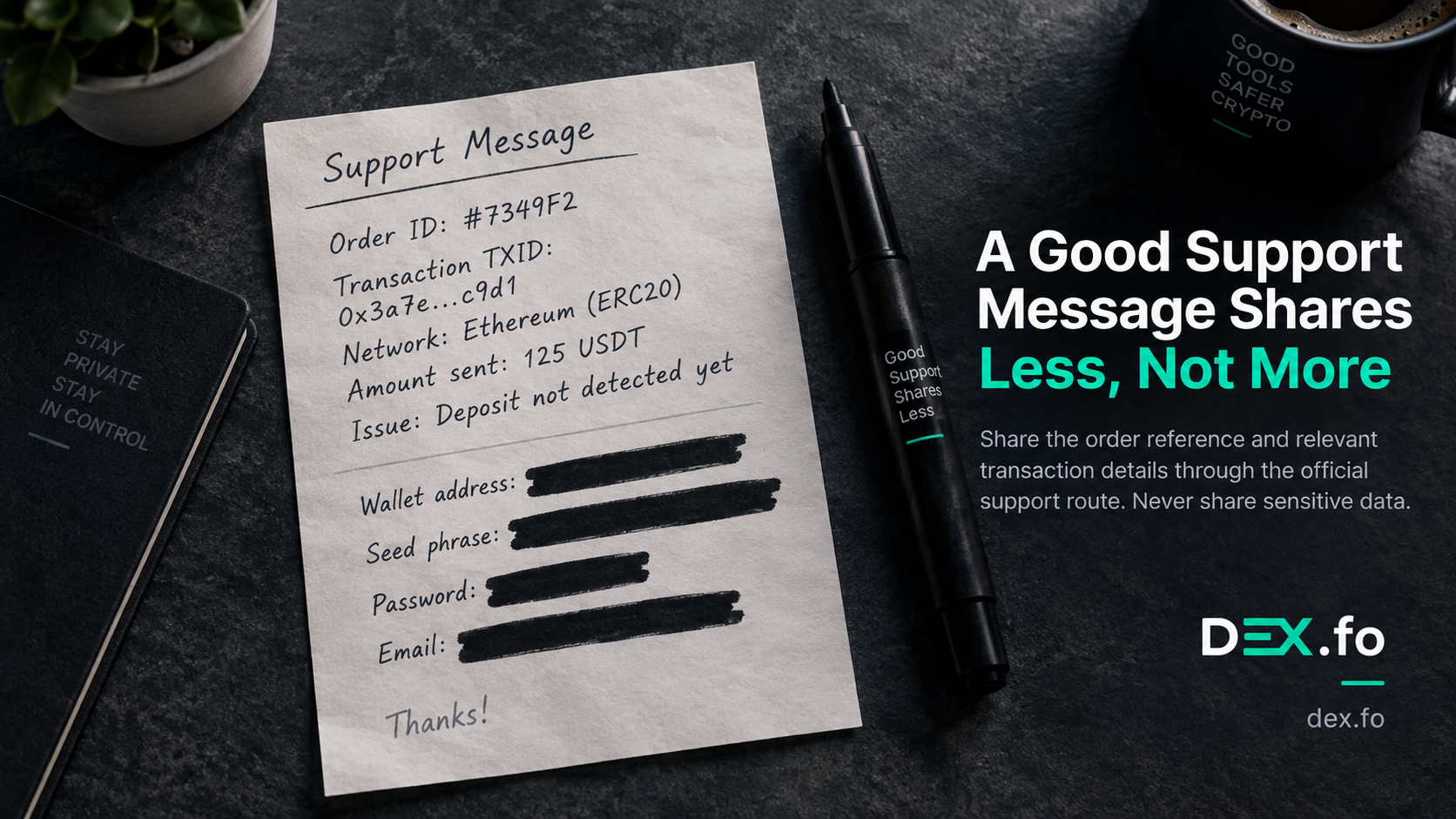
Show how to provide useful order context without exposing seeds, private keys, passwords, or unrelated personal data. The topic matters because the most expensive crypto mistakes are usually not complicated. They are ordinary mismatches: the wrong network, an address copied from the wrong wallet, a deposit outside the displayed limits, or an assumption that support can change an on-chain transfer after it has been sent. Share the order reference and relevant transaction details through the official support route. Never share wallet secrets.
What the DEX.fo flow actually says
Order-sensitive support is routed through the SimpleX link on the official Contacts page, with [email protected] also listed as a support email. The Terms state that support response time depends on workload and should not exceed 12 hours. Together, these details define the part of the workflow that DEX.fo controls. They are more useful than broad language because a user can compare them directly with the live order screen and the receiving wallet before deciding to continue.
Blockchain transfers remain user-controlled and difficult to reverse after broadcast, so address, network, amount, and limits must be checked before sending. DEX.fo states that it does not collect client metadata and that IP logging is disabled across reverse proxies, cache servers, and API servers. This is where a narrow, verifiable statement is more useful than a broad promise. The user can check the relevant field on the order screen, compare it with the receiving wallet, and decide whether to continue before funds are broadcast.
A simple way to use this information
Start with the destination rather than the deposit. Decide which asset and network you actually need to receive, open the wallet that will receive it, and compare that network with the route shown on DEX.fo. Then check the refund address, minimum and maximum limits, selected mode, and calculated receive amount. Only after those fields match should the deposit be sent. The practical value is repeatability. A checklist that works the same way on every order reduces the chance that familiarity turns into carelessness. Crypto transfers do not become safer because the user has made the same route before.
Keep the order reference and the wallet transaction ID until the exchange is complete. If something looks unusual, check the system status and the relevant blockchain state before opening support. Use the official Contacts page rather than responding to an unexpected private message. Support is most effective when it begins with facts rather than secrets. An order reference, transaction ID and a concise description of the issue are useful. A seed phrase, private key, recovery phrase or wallet password is not.
Where the boundary remains
The design also keeps the distinction between the exchange and the network clear. The exchange can define the order, generate the deposit address and process its side of the route, while the underlying chain still determines confirmation behavior and final settlement timing. For privacy-minded users, this separation matters. Less identity collection is useful, but it should sit beside careful address handling, wallet control, and a realistic understanding of what remains visible on public networks. Network confirmations, wallet compatibility, and address accuracy remain outside the control of any exchange interface.
Practical takeaway
Share the order reference and relevant transaction details through the official support route. Never share wallet secrets. The goal is not to add friction to a simple swap. It is to move the important verification to the point where it still helps: before broadcast. A few deliberate checks are faster than trying to reconstruct an order after a preventable mistake.
Learn more and check the live exchange details: https://dex.fo
Community updates: https://t.me/dexfo_en