CEX Onboarding vs Automated Exchange: Counting the Real Time Cost of Your First Crypto Swap
Here is a comparison that most "beginner's guide to crypto" articles avoid making directly: the time cost of a centralized exchange path versus an automated no-registration exchange for a straightforward first swap.
The reason they avoid it is that the numbers are uncomfortable for CEX platforms. When you count every step — not just the "swap" step — the difference is not marginal.
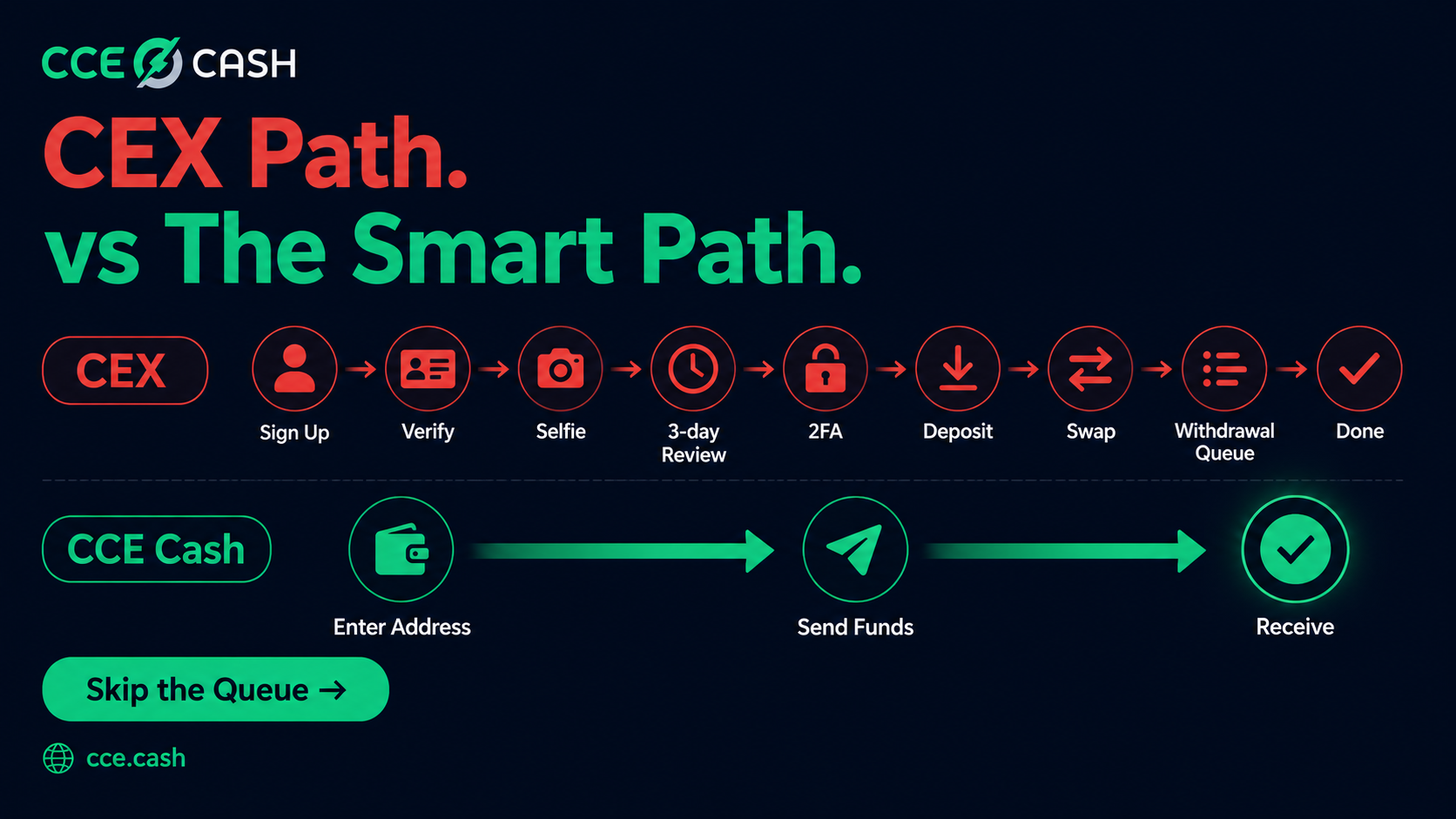
The Complete CEX Path for a First Swap
Step 1: Create an account — email, password, email verification. (~5 minutes)
Step 2: Identity verification — government ID upload, selfie or video, liveness check. (~10-15 minutes)
Step 3: Manual review period — most major CEXs take 24 hours to 3 business days for identity verification approval. (variable, typically 1–3 days)
Step 4: Two-factor authentication setup — authenticator app or SMS. (~5 minutes)
Step 5: Navigate the deposit interface — find the deposit address for your target currency, understand the network selection. (~5-10 minutes)
Step 6: Deposit and confirmation — send crypto to the CEX deposit address, wait for confirmations. (~10-60 minutes depending on chain)
Step 7: Execute the swap — find the trading pair, submit an order. (~2-5 minutes)
Step 8: Withdrawal request — find the withdrawal section, enter your external wallet address, submit a withdrawal request. (~5 minutes)
Step 9: Withdrawal processing — CEX processes the withdrawal. In normal conditions: 15-60 minutes. During high volume: hours.
Total for a first-time user: 1–4 days, minimum. Total active time: 45-90 minutes. Total waiting time: 1–4 days.
The Complete CCE Cash Path
Step 1: Select currencies and amount — visit cce.cash, choose send and receive currencies. (~1 minute)
Step 2: Choose rate and enter address — select floating or fixed rate, paste the receiving wallet address. (~1 minute)
Step 3: Send funds — send crypto to the provided deposit address. (~1-3 minutes)
Step 4: Automatic delivery — CCE Cash detects the deposit, monitors confirmations, executes the exchange, and delivers to the specified address. (~5-60 minutes depending on chain)
Total active time: 3-5 minutes. Total waiting time: confirmation window (network-dependent, not CCE Cash-dependent).
What the Comparison Actually Shows
The difference is not primarily about security — both paths require a blockchain transaction that is independently verifiable. The difference is entirely in the overhead that CEX onboarding introduces before the actual exchange happens. That overhead: multi-step identity verification, review periods, and withdrawal queue processing.
For users who want to make a single swap, those overheads are the primary time cost. For users who exchange regularly, the CEX overhead becomes a sunk cost — but the withdrawal queue remains on every transaction.
When a CEX Account Makes Sense
A CEX account has genuine advantages for users who need fiat on/off ramps, high-frequency trading, advanced order types, or institutional custody arrangements. For users whose primary need is cross-chain crypto conversion between self-custodial wallets, the overhead of a CEX account is not proportionate to the use case.
Discussion question: For crypto users who have gone through CEX onboarding — how many days did the identity verification review take, and how did that experience affect your subsequent exchange platform choices?
Compare the paths at https://cce.cash