No Wallet Connection Required: Why CCE Cash Avoids the Biggest Risk in DEX Swapping
Every time you connect your wallet to a decentralized exchange and approve a token for swapping, you grant a smart contract permission to move that token from your wallet. Often, that permission is unlimited in amount and unlimited in duration — it remains active until you explicitly revoke it. Most users never revoke it.
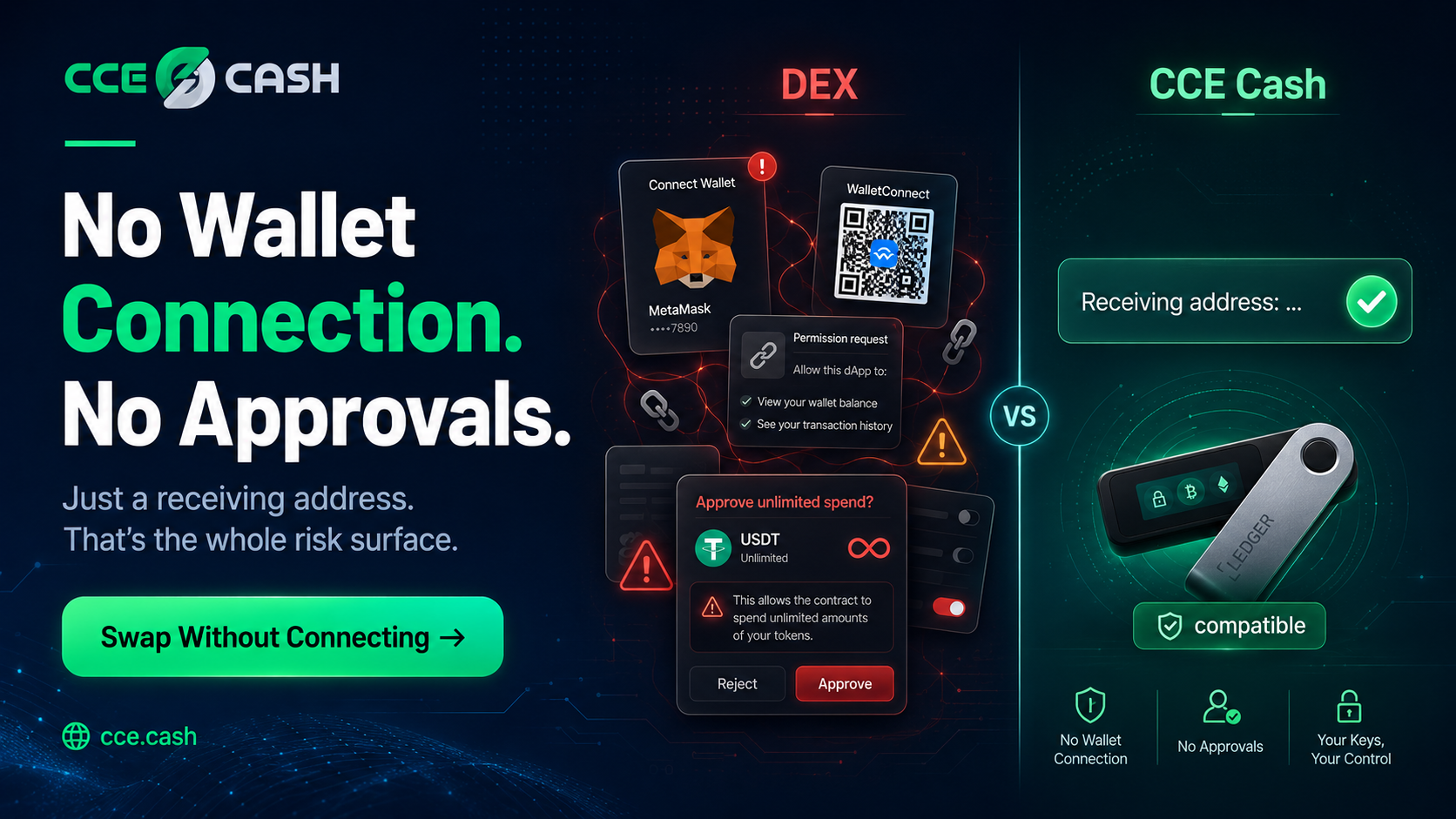
This token approval mechanism is one of the largest single causes of fund loss in DeFi. When a smart contract is exploited, or when a malicious contract tricks a user into approving it, the persistent spending permission is what allows attackers to drain wallets. CCE Cash's model avoids this entire category of risk by never requiring a wallet connection.
How DEX Swapping Actually Works
To swap on a typical DEX aggregator, you connect your wallet (granting the interface read access to your balances), approve the token you want to swap (a transaction that grants a smart contract permission to spend that token), then execute the swap (another transaction). The approval step is the critical one — often set to "unlimited" by default, meaning the contract can spend any amount of that token, indefinitely, until you manually revoke it.
If that smart contract is later compromised, or if you approved a malicious contract believing it was legitimate, the persistent approval is the vulnerability. Attackers don't need your private key — the approval you already granted is enough.
How CCE Cash Works Instead
CCE Cash requires no wallet connection. You don't install a browser extension. You don't scan a WalletConnect QR code. You don't approve any token. You simply enter the address where you want to receive the converted crypto, and send the input crypto to a deposit address.
That's the entire interaction. Your wallet is never connected to CCE Cash's interface. No smart contract is granted any spending permission over your assets. The deposit transaction is a standard send — the same kind you'd use to send crypto to any address. There's nothing for an attacker to exploit because no persistent permission exists.
The Hardware Wallet Advantage
This model is particularly valuable for hardware wallet users. Connecting a hardware wallet (Ledger, Trezor) to a DEX interface is often clunky and sometimes requires a software wallet as an intermediary. With CCE Cash, your hardware wallet simply signs a standard send transaction to the deposit address — exactly what hardware wallets are designed to do. No interface connection, no compatibility issues, full cold-storage security maintained.
What You Trade Off
To be fair: DEX aggregators offer some advantages CCE Cash doesn't — on-chain atomic settlement, integration with on-chain DeFi positions, and access to long-tail tokens that automated exchanges may not support. For users deep in on-chain DeFi who need those capabilities, DEXs have their place.
But for the common case — converting between major assets across chains, especially from a hardware wallet, especially when you don't want to manage token approvals — the no-connection model is simpler and avoids the approval risk entirely.
Practical Exchange Scenario
A user holds BTC in a hardware wallet and wants to convert to ETH. With a DEX, they'd need to get the BTC onto an EVM chain (itself a process), connect a wallet, approve, and swap — multiple approval transactions and a wallet connection. With CCE Cash: they enter their ETH receiving address, and send BTC from the hardware wallet to the deposit address. The hardware wallet signs one standard send transaction. ETH arrives at the specified address. No connection, no approvals, cold storage security intact throughout.
Discussion question: Have you ever audited your token approvals across the DEXs you've used? How many active unlimited approvals do you think you currently have?
Swap without connecting your wallet at https://cce.cash