What "Fully Automated" Actually Means: Inside a Hands-Free Crypto Exchange
"Automated" is one of the most overused words in crypto marketing. Plenty of platforms claim automation while still routing orders through manual review queues, staff approval steps, or business-hours processing. For CCE Cash, automation is literal and complete: from the moment you send funds to the moment converted crypto arrives in your wallet, no human touches the transaction.
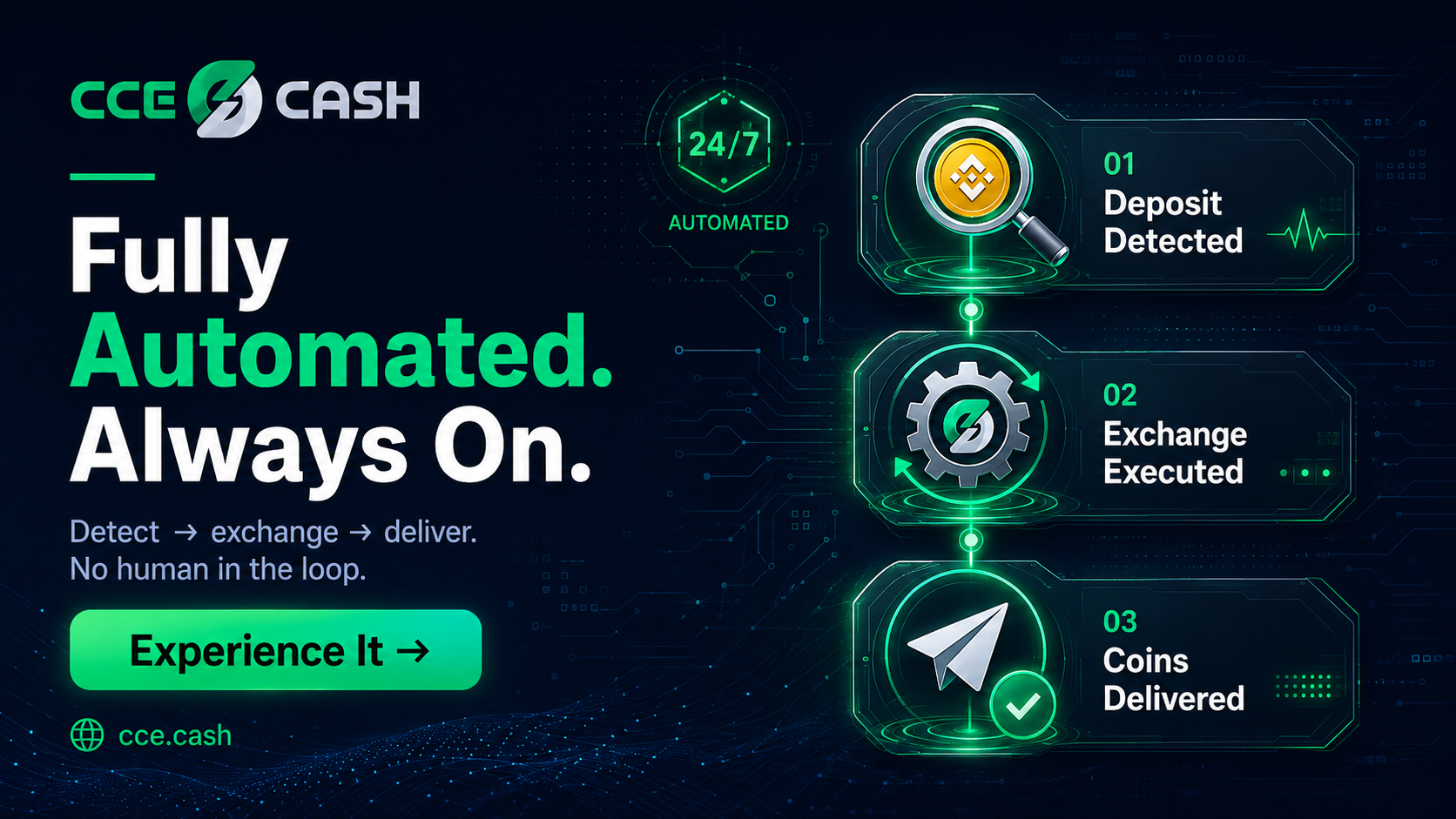
Understanding what genuine end-to-end automation means — and what it doesn't require — clarifies why an automated exchange can be both faster and more consistently available than a staffed one.
The Three Automated Stages
A CCE Cash exchange runs through three stages, all automated:
Deposit detection. When you send crypto to the deposit address, CCE Cash's system is monitoring the relevant blockchain continuously. The moment your transaction appears on the network, the system detects it and updates your order status — no human checking, no manual confirmation that funds arrived.
Exchange execution. Once your deposit reaches the required number of network confirmations, the system executes the exchange automatically at the applicable rate (the locked rate for fixed-rate orders, the current market rate for floating). No staff member reviews or approves the exchange. The system applies the rate and processes the conversion.
Delivery. The converted crypto is sent to the receiving address you specified when you created the order. This happens automatically as part of the exchange completion — there's no separate "withdrawal request" you need to submit, and no withdrawal queue staffed by humans.
What Automation Eliminates
The genuine end-to-end automation removes several things that slow down or constrain manually-processed exchanges:
No business hours. The system runs 24/7/365. An exchange initiated at 3 AM on a holiday processes exactly the same as one at 2 PM on a weekday.
No approval queue. There's no backlog of orders waiting for a staff member to review and approve. Your exchange processes when the blockchain confirms your deposit — not when a human gets to it.
No withdrawal request step. Because delivery is automatic, you never submit a withdrawal request or wait in a withdrawal queue. This is one of the largest time savings versus the centralized exchange model.
What Automation Doesn't Mean
Automation doesn't mean instant — the exchange still has to wait for blockchain confirmations, which are network-controlled and can vary with congestion. And automation doesn't mean unsupervised in a compliance sense: the automated AML system (SumSub) screens every transaction, and flagged transactions are held for review. Automation handles the routine path; the compliance layer handles exceptions.
Why Automation Is More Reliable Than Manual Processing
A manually-processed exchange depends on staff availability, working hours, and queue management. Volume spikes create backlogs. Holidays and nights create delays. An automated system has none of these constraints — its processing capacity doesn't fluctuate with staffing, and it doesn't sleep. The result is consistent, predictable processing regardless of when you initiate or how busy the platform is.
Practical Exchange Scenario
A user initiates a SOL → USDT exchange at 2 AM their local time, on a public holiday. There are no staff working. It doesn't matter. The system detects their SOL deposit within seconds, waits for Solana confirmations (also seconds), executes the exchange, and delivers USDT to their address — the entire process completing in a couple of minutes, fully automated, at an hour when every staffed exchange's support team is asleep.
Discussion question: Have you ever been stuck waiting on a manually-processed crypto transaction outside business hours? How long did it take to resolve?
Experience fully automated exchange at https://cce.cash