When a Crypto Exchange Goes Wrong: Expired Orders, Wrong Amounts, and CCE Cash's Complete Resolution Framework
The true test of a crypto exchange isn't how it performs when everything goes smoothly — it's what happens when something goes wrong. An order expires. The wrong amount gets sent. A transaction gets flagged. In those moments, the difference between a trustworthy platform and a risky one becomes clear.
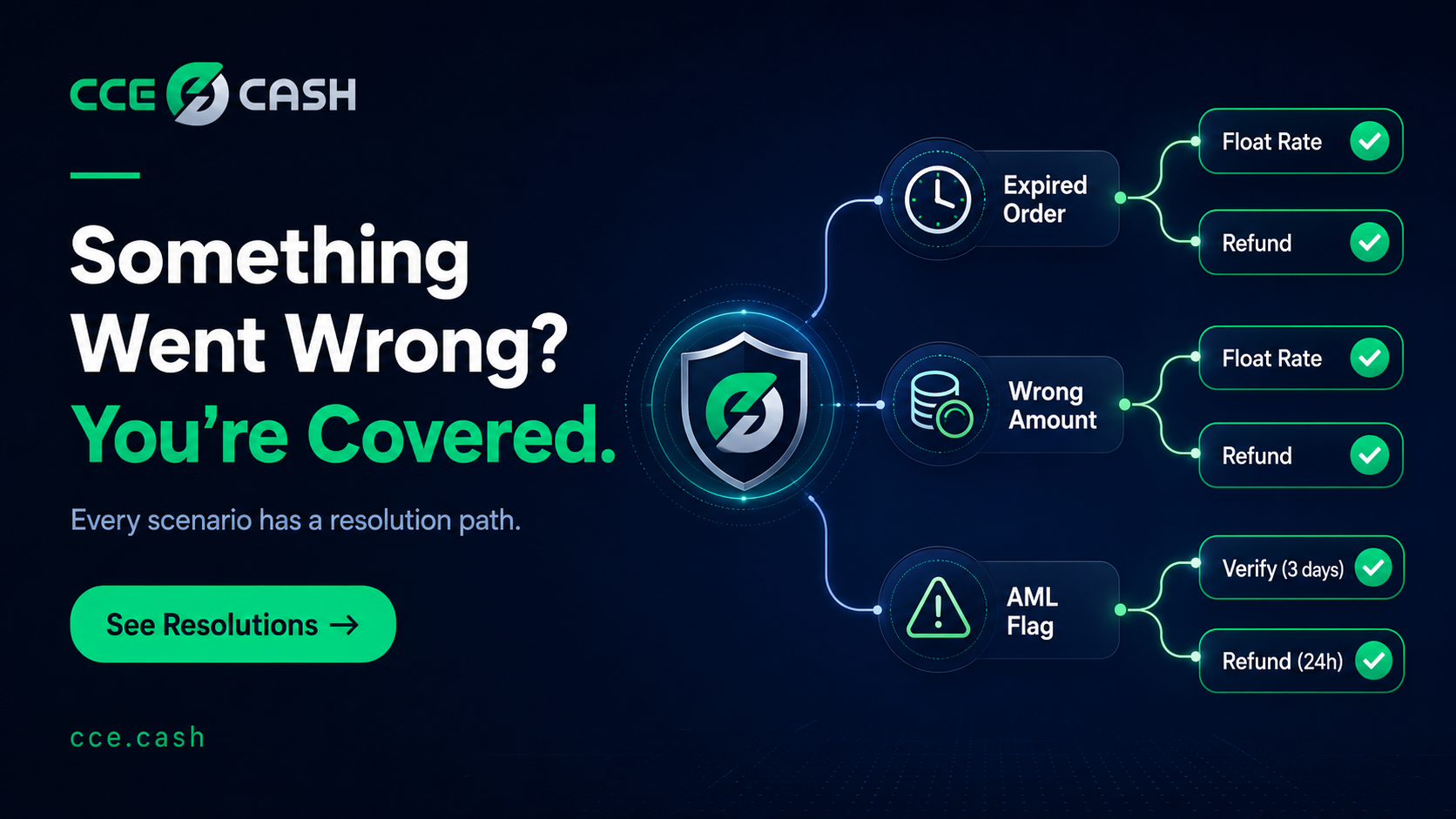
CCE Cash has a documented resolution path for every scenario where an exchange can't complete as originally planned. This post walks through each one, so you know exactly what to expect before you ever need it.
Scenario 1: Your Fixed-Rate Order Expires
Fixed-rate orders lock the exchange rate for 10 minutes. The deal: if your funds arrive within 10 minutes and match the order amount exactly, you get the locked rate. If your transaction arrives after the window closes — because of a network delay, a late send, or congestion — the locked rate can no longer be honoured.
Resolution: you have two options. Continue the exchange at the current floating rate (the exchange processes at market price when your deposit is confirmed), or request a refund of your deposited funds minus the network fee for the return transaction. You initiate either option by contacting CCE Cash support — live chat or email — with your order inquiry code.
Scenario 2: You Send the Wrong Amount
Fixed-rate orders are calculated for a specific input amount. If you send a different amount — maybe your wallet deducted a network fee from the send total, maybe you mistyped, maybe an auto-fill used a previous amount — the locked rate, which was calculated for the exact order amount, can't be applied to the actual received amount.
Resolution: contact support with your order code. Two options: process the exchange at the current floating rate for the amount actually received, or receive a refund of the received amount minus network fees. The exchange isn't lost — it just can't use the original locked rate for a different amount.
Scenario 3: Your Transaction Is Flagged by the AML System
CCE Cash's automated AML system (SumSub) screens every transaction. If yours is flagged as potentially suspicious, it's frozen pending review. You're notified and given three days to complete an identity verification process if you want to proceed.
Resolution: complete the SumSub verification within three days to proceed with the exchange, or — if you prefer not to verify — email [email protected] within 24 hours of the flag to request a refund. The refund is processed to your deposit address within 24 hours, minus network fees.
The Common Thread: No Funds Vanish
Across all three scenarios, there's a consistent principle: CCE Cash does not retain your funds without offering a resolution path. Every exception has either a "continue the exchange" option or a "refund" option, or both. The network fee deduction on refunds reflects the actual blockchain cost of sending your funds back — not a penalty or service charge.
How to Initiate Any Resolution
For expired orders and wrong amounts: contact live chat (fastest) or email [email protected], with your order inquiry code ready. For AML flag refunds: email [email protected] within 24 hours. The order inquiry code is the key piece of information — it lets support locate your specific order immediately.
Prevention: The Two Things That Avoid Most Issues
First, for fixed-rate orders: send your funds immediately after creating the order, and on slower chains (BTC especially), make sure network conditions aren't congested. Second, always verify that the amount you're sending matches the order amount exactly before confirming the transaction — this single check prevents the most common wrong-amount scenario.
Discussion question: Have you ever had an exchange order go wrong on any platform? What was the resolution experience like, and what would have made it better?
Understand the full resolution framework at https://cce.cash