XMR Without Registration: Why Monero Holders Rely on Automated Exchanges Now
Monero presents a structural infrastructure question as regulatory pressure on privacy coins increases: as major centralized exchanges delist or restrict XMR, where do Monero holders reliably swap? The answer increasingly is automated no-registration exchanges — for two distinct reasons.
The Availability Reason
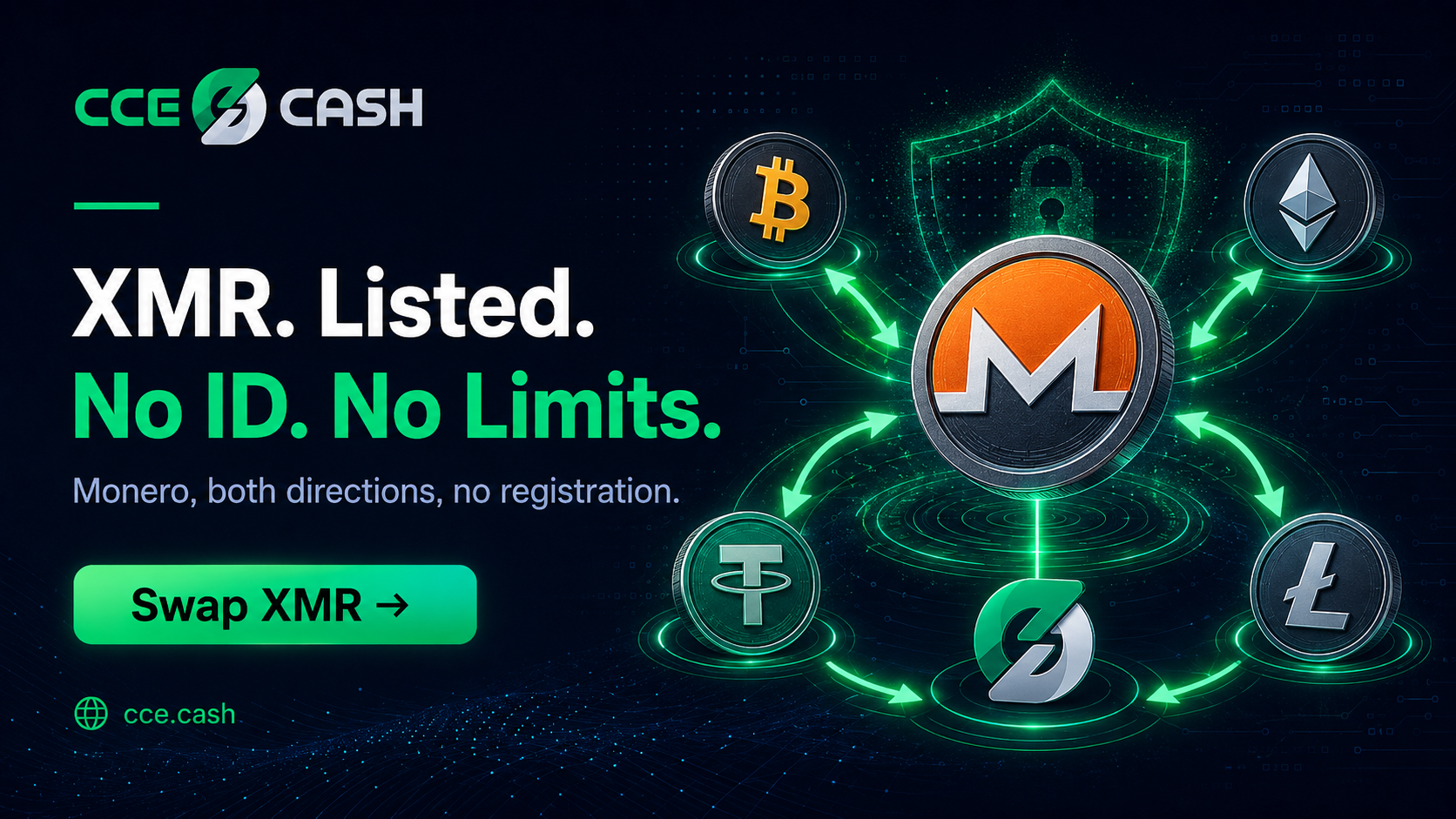
CEX delistings have redirected XMR exchange demand to platforms that continue supporting it. CCE Cash supports XMR bidirectionally — XMR to BTC/ETH/USDT/LTC/SOL and back — with no registration. For holders whose regional CEX options have removed Monero, this availability is the immediate value.
The Alignment Reason
This is the more interesting point. Monero's value proposition is transaction privacy. Converting XMR through a KYC-required CEX links Monero activity to a verified identity, undermining the asset's core property. A no-registration exchange — requiring only a wallet address — preserves the separation between exchange activity and identity. The exchange model aligns with the asset's purpose.
Operational Consideration
Monero's longer confirmation times (10-20 minutes for sufficient finality) mean floating rate is often more practical for XMR deposits than fixed rate, whose 10-minute window can be tight against Monero's confirmation requirements unless funds are submitted immediately.
The Broader Trend
The privacy coin regulatory landscape continues to evolve. For the segment of users who prioritize financial privacy, the infrastructure that serves them is shifting toward automated, no-registration models — a trend worth tracking for anyone analyzing crypto market structure.
Discussion question: For those analyzing crypto regulatory trends — how do you see the privacy coin access infrastructure evolving as CEX restrictions continue?