From Trade to Coffee: How Active Crypto Traders Use Cards for Daily Expenses
The friction most traders don't talk about
Active crypto traders solve hard problems daily — reading order books, managing risk, sizing positions, timing entries. The thing that quietly takes more time than it should is the boring one: getting trading gains into spendable form for normal life expenses. The standard monthly ritual goes deposit-to-exchange, sell, bank withdrawal, wait one to three days, then spend through a regular debit card. It works. It's also a recurring operational task that has nothing to do with the actual trading work, and the time it consumes adds up across a year. A crypto-funded card with at-the-moment conversion changes the structure of this task rather than the underlying economics.
What the manual offramp actually costs traders
The full cost of monthly manual offramping includes obvious line items and hidden ones. Exchange withdrawal fees in the $5–$25 range per withdrawal. Trading fees of 0.1–0.5% on the conversion. Bank withdrawal delays of one to three business days. KYC limits at each platform that may require the user to manage multiple exchange accounts. And the time cost of running the workflow — picking the right exchange, watching the spread, timing the network fees, monitoring the bank transfer. For a trader doing this monthly, that's maybe an hour per cycle of attention that could be spent on actual trading work. Over a year, that's a meaningful amount of professional time.
How at-the-moment conversion changes the structure
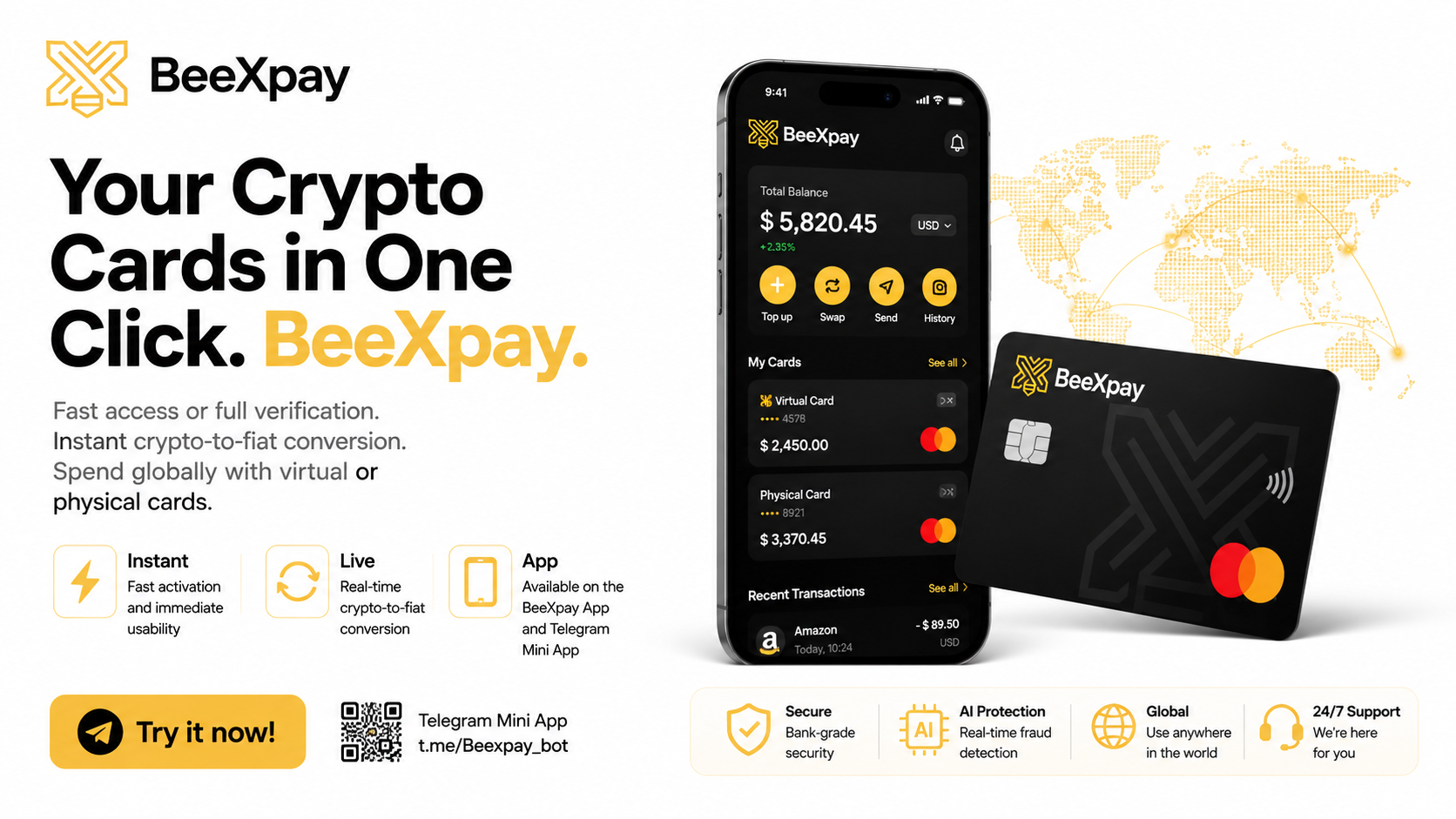
A BeeXpay card with at-the-moment conversion handles the conversion differently. Funds stay in the trader's wallet. When the card is used, the platform converts crypto to USD at the rate available at that instant, which takes about five seconds, and the merchant receives USD. The trader never holds an interim fiat balance. There's no scheduled monthly task. The offramp is distributed across actual purchase moments throughout the month rather than concentrated in a single event. For the kind of distributed personal spending most traders have, this fits the rhythm of actual cash needs better than the monthly batch model.
The fee comparison done honestly
The fee economics of the two approaches need to be compared on actual numbers rather than gut feel. A trader spending $1,500/month on personal expenses through manual offramping pays roughly: $15 in withdrawal fees plus 0.2% in trading fees ($3) plus 1.5% bank FX ($22.50) = about $40. Through a BeeXpay card with Full KYC: 2.5% reload ($37.50) plus 30 flat transaction fees at $0.35 average ($10.50) plus FX on non-USD portion. For a USD-heavy spender, the card model comes out cheaper. For a heavy local-currency spender, the two come out close. Neither model is uniformly cheaper across all spending patterns — the choice depends on the actual mix. The point of the card model isn't always-lower fees; it's the workflow simplification at competitive cost.
Volatility exposure differs between the two approaches
The other variable worth considering is volatility exposure. Manual offramping converts a lump sum at one point in time. The trader's exposure to crypto price movement is bounded — once converted, the value is locked in fiat. Card-based conversion at the moment of payment means the trader's exposure stays in crypto until each individual purchase. Over a month of regular spending, the actual conversion happens at many different prices, which functionally averages the price exposure rather than concentrating it. For traders comfortable with the price movement on their existing holdings, this isn't a problem and may be preferable. For traders who actively manage exposure, the difference is worth modeling.
What this looks like for different trader profiles
Day traders with high frequency of small position changes find the at-the-moment conversion model fits naturally because they're already comfortable with frequent price exposure. The card just extends that comfort to personal spending. Position traders holding longer-term spot positions may prefer the manual offramp because it lets them choose conversion timing strategically. Yield farmers and stakers with steady on-chain income find the card model collapses the workflow nicely because their income arrives in a wallet they're already monitoring. Each profile has a different optimal answer; the model fits some patterns better than others.
Tax tracking considerations
For traders in jurisdictions where crypto-to-fiat conversion is a taxable event, distributed conversion through a card creates more individual taxable events than batch conversion. Each card transaction is a separate disposal. For traders who already maintain detailed transaction records, this is additional but not necessarily harder — the platform provides transaction history, and the records can be exported. For traders who batch their tax reporting, the model may produce more complexity than they want. The honest framing is that the card model fits some tax workflows better than others, and individual circumstances dictate the right choice.
The honest framing for traders considering this
A crypto card with at-the-moment conversion is not a universal upgrade over manual offramping. It's a workflow choice that suits some patterns better than others. Traders with high spending frequency benefit most from the workflow simplification. Traders with mostly USD-denominated spending benefit from the favorable fee comparison. Traders with strict timing preferences on conversion may prefer batch offramping. The decision depends on personal circumstances, and trying both at small scale before committing fully is the most reasonable evaluation approach. BeeXpay's $10 virtual card is structured for this kind of low-commitment trial.
Closing thought
The interesting development for traders in 2026 isn't that crypto cards exist — they've existed for years. It's that the workflow simplification is now reliable enough to compete on convenience with the manual offramp on cost. For traders whose personal time has real opportunity cost, the choice is worth examining.
→ Try it: https://beexpay.app