Cross-chain users don’t care about bridges — they care about execution
Cross-chain transfers now move billions of dollars every week across Ethereum, rollups, and app-specific chains. Public infrastructure trackers show sustained bridge volumes in the tens of billions per month, making cross-chain execution a core DeFi primitive.
And yet, reliability remains inconsistent.
Common failure patterns persist:
missing liquidity on active routes
execution failures or delayed settlements
price slippage caused by limited routing
fragmented liquidity across disconnected systems
These issues exist by design, not by accident. As liquidity disperses across more chains, execution paths built around single bridges increasingly break down.
Fixed bridges don’t adapt
Traditional bridges rely on: isolated liquidity, predefined routes, static execution logic
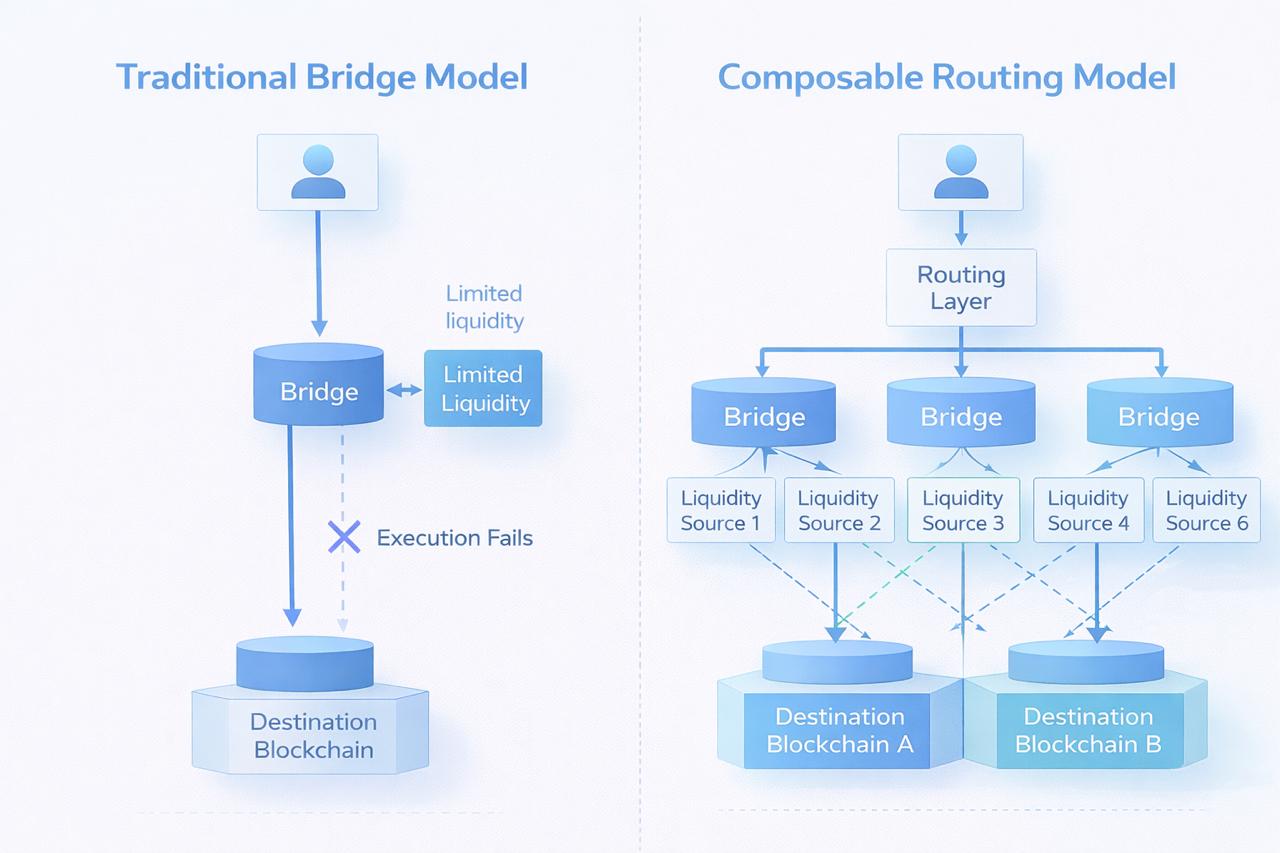
This model assumes balanced flow. In reality, cross-chain demand is lopsided and volatile. When liquidity is unavailable, execution simply fails — forcing users to start over elsewhere.
Even well-funded bridges face this constraint.
Routing becomes the product
Composable routing reframes the problem.
Instead of asking which bridge to use, systems ask how execution should complete. Routes are assembled dynamically, evaluated in real time, and rerouted automatically when conditions change.
This is the same shift that transformed DEX trading through aggregation.
CrossCurve’s infrastructure role
CrossCurve is built as a routing layer coordinating execution across:
its own bridge-layer
external bridge integrations
on-chain liquidity sources
Execution follows the optimal path available at the moment of transaction. Users never need to choose routes manually.
CrossCurve does not replace bridges. It orchestrates them.
Comparing architectural philosophies
Aggregators (LiFi, Bungee): better discovery, limited execution control
Single bridges: deep optimization, high dependency risk
CrossCurve: infrastructure-level routing intelligence
Routing decisions happen inside the system, not the interface.
Scaling advantages
Composable routing improves:
execution reliability
failure recovery
UX simplicity
capital efficiency
As networks multiply, this model compounds.
Final takeaway
Cross-chain infrastructure is becoming invisible — and that’s the point.
The systems that win will be those that make execution predictable, not those that market bridges.