How Do Concrete Vaults Actually Work?
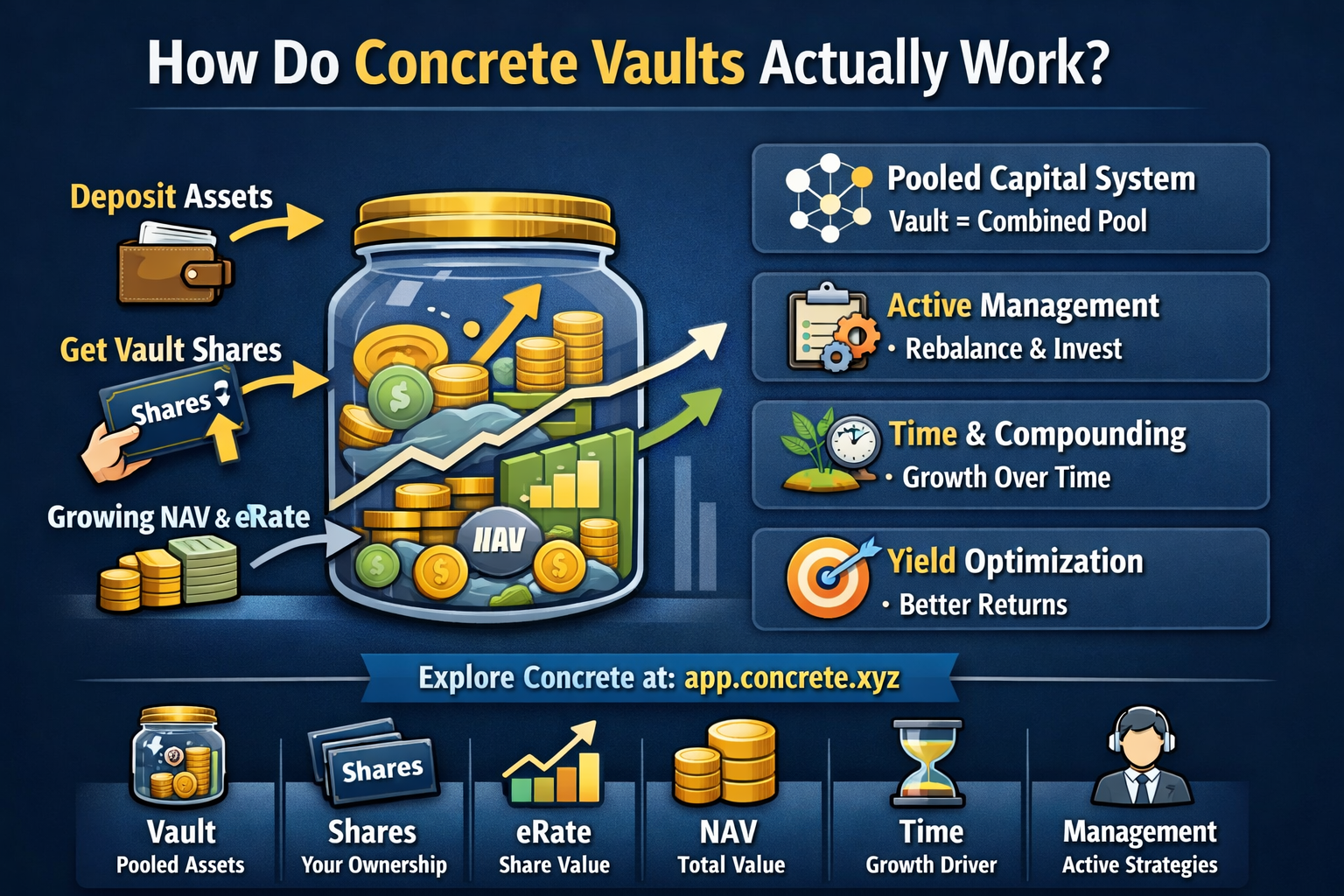
If you’ve ever used DeFi vaults, the process usually looks simple on the surface.
You deposit into a vault.
You receive vault shares.
Over time, your balance grows.
But when you open the dashboard, you might see terms like eRate, NAV, and vault shares. For many users — especially those new to DeFi — it’s natural to ask:
What do these numbers actually mean?
And more importantly: what’s happening behind the scenes after I deposit?
In this article, we’ll break down how Concrete vaults actually work in a simple and intuitive way.
Starting From the User’s Perspective
Let’s imagine a simple scenario.
You decide to deposit your assets into a Concrete vault.
After depositing:
- You receive vault shares
- The vault dashboard shows metrics like eRate
- The NAV (Net Asset Value) changes over time
Your wallet doesn’t just hold the original tokens anymore — it holds shares of the vault.
At first glance, this can feel confusing.
But once you understand the mechanics, the system becomes very intuitive.
Understanding Vault Shares & eRate
When you deposit assets into a vault, you are not just storing tokens. Instead, you receive vault shares that represent your ownership of the vault.
Think of the vault like a large jar filled with assets.
Every person who deposits into the vault owns a slice of that jar.
Your vault shares represent that slice.
Now let’s talk about eRate.
The eRate reflects the value of each vault share. As the vault strategies generate yield, the value of each share increases.
In simple terms:
- Vault shares = your ownership
- eRate = the value of each share
If the vault performs well and generates yield, the eRate increases, which means your shares become more valuable over time.
What is NAV?
Another important concept is NAV, or Net Asset Value.
NAV simply represents the total value of all assets inside the vault.
You can think of it like this:
- NAV = the total pool of assets
- Shares = your slice of that pool
If more capital enters the vault, NAV increases.
If strategies generate profits, NAV also increases.
As NAV grows, the value of each share grows as well.
This is why your position in the vault can increase in value without you doing anything manually.
Why Time Matters in Vaults
One important thing to understand about vaults is that they are not designed for short-term use.
Vault strategies need time to generate meaningful results.
There are several reasons for this:
- Strategies take time to deploy capital effectively
- Transactions involve gas costs and execution fees
- Rebalancing strategies requires careful timing
- Markets fluctuate in the short term
A helpful analogy is planting a garden.
When you plant seeds, nothing happens immediately. Growth takes time. But if you let the system work, the results compound.
The same idea applies to automated compounding in DeFi vaults.
The longer capital stays in the system, the more effectively it can grow.
Vaults Are Actively Managed
Another common misconception is that vaults simply hold assets.
In reality, Concrete vaults are actively managed systems.
The capital deposited into the vault is continuously:
- Deployed across different strategies
- Rebalanced when better opportunities appear
- Adjusted based on market conditions
You can think of the vault like a chef managing ingredients in a kitchen.
The ingredients (capital) are constantly being used, adjusted, and optimized to create the best possible outcome.
This is what makes managed DeFi powerful.
Instead of users manually chasing opportunities across protocols, the vault system handles the operational complexity.
How This Creates Better Outcomes
When all these pieces work together, the system becomes powerful.
Concrete vaults combine:
- Automated compounding
- Active capital deployment
- Strategic rebalancing
Over time, this creates several benefits:
- Yield compounds automatically
- Capital is moved to better opportunities
- Strategies adapt to market conditions
In other words, users benefit not just from yield, but from how that yield is managed.
A Simple Way to Think About It
At the end of the day, Concrete vaults can be understood through a simple mental model.
- Vault = pooled capital system
- Vault shares = your ownership
- eRate = value of each share
- NAV = total vault value
- Time = growth driver
- Management = optimization layer
Once you understand these pieces, the system becomes much easier to follow.
Vaults aren’t just passive storage — they are actively managed engines for onchain capital deployment.
And the longer they operate, the more powerful automated compounding becomes.
**Explore Concrete at:**