August wildlife in southeastern Pennsylvania: Mammals and more small birds
For the third and fourth posts of the month, I divided the mammals and remaining small birds so that the numbers of animals and iNaturalist observations would be balanced, but I did it before actually sifting through the photos. For this post, I included all of the mammals and some of the remaining small birds. The next post will cover the remaining small birds. Then, as usual, the last post of the month will have the raptors.
Now that I have prepared the photos for this post, however, it appears that this one is probably going to be a lot longer and have many more photos than either of the next two. I hadn't realized how many sightings I had of these animals that weren't recorded as observations with iNaturalist. The good news from that is that many of these photos can only be seen on Steem.
At any rate, the summary table below lists the animals and observation counts with iNaturalist. In all, there are 7 species of animal and 18 observations. Feel free to skim or skip the table and move on to the photos and write-ups. Because I generally wait at least a week between logging the same species to iNaturalist, the dates in this summary table may not match up with the dates in the following sections.
| Common Name | Total | First Seen | August Count | Observations |
|---|---|---|---|---|
| Northern Cardinal | 23 | 03/30/26 | 4 | 08/04/26, 08/08/26, 08/08/26, 08/19/26 |
| American Red Squirrel | 16 | 03/22/26 | 3 | 08/08/26, 08/17/26, 08/26/26 |
| Eastern Cottontail | 9 | 05/26/26 | 3 | 08/02/26, 08/09/26, 08/18/26 |
| White-tailed Deer | 6 | 05/29/26 | 3 | 08/02/26, 08/14/26, 08/29/26 |
| American Robin | 12 | 04/10/26 | 2 | 08/14/26, 08/24/26 |
| Gray Catbird | 15 | 05/01/26 | 2 | 08/04/26, 08/31/26 |
| Eastern Bluebird | 3 | 04/28/26 | 1 | 08/25/26 |
Northern Cardinal
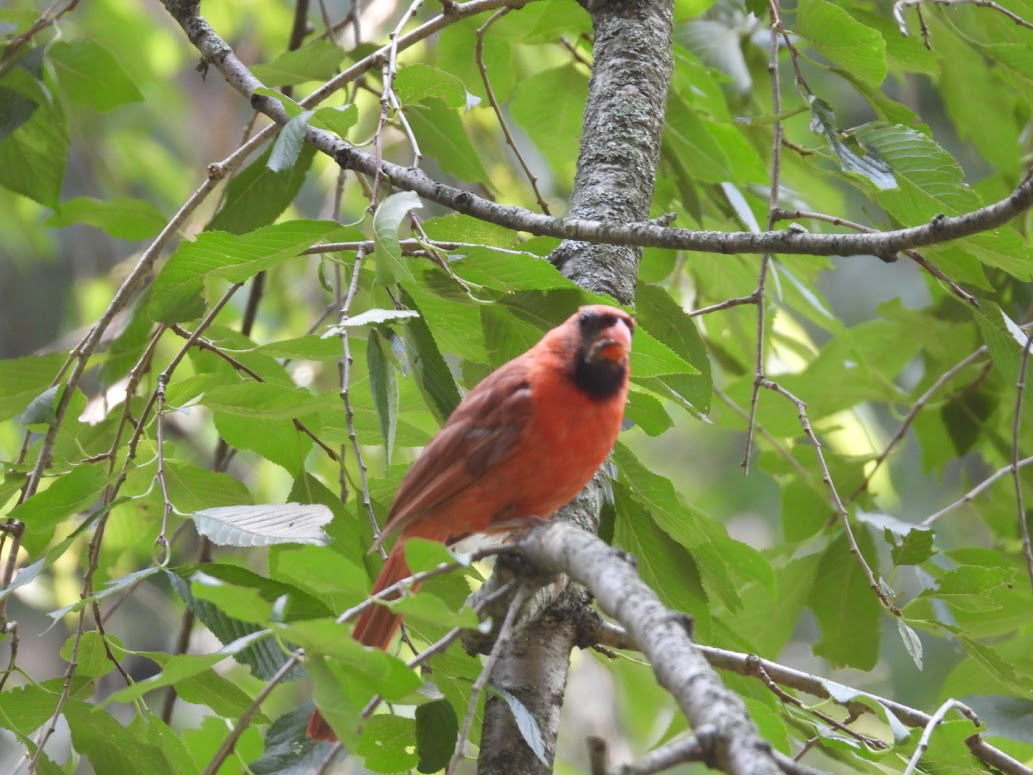
The Northern Cardinal is a non-migratory bird that ranges across much of the eastern and central United States. It is a common bird with a population above 100 million and low concern conservation status.
As shown in the August 8 photos, it's very easy to distinguish between the male and female by the color of the feathers. The male is bright red. The female has red, too, but she's somewhat drab in comparison.
I think the most interesting sighting in August was on August 19 when I saw a male Cardinal in a bush whose leaves were changing colors. You can compare the zoomed-in shot (left) with the zoomed-out shot (right) to see how well the male blends in with the leaf coloring. Believe it or not, there is a bird in that right-hand picture. I almost missed it in real life, too.
These birds seem to be very good at blending in with the shrubbery, because it's quite common for Merlin to hear them without me being able to find them by sight.
| August 4 | August 4 |
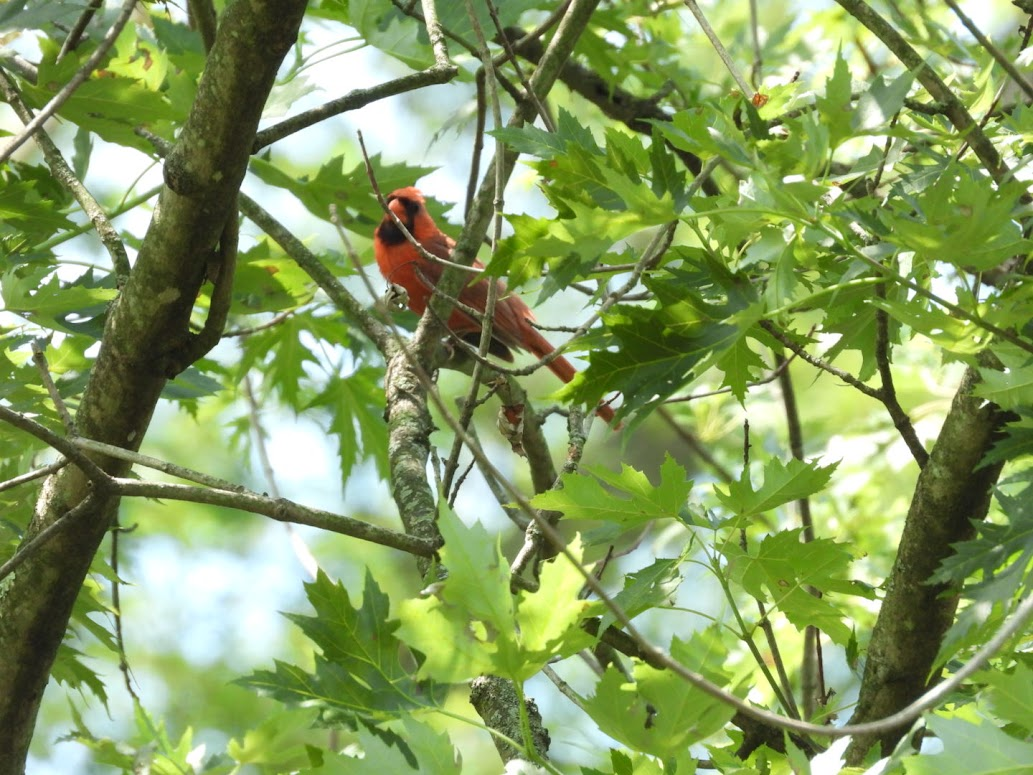 | 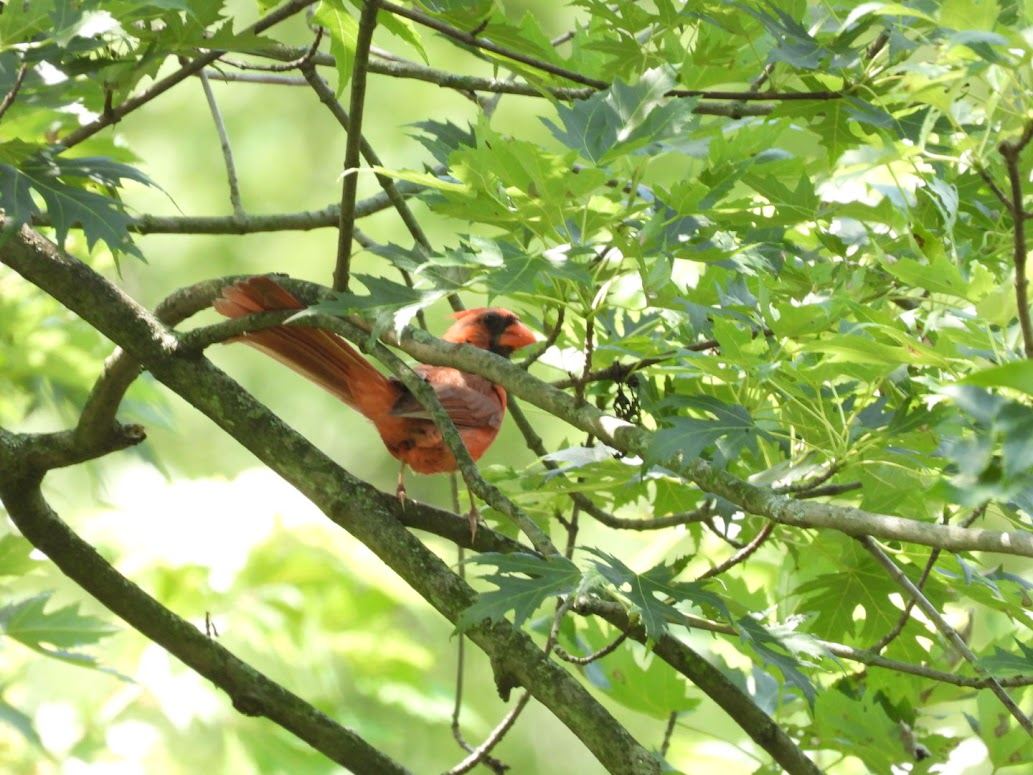 |
| ƒ/5.6, 1/160, ISO400, 270mm (1503mm equiv, 62.6X) | ƒ/6.3, 1/125, ISO450, 324mm (1803mm equiv, 75.1X) |
| August 8 (Male) | August 8 (Female) |
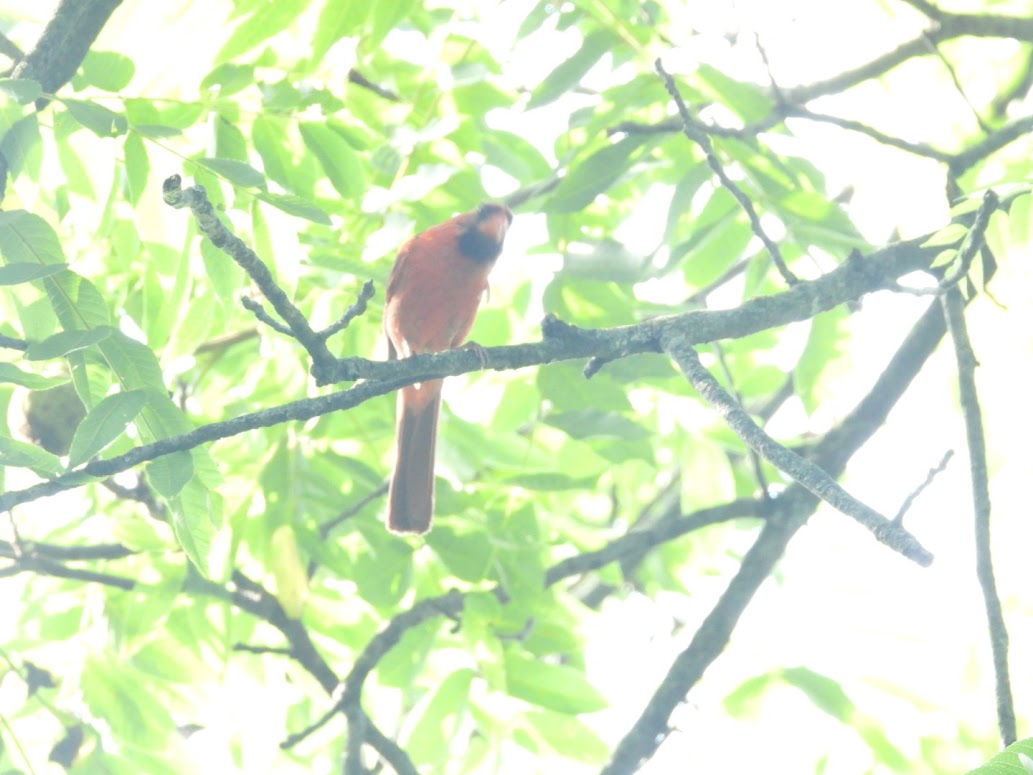 | 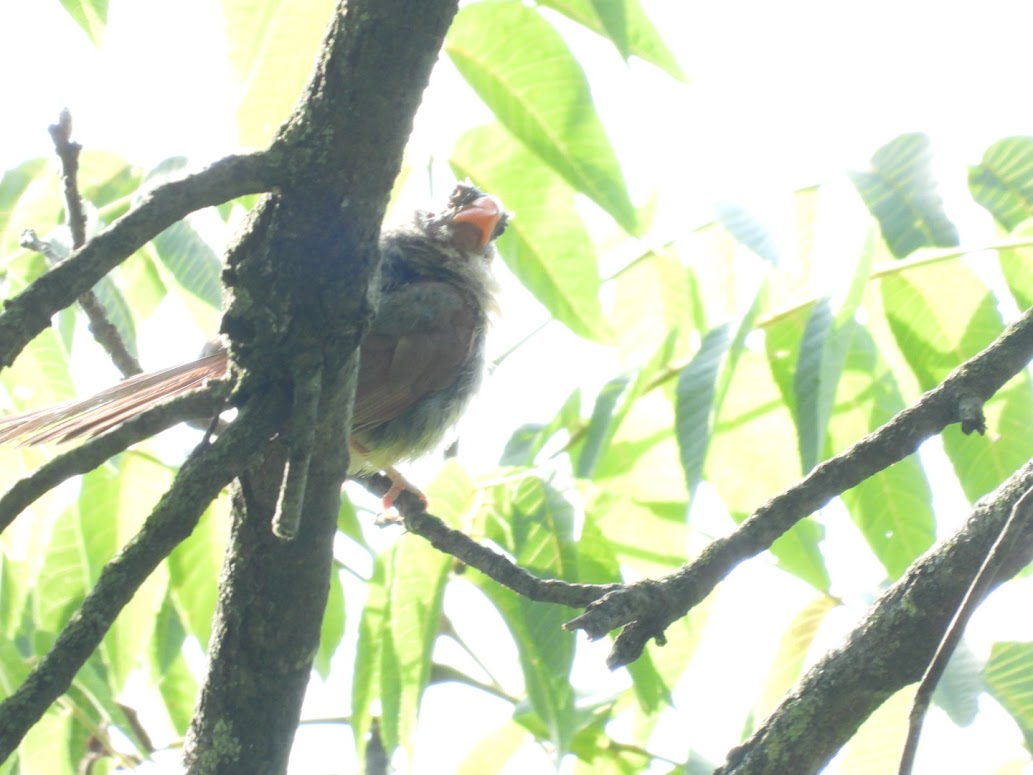 |
| ƒ/5.6, 1/100, ISO800, 135mm (751mm equiv, 31.3X) | ƒ/8, 1/125, ISO500, 539mm (3000mm equiv, 125.0X) |
| August 11 | August 11 |
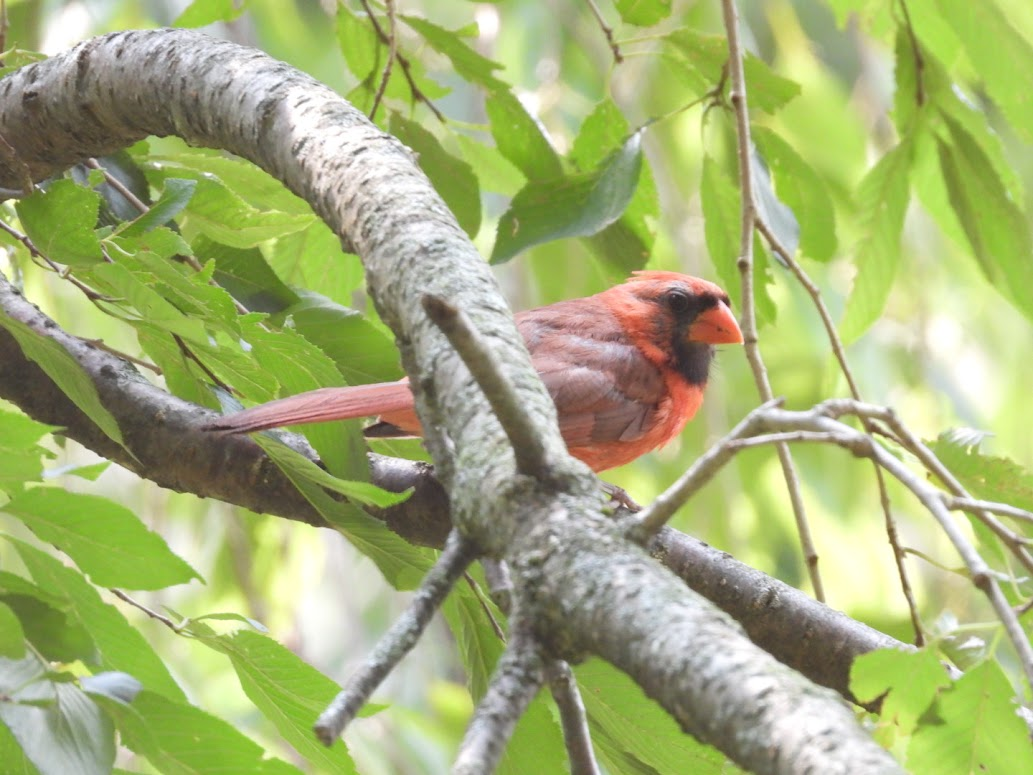 | |
| ƒ/5.6, 1/100, ISO800, 270mm (1503mm equiv, 62.6X) | ƒ/5.6, 1/125, ISO640, 198mm (1102mm equiv, 45.9X) |
| August 19 | August 19 |
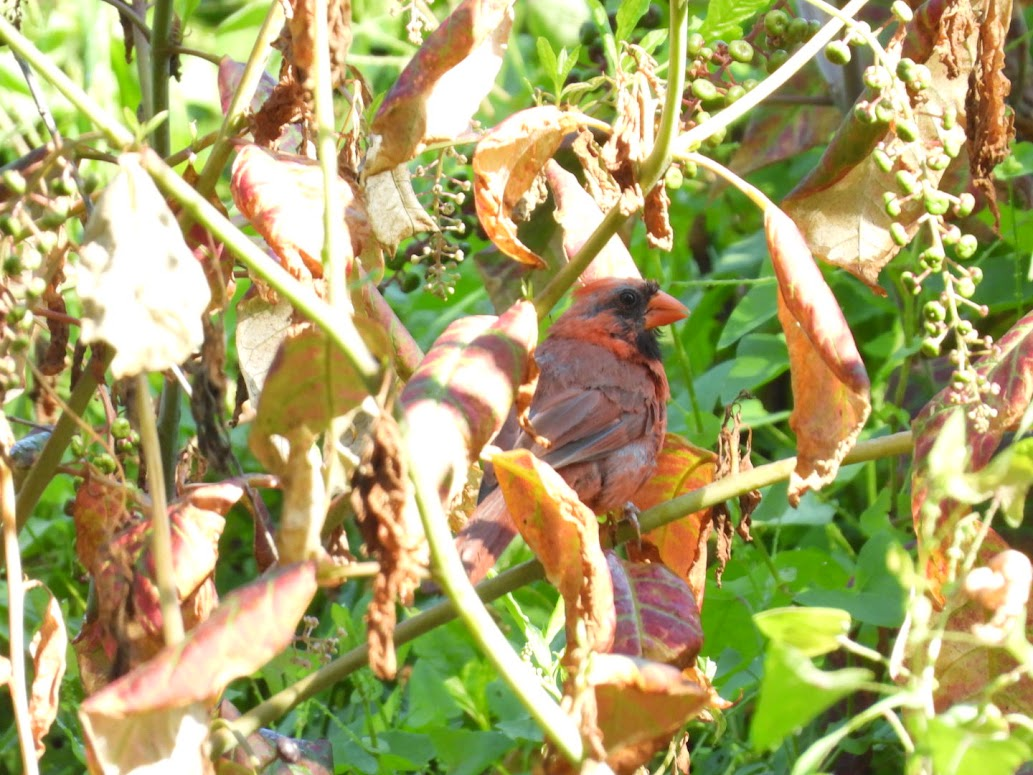 | 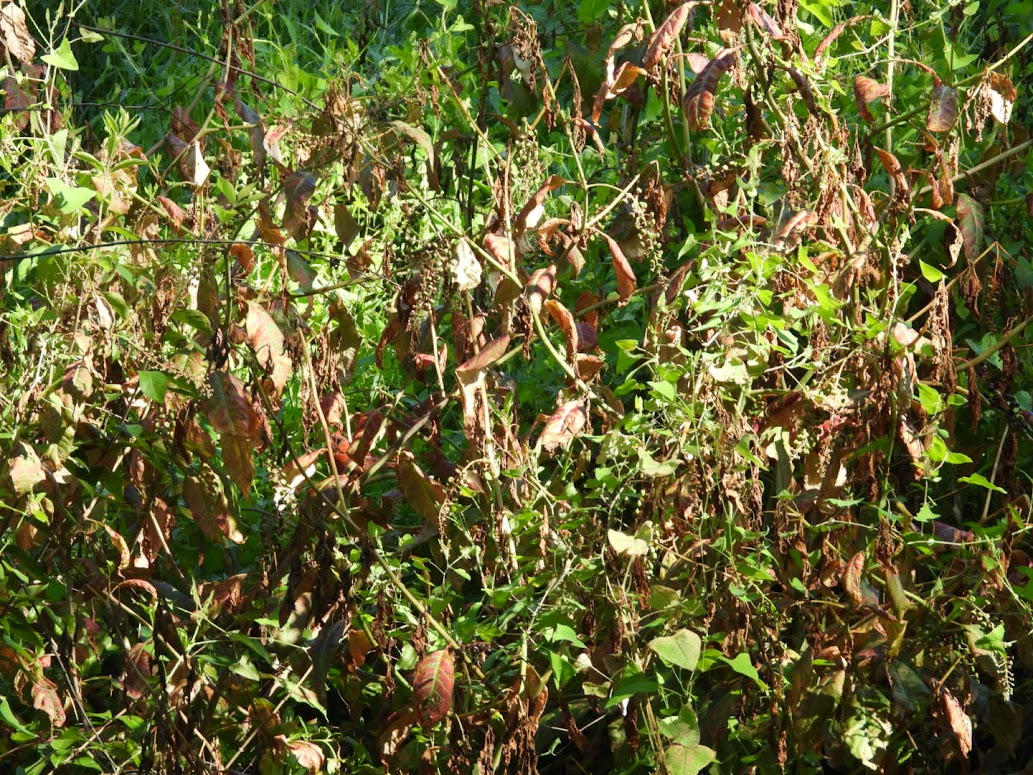 |
| ƒ/7.1, 1/125, ISO640, 395mm (2199mm equiv, 91.6X) | ƒ/5, 1/250, ISO250, 89.9mm (500mm equiv, 20.8X) Can you find it? |
American Red Squirrel
The American Red Squirrel is well-known for its aggression. It's much smaller than the Gray Squirrel, for example, but will readily chase one away from its food cache. These squirrels are common, with low conservation risk, and can be found across most of the US and Canada. The average lifespan is up to about 5 years, with some individuals observed living up to 12 years.
It's interesting when I encounter them on my walks through the yard, because they can respond to my presence in a variety of ways. Sometimes, they'll chatter at me and take a sort of an aggressive stance (see the August 8 photo). Other times, they'll ignore me - especially if they're eating. Still other times, they'll try to hide (see the August 11 photo). Or, finally, they might just run away.
The most interesting encounters in August were on the 11th and 12th. On the 11th, the squirrel ignored me while it was eating for about 8 minutes (based on image timestamps). After it finished eating, however, it got wary and tried to blend into the tree. But then it lost interest in me again and started grooming itself.
On August 12, you can see how much progress it made eating a Black Walnut over the course of about 11 minutes. As with the rabbits in some of my previous posts, you can also see trees and sky reflected in its eyes at super-high zoom (539mm focal length with 2X digital zoom).
| August 8 | August 8 |
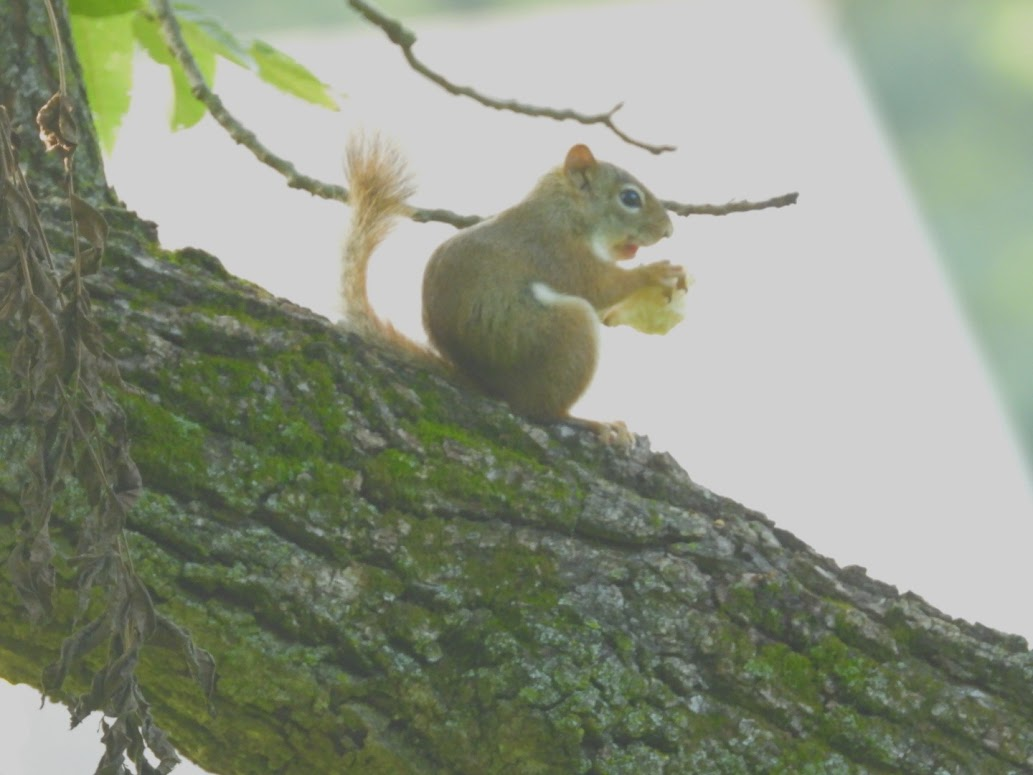 | 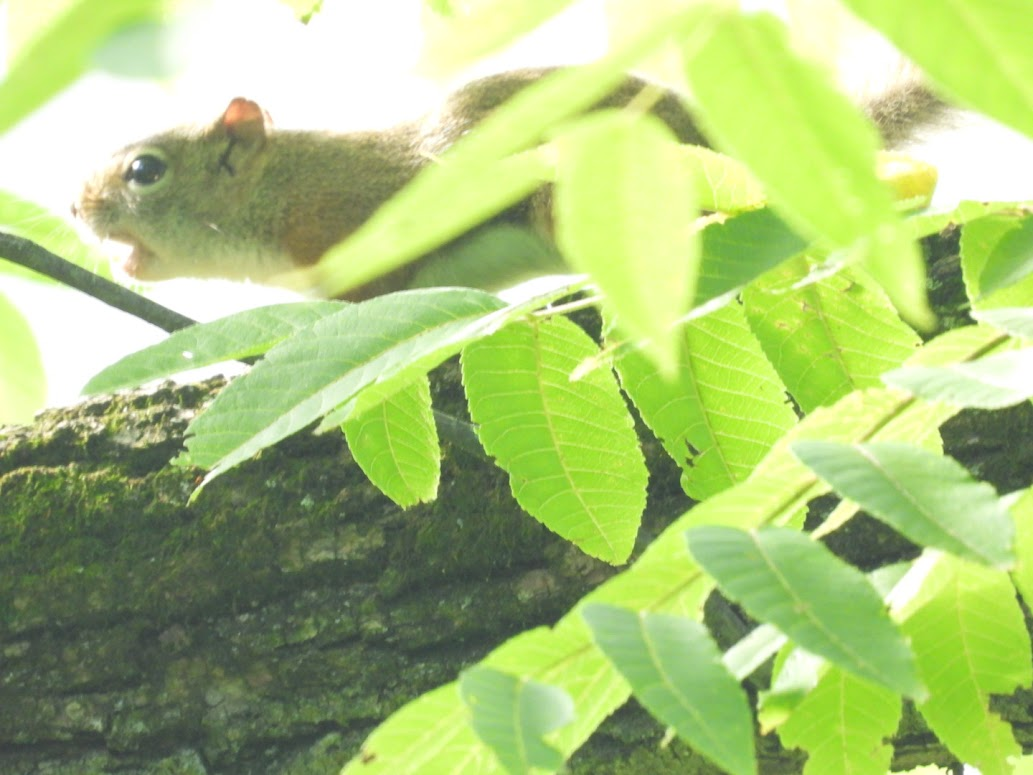 |
| ƒ/5.6, 1/80, ISO800, 234mm (1302mm equiv, 54.3X) | ƒ/7.1, 1/30, ISO800, 432mm (2404mm equiv, 100.2X). Not happy about my presence |
| August 11 | August 11 |
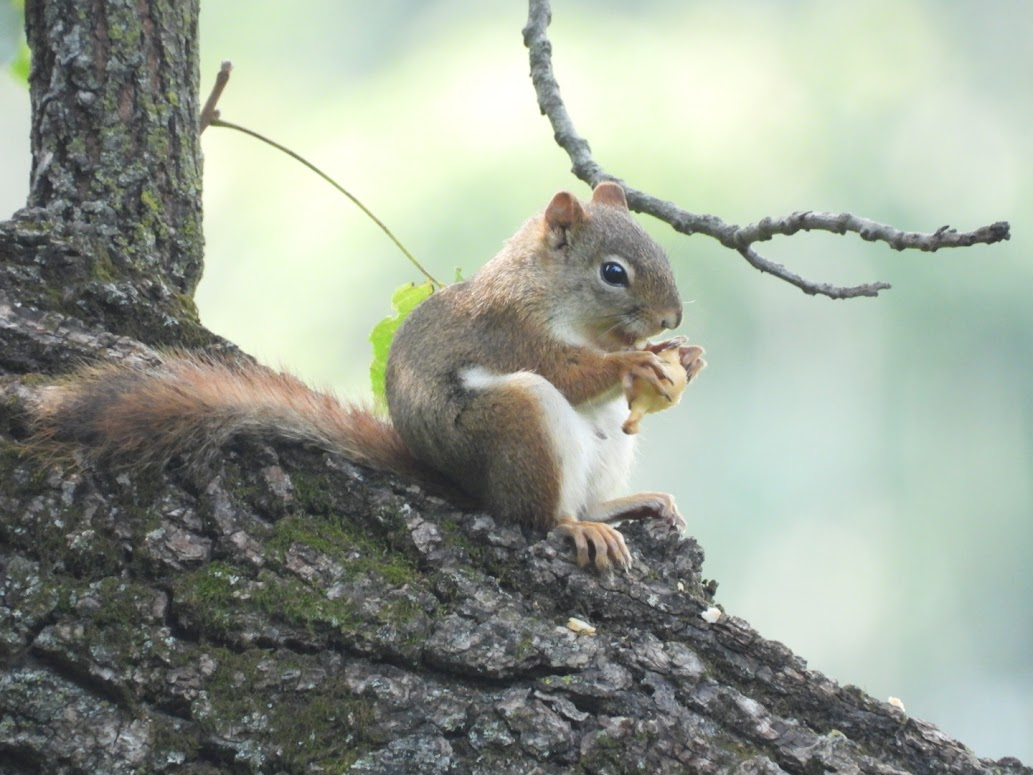 | 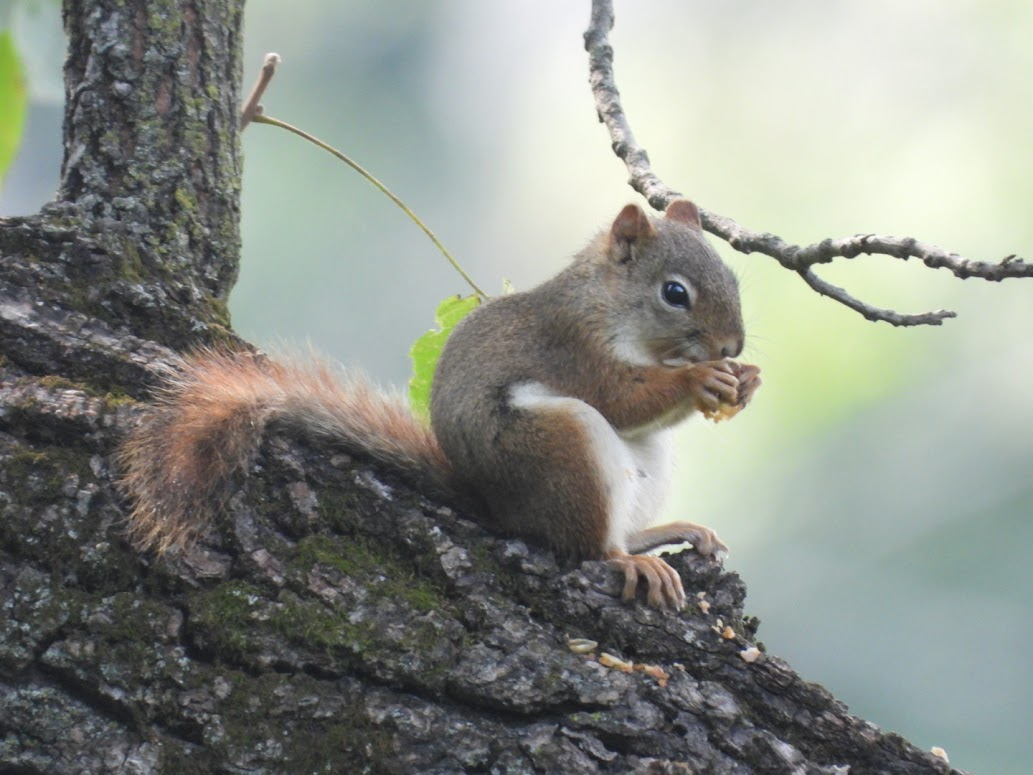 |
| ƒ/8, 1/125, ISO800, 503mm (2800mm equiv, 116.7X) | ƒ/8, 1/125, ISO720, 539mm (3000mm equiv, 125.0X). 8 minutes later |
| August 11 | August 11 |
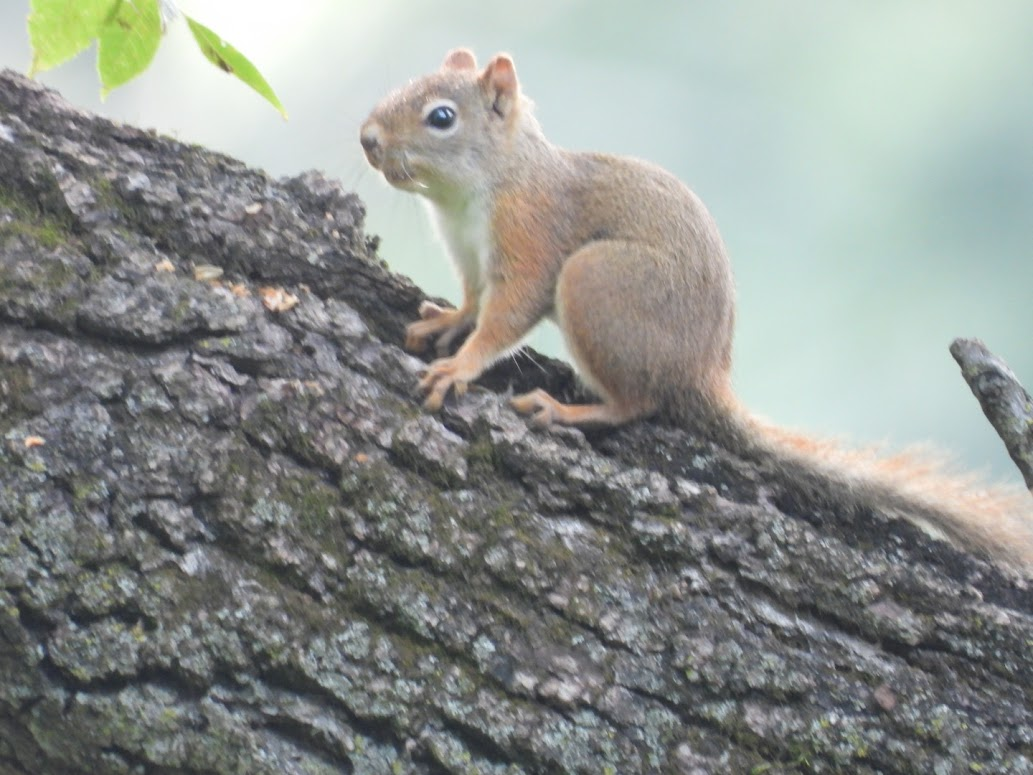 | 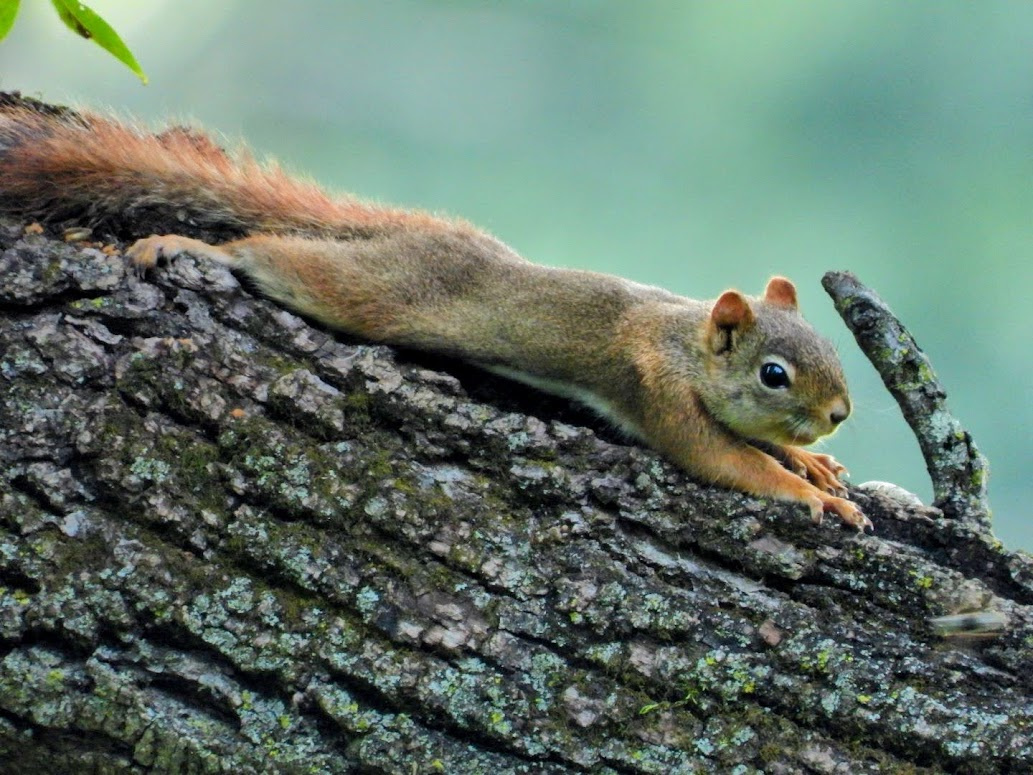 |
| ƒ/8, 1/80, ISO800, 539mm (3000mm equiv, 125.0X). Done eating. Now it sees me. | ƒ/8, 1/125, ISO450, 539mm (3000mm equiv, 125.0X). Commando Crawl |
| August 11 | August 12 |
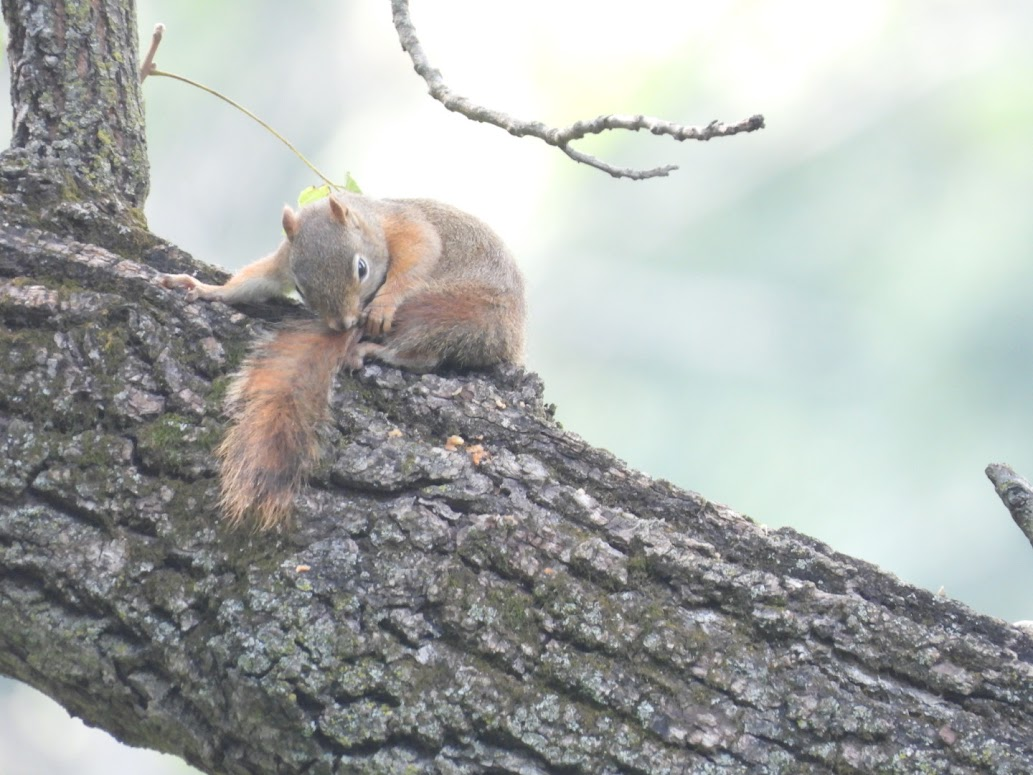 | 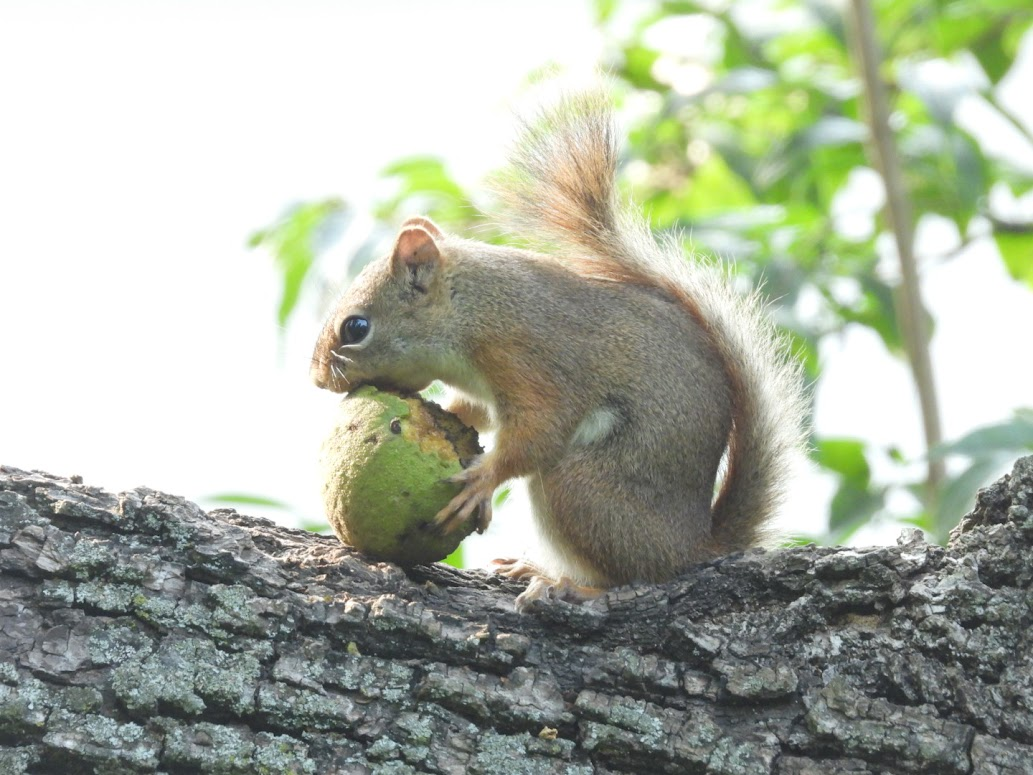 |
| ƒ/7.1, 1/100, ISO800, 395mm (2199mm equiv, 91.6X). Never mind hiding. That itch needs scratching. | ƒ/6.3, 1/125, ISO800, 270mm (1503mm equiv, 62.6X) |
| August 12 | August 14 |
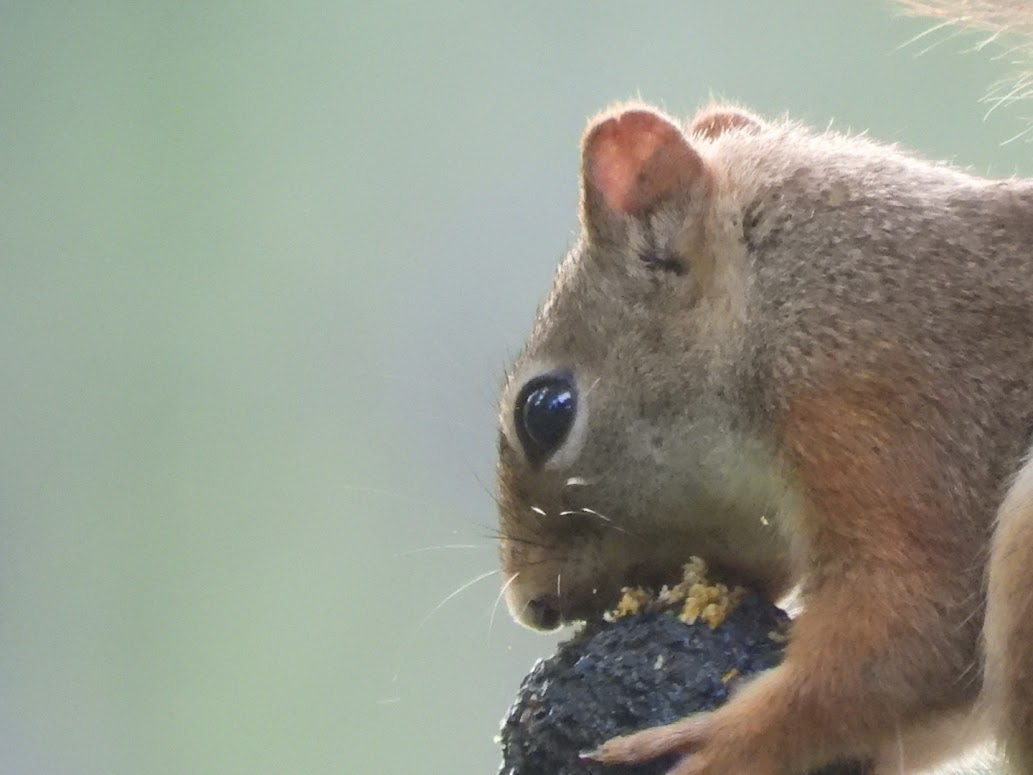 | 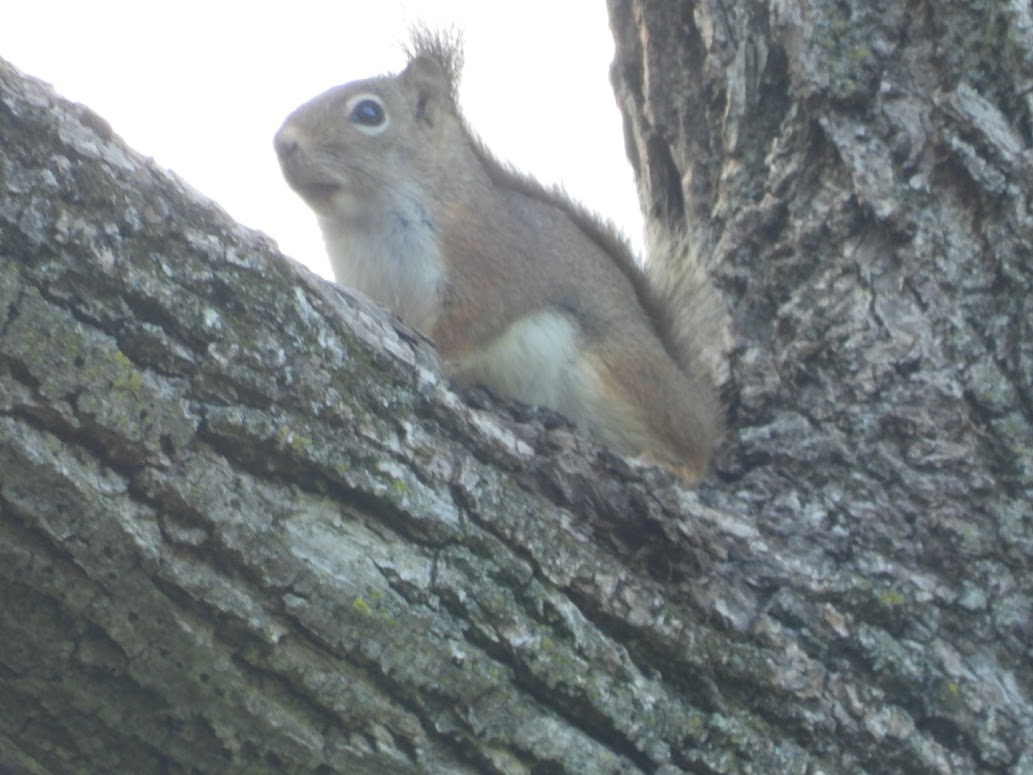 |
| ƒ/8, 1/200, ISO1600, 1,078mm (6000mm equiv, 250.0X). 11 minutes later | ƒ/8, 1/125, ISO640, 539mm (3000mm equiv, 125.0X) |
| August 17 | August 19 |
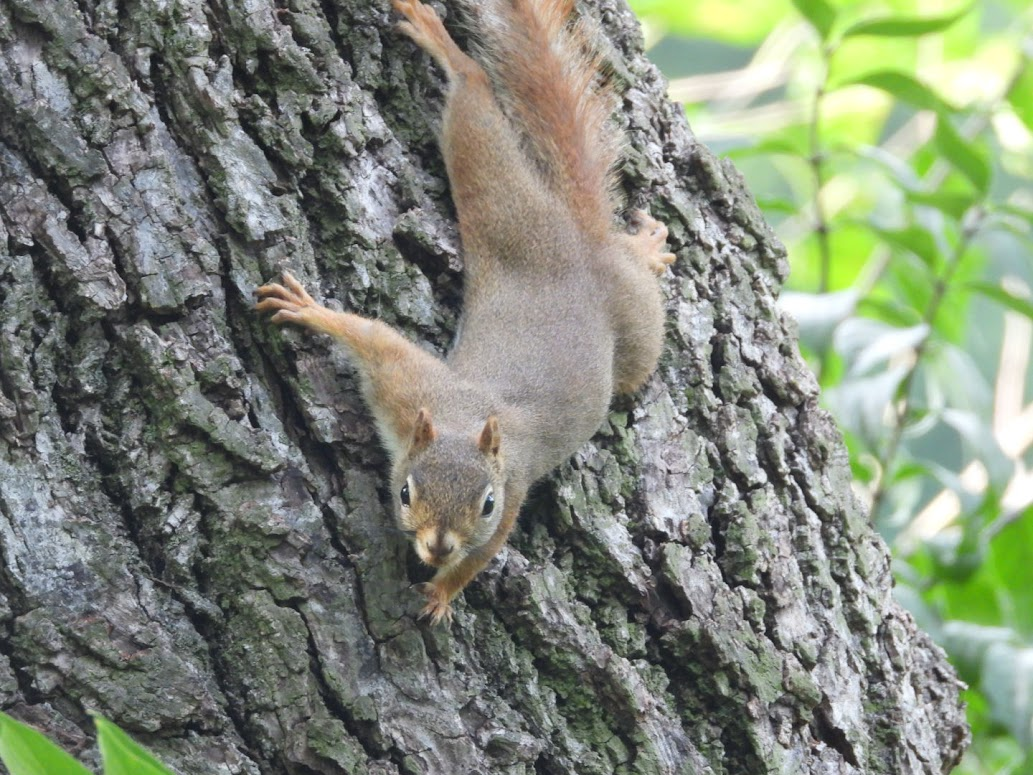 | 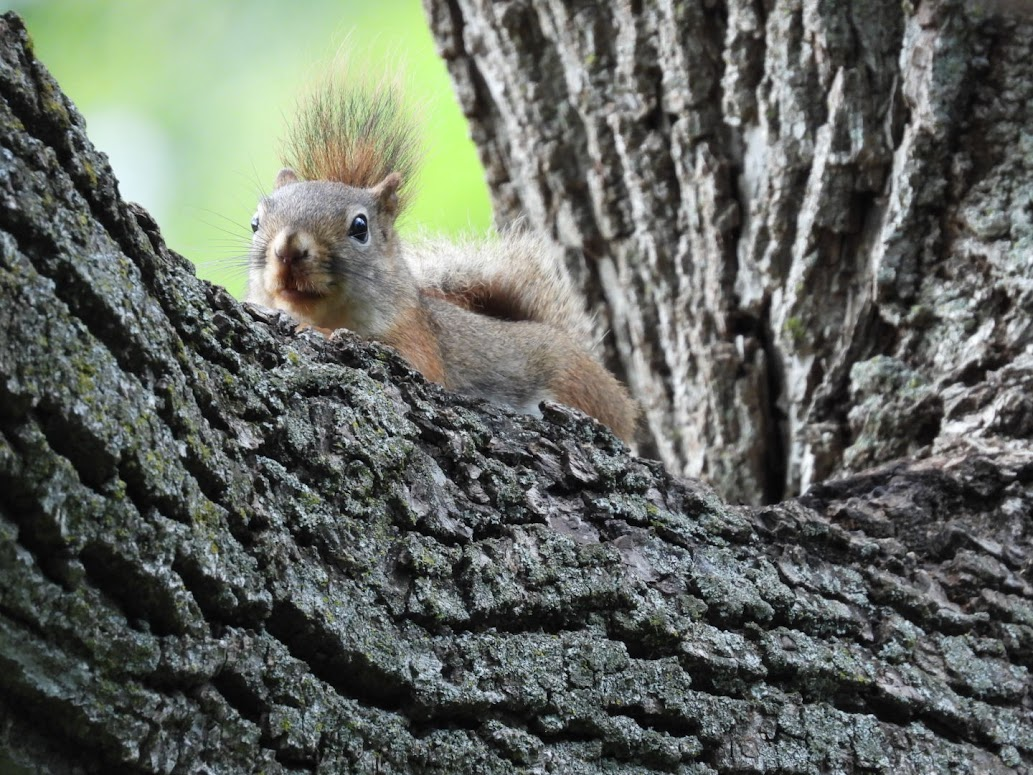 |
| ƒ/5.6, 1/125, ISO720, 167mm (929mm equiv, 38.7X) | ƒ/6.3, 1/125, ISO500, 288mm (1603mm equiv, 66.8X) |
Eastern Cottontail
Like the American Red Squirrel, the Eastern Cottontail varies in its reactions to seeing me in the yard. It frequently bolts as soon as it sees me, but sometimes it will watch warily or ignore me. Also like the American Red Squirrel, if it's eating, it seems more likely to ignore me. Due to its high adaptability and reproductive rates, the Eastern Cottontail is also common, with a low conservation risk.
An interesting bit of trivia that I learned recently is that the animal's name in German (Florida-Waldkaninchen) translates to "Florida Woods Rabbit".
Meta's new muse agent made a set of flashcards for me so I can learn the names of these animals in German. When I saw the German name, I was curious about the history (since Florida is about 2,000 miles from me). Here's the explanation from muse.
The scientific name is Sylvilagus floridanus. In 1890, the naturalist J. A. Allen formally described the species from specimens collected in Florida (Brevard County) — so he named it floridanus, "the Floridian one." The German name just translates the science: Florida (where the type specimen came from) + Waldkaninchen ("wood rabbit," from the genus Sylvilagus = forest-hare).
These rabbits are difficult to distinguish, visibly, from the European Rabbit, which can also be found in the area, but European Rabbits are burrowers. Since there are no burrows in my area, I am assuming that the ones I see are Eastern Cottontails.
| August 2 | August 2 |
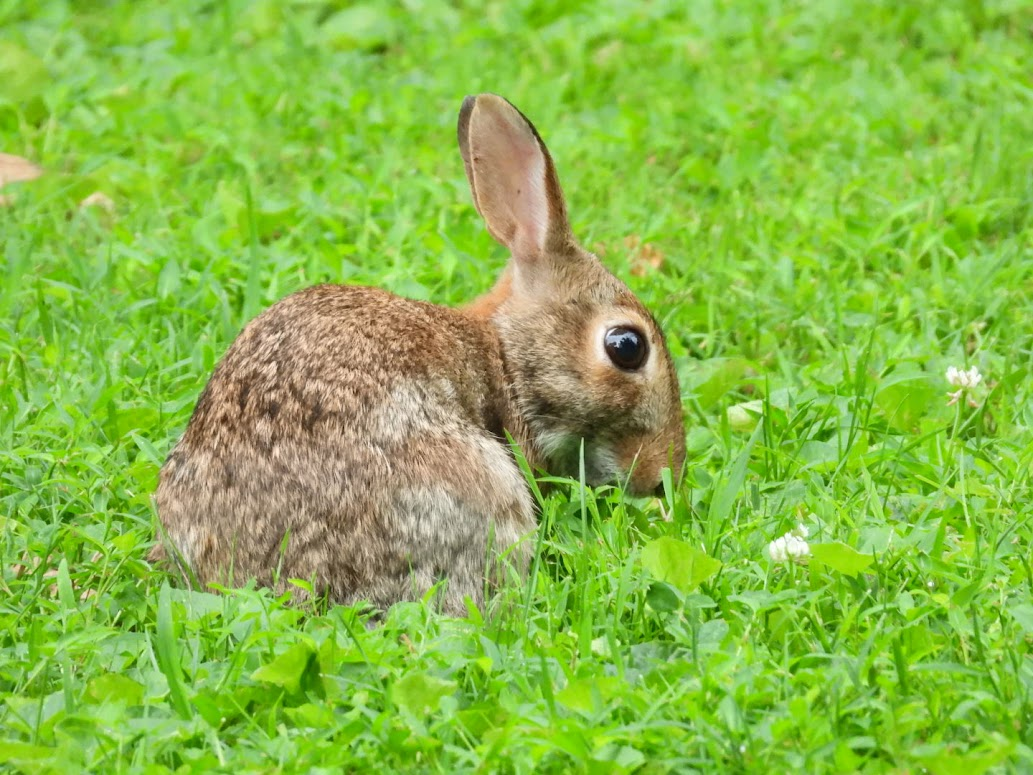 | 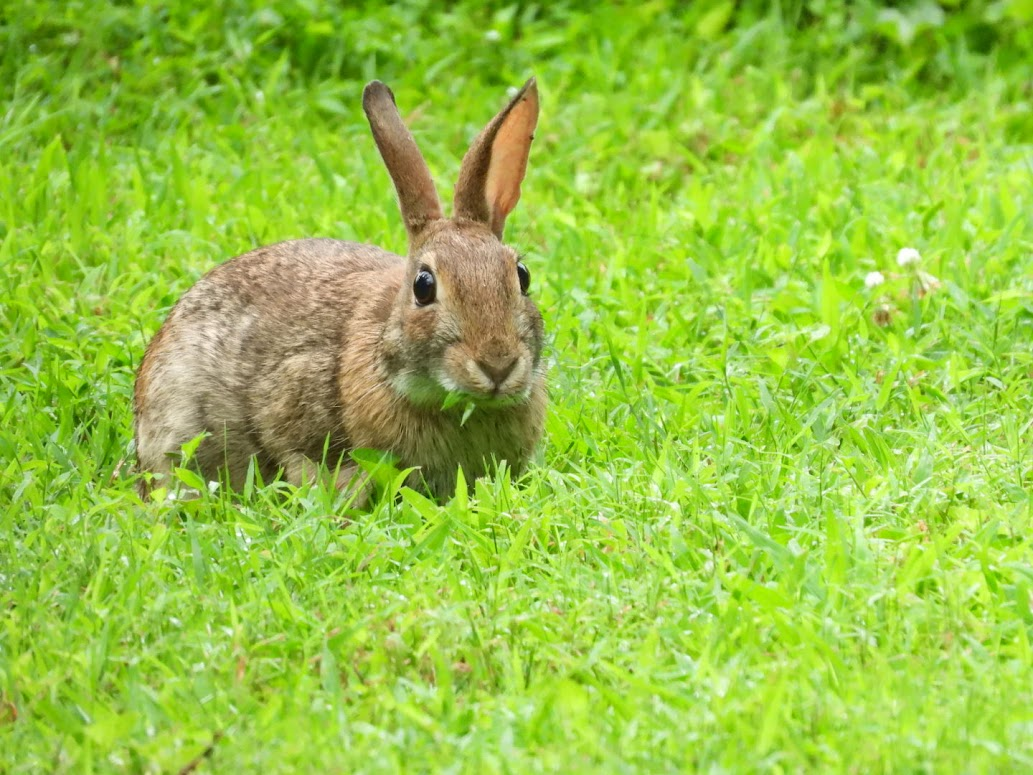 |
| ƒ/6.3, 1/500, ISO1600, 288mm (1603mm equiv, 66.8X) | ƒ/6.3, 1/500, ISO1600, 324mm (1803mm equiv, 75.1X) |
| August 2 | August 9 |
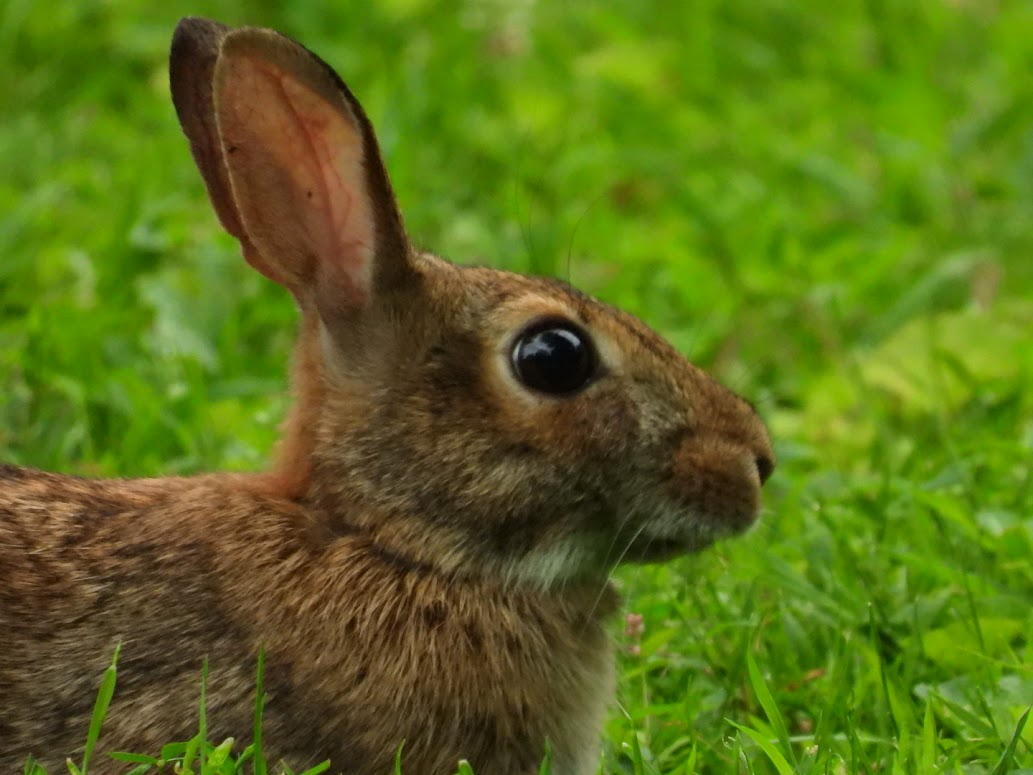 | 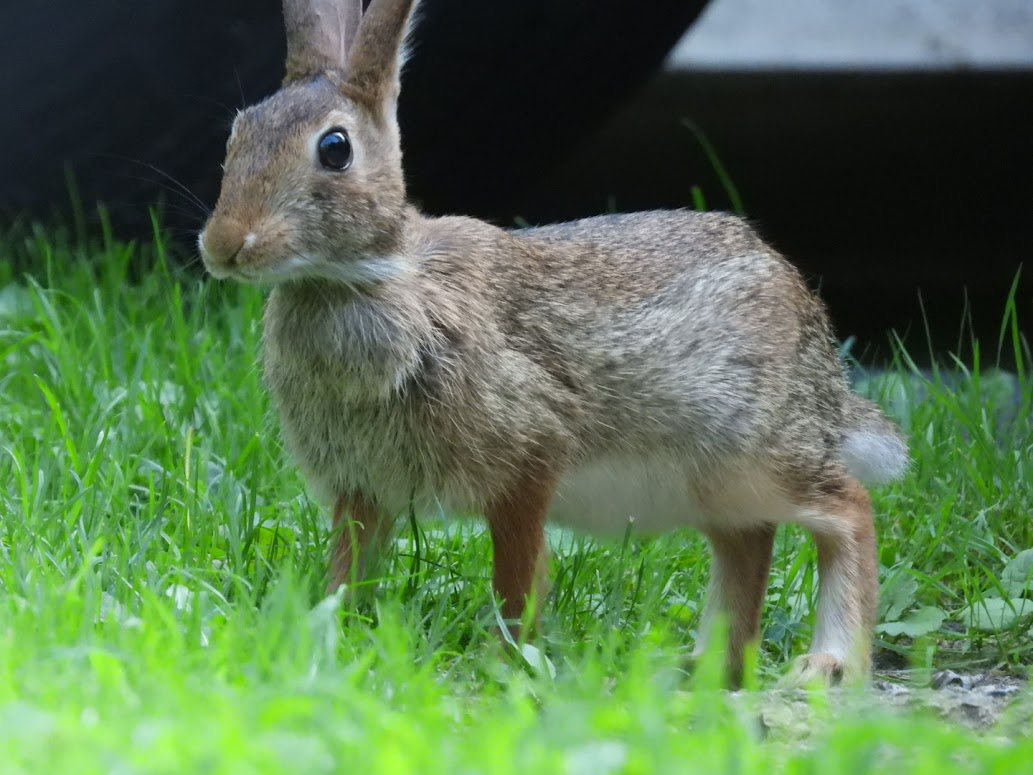 |
| ƒ/8, 1/500, ISO1600, 539mm (3000mm equiv, 125.0X) | ƒ/5.6, 1/320, ISO1600, 270mm (1503mm equiv, 62.6X) |
| August 10 | August 17 |
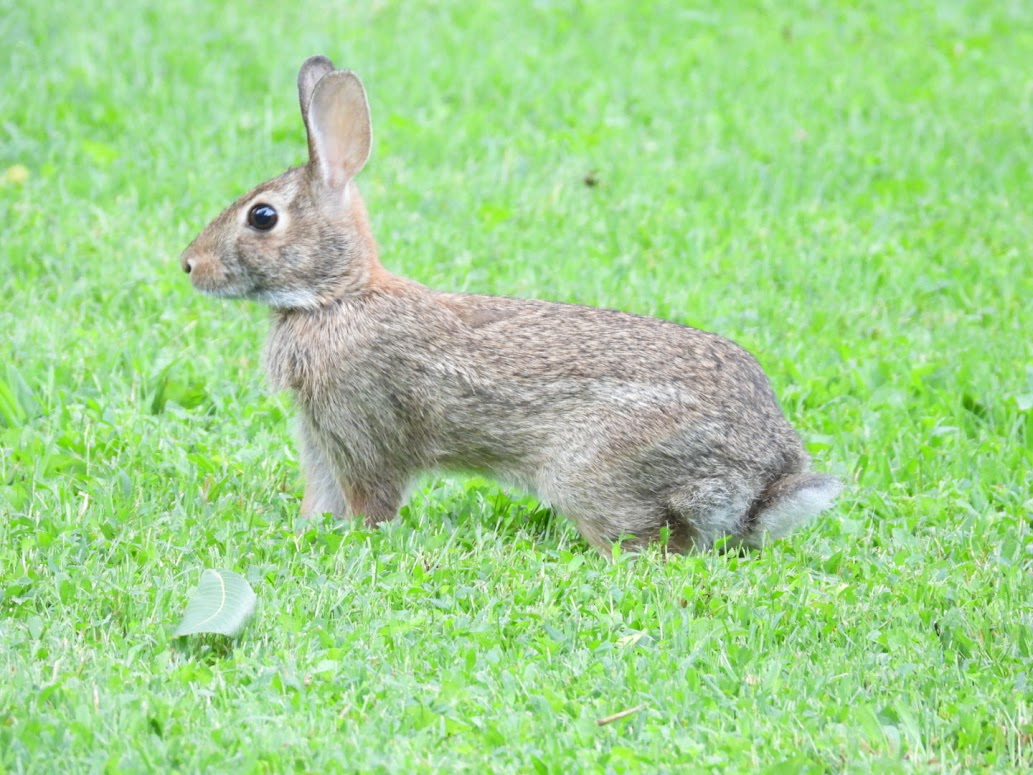 | 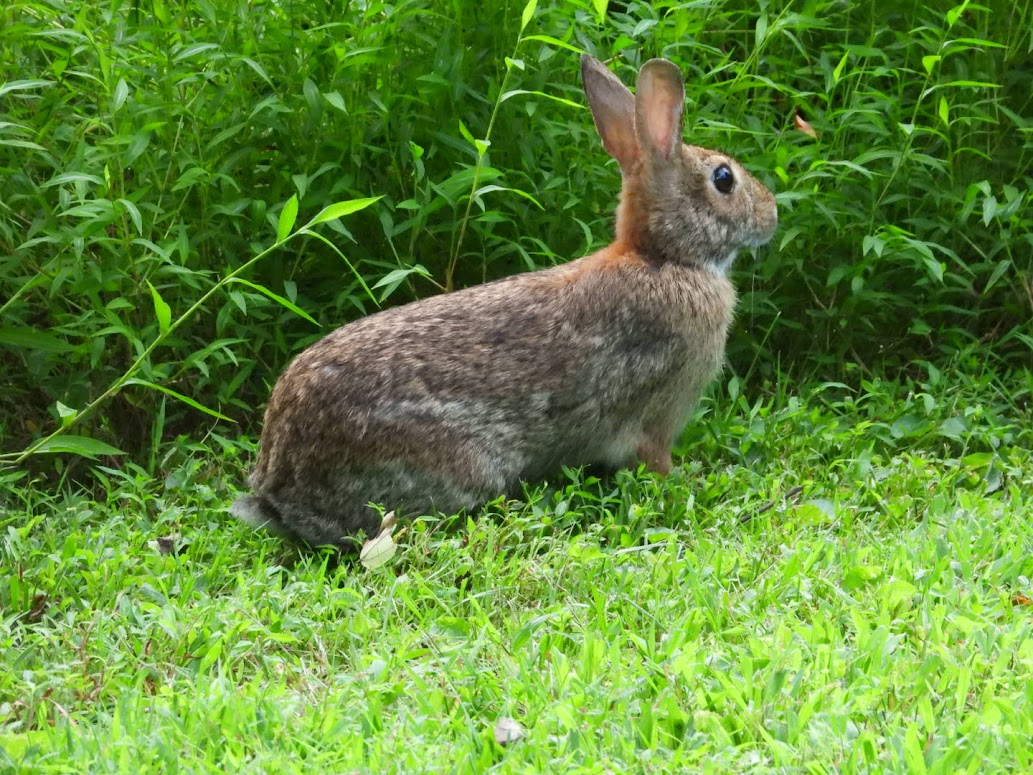 |
| ƒ/5.6, 1/60, ISO800, 180mm (1002mm equiv, 41.8X) | ƒ/5.6, 1/320, ISO1600, 180mm (1002mm equiv, 41.8X) |
| August 18 | August 18 |
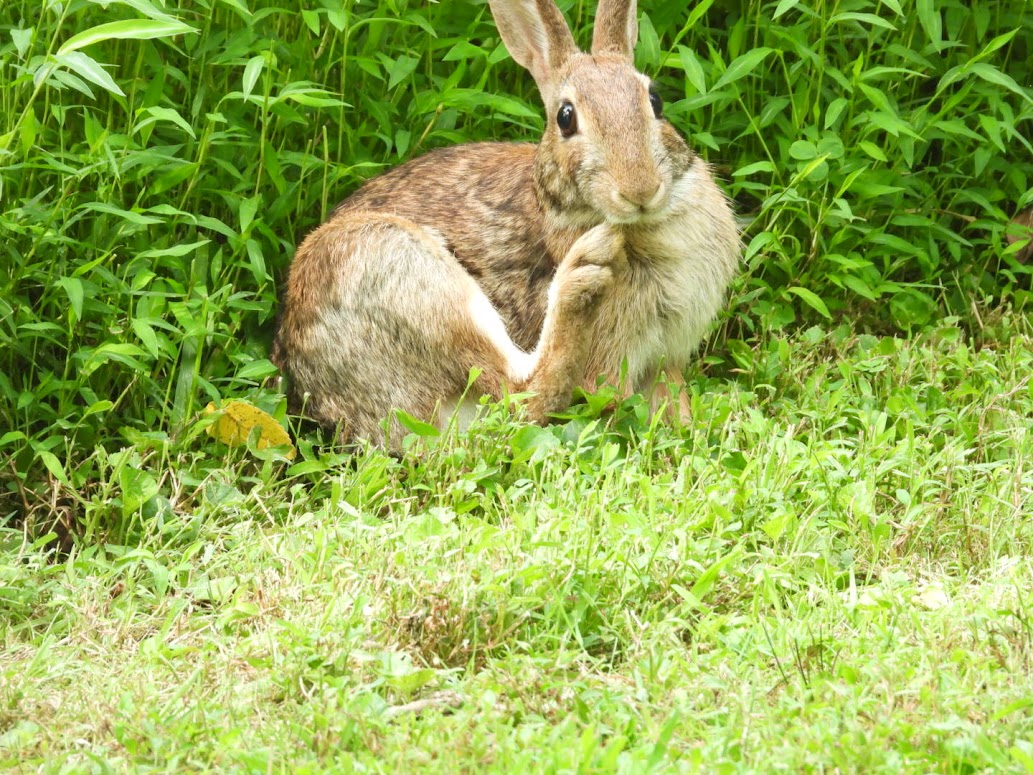 | 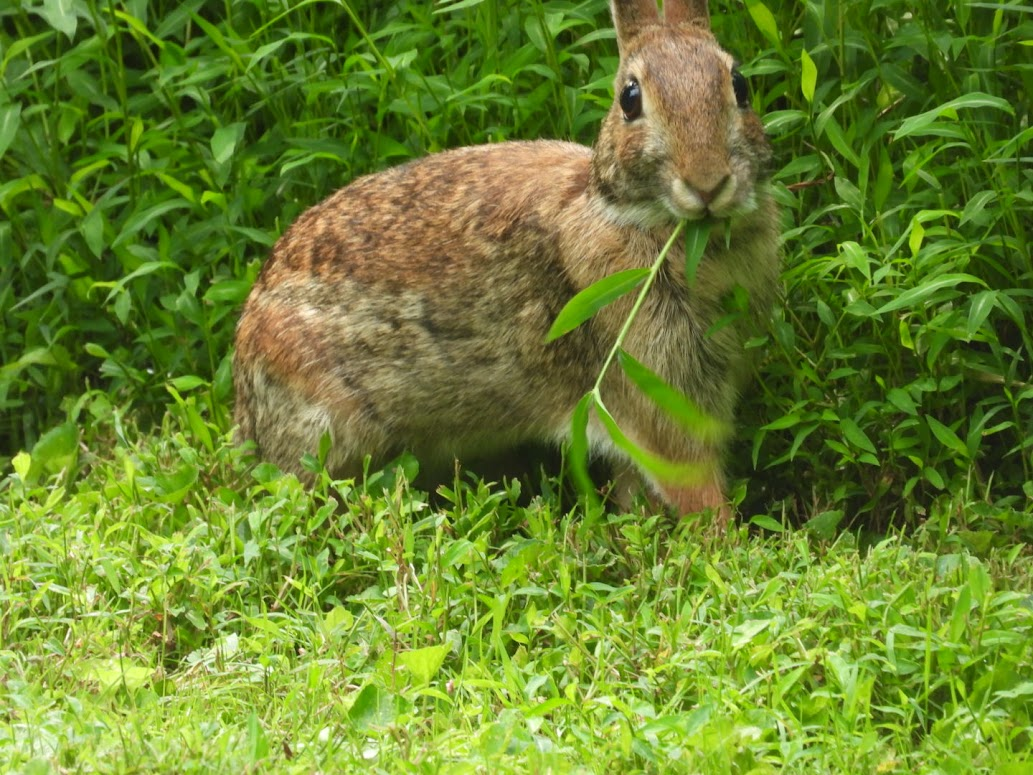 |
| ƒ/5.6, 1/125, ISO560, 198mm (1102mm equiv, 45.9X) | ƒ/6.3, 1/125, ISO400, 324mm (1803mm equiv, 75.1X) |
White-tailed Deer
Due to their propensity to cause accidents, White-tailed Deer are considered to be one of Pennsylvania's deadliest animals. They are another species with low conservation risk, and they range throughout most of the continental US, Mexico, and Central America.
Up until roughly a year ago, I would see these in my yard on an almost daily basis. More recently, they have become much less common. I'm not entirely sure why. The photos on August 2 and August 14 were taken from my yard, with the deer standing in an adjacent property. The photos on August 29 were taken at the Stroud Preserve.
| August 2 | August 2 |
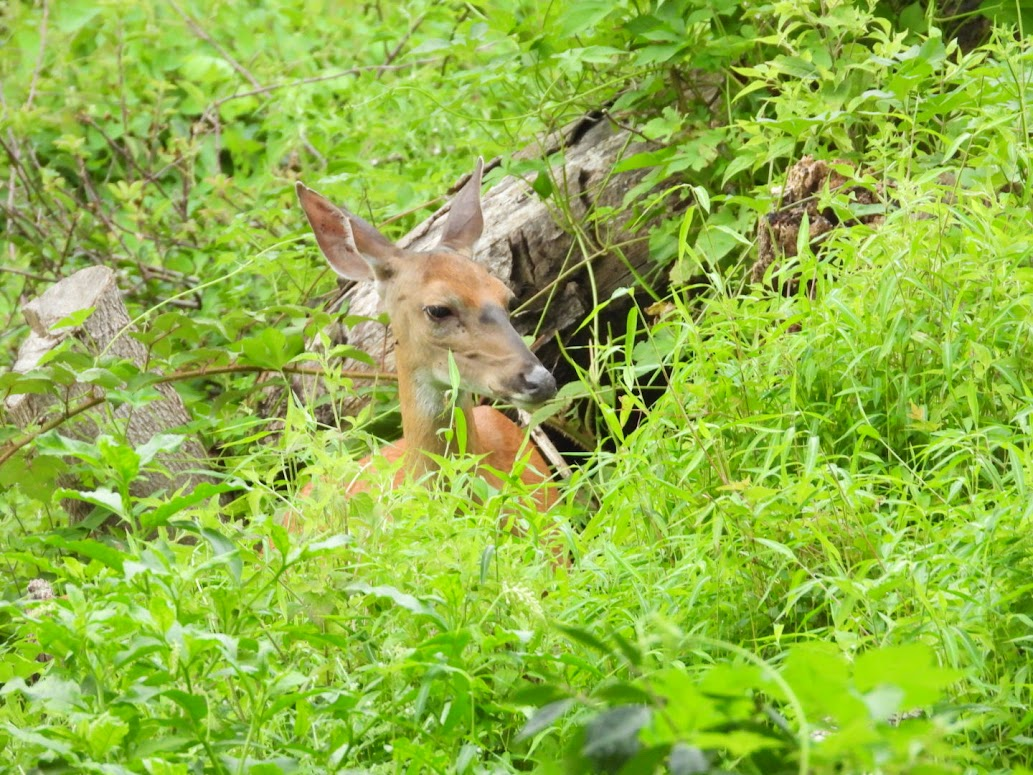 | 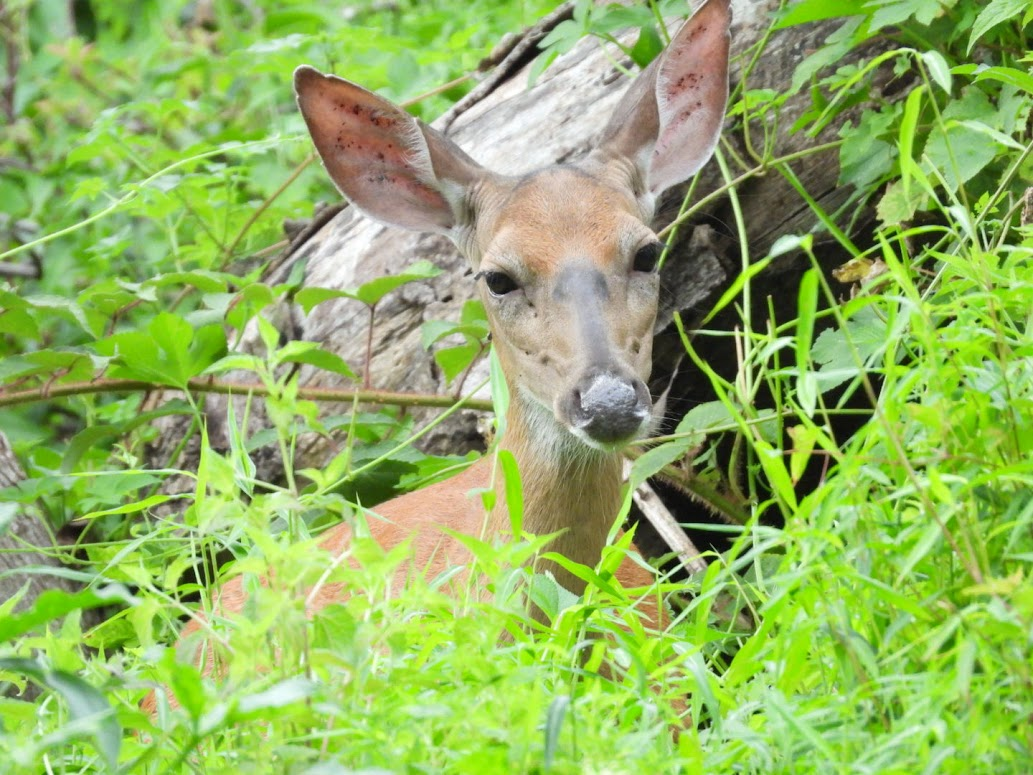 |
| ƒ/5.6, 1/250, ISO900, 155mm (863mm equiv, 36.0X) | ƒ/6.3, 1/250, ISO1100, 288mm (1603mm equiv, 66.8X) |
| August 2 | August 14 |
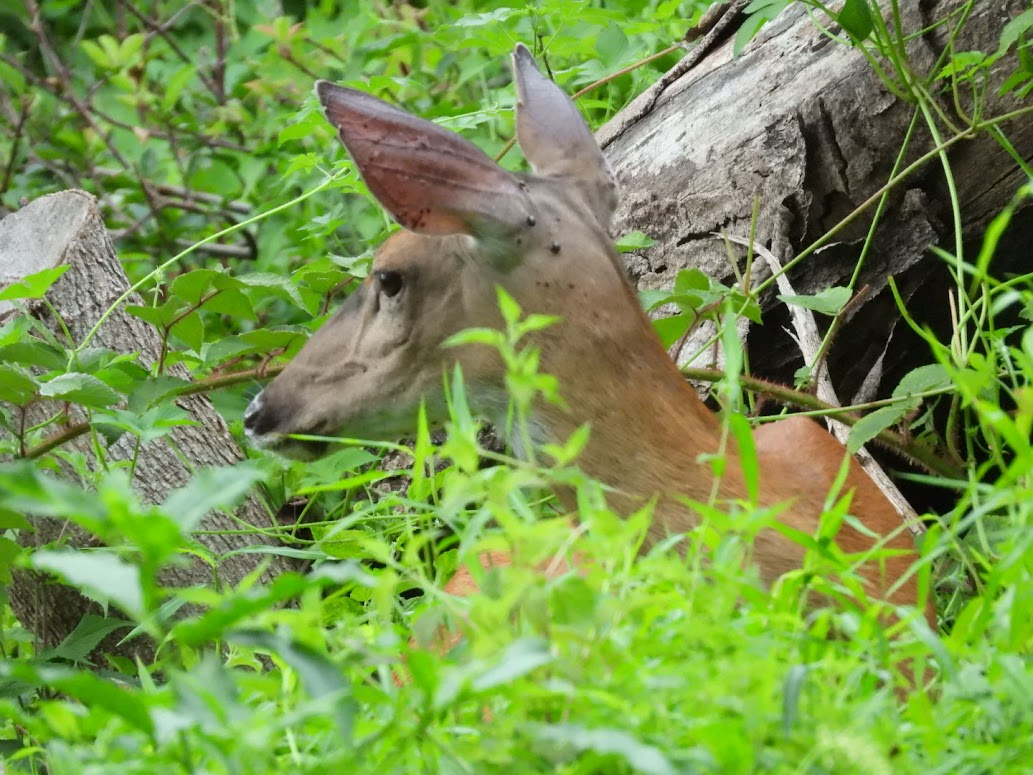 | 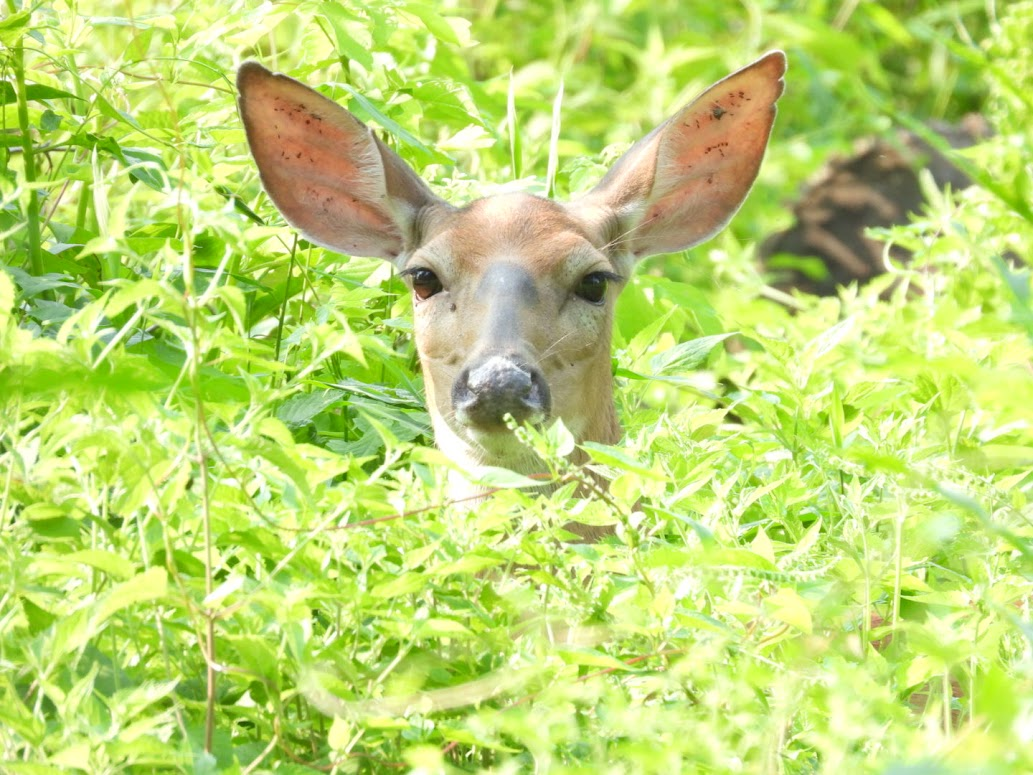 |
| ƒ/6.3, 1/500, ISO1600, 288mm (1603mm equiv, 66.8X) | ƒ/5.6, 1/200, ISO400, 270mm (1503mm equiv, 62.6X) |
| August 29 | August 29 |
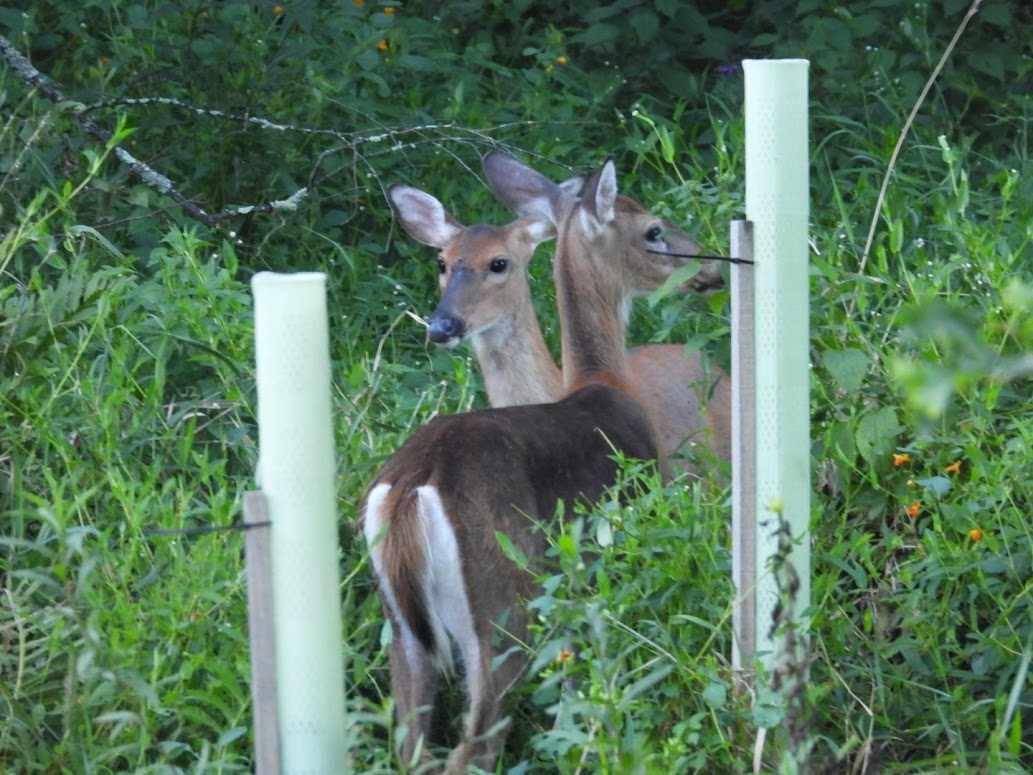 | 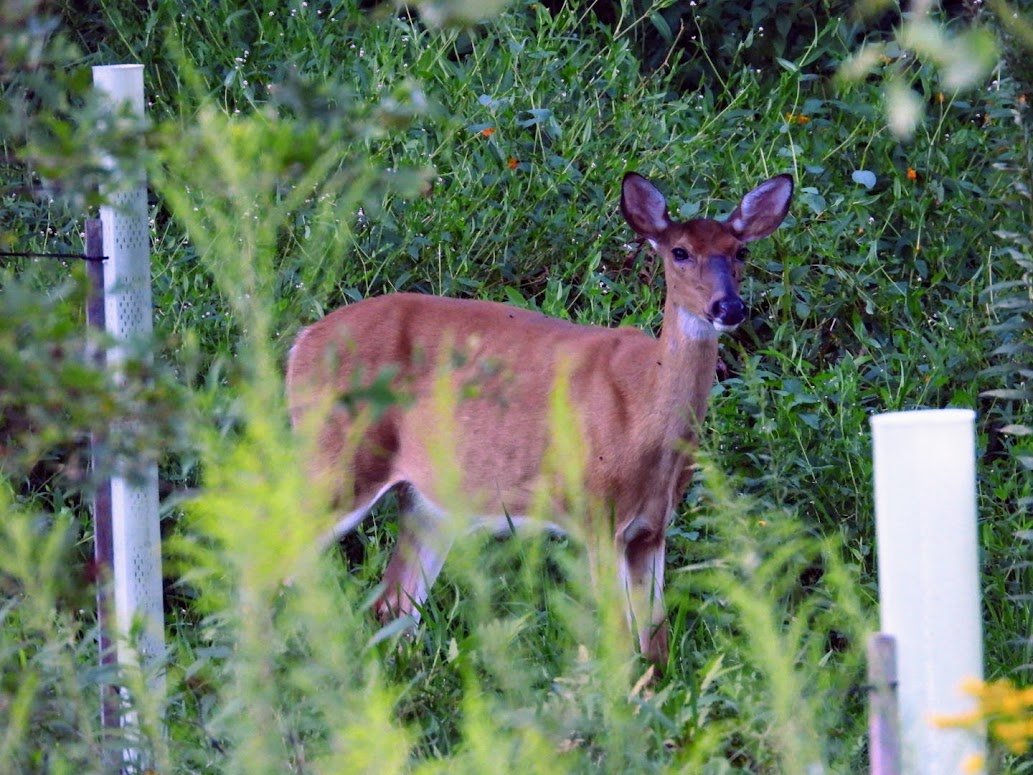 |
| ƒ/5.6, 1/60, ISO800, 198mm (1102mm equiv, 45.9X) | ƒ/5.6, 1/100, ISO800, 167mm (929mm equiv, 38.7X). Lighting adjusted in Google Photos |
American Robin
The American Robin, a type of thrush, was showing up daily in my yard from March through June, but starting in July it has become much less common. I asked one of the LLMs about this and learned that the robin's diet changes from earthworms to berries during the late summer months, and the robin relocates from suburban lawns to nearby forests and meadows. Overall, the Robin has a population numbering in the hundreds of millions and is another species with low conservation concern.
The photos from August 5th show the only time when I saw a Robin carrying some sort of a caterpillar, presumably to take back to the nest. Similarly, one of the August 9th photos shows one holding an earthworm. I'm pretty sure that's the last one that I saw in the lawn.
During previous months, you may recall that these birds were so common that I was only posting iNaturalist observations for unusual events, but in August the Robin has become unusual enough that I started reporting routine encounters again.
| August 5 | August 5 |
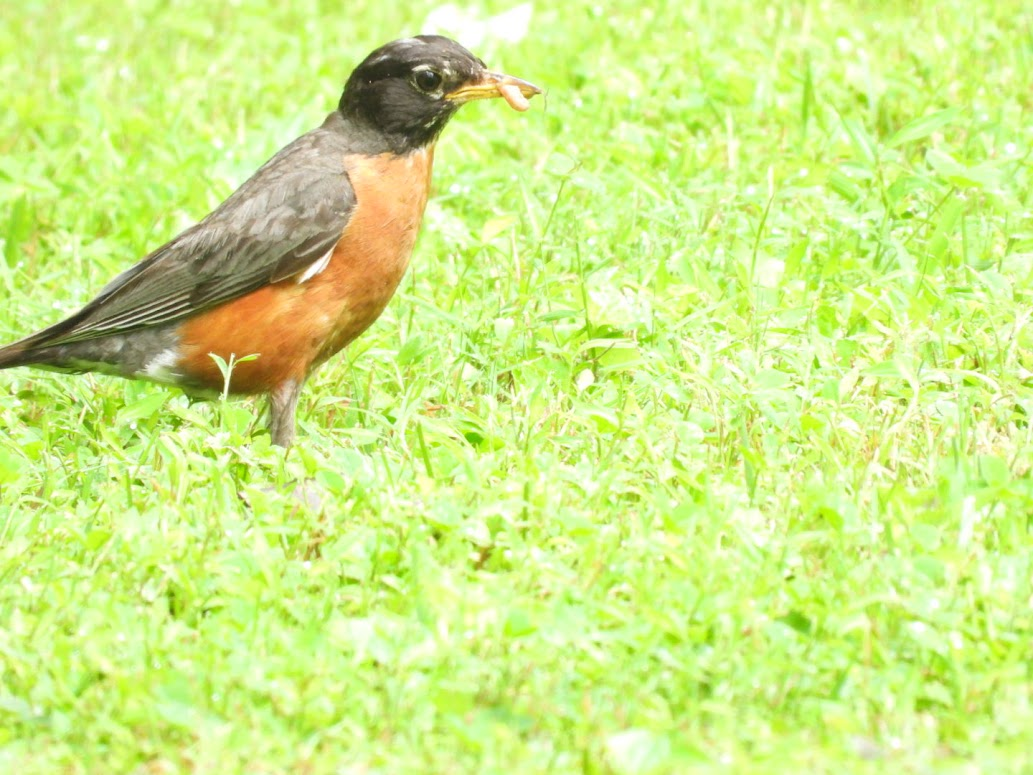 | 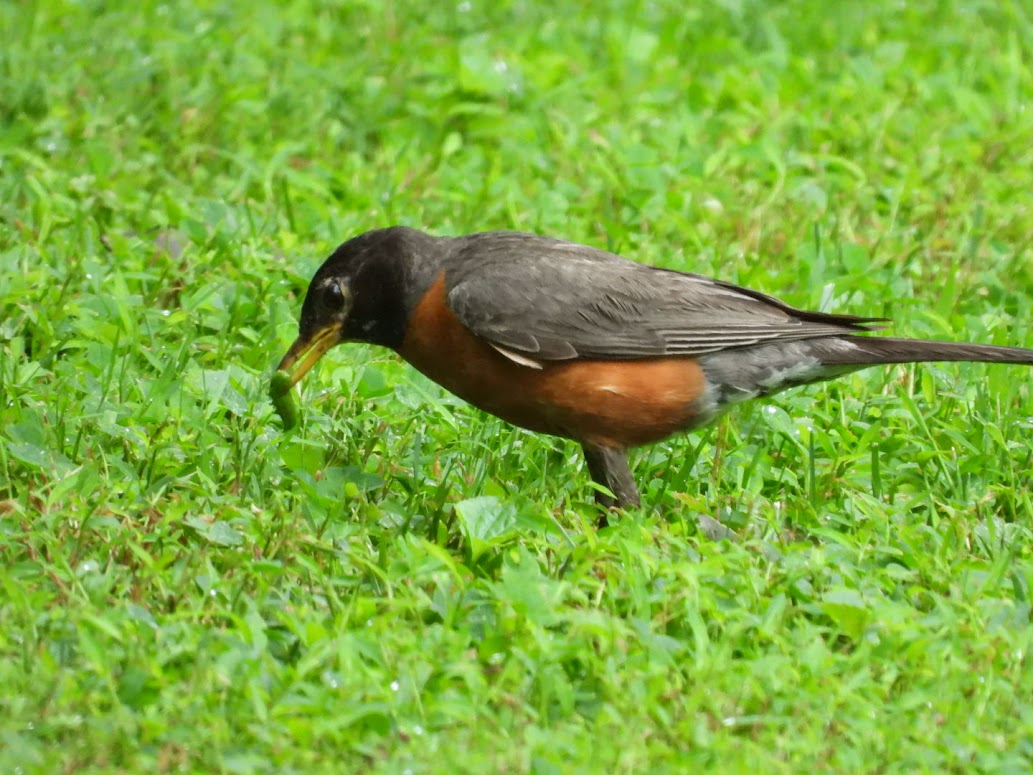 |
| ƒ/8, 1/80, ISO800, 539mm (3000mm equiv, 125.0X) | ƒ/8, 1/500, ISO1600, 539mm (3000mm equiv, 125.0X) |
| August 5 | August 7 |
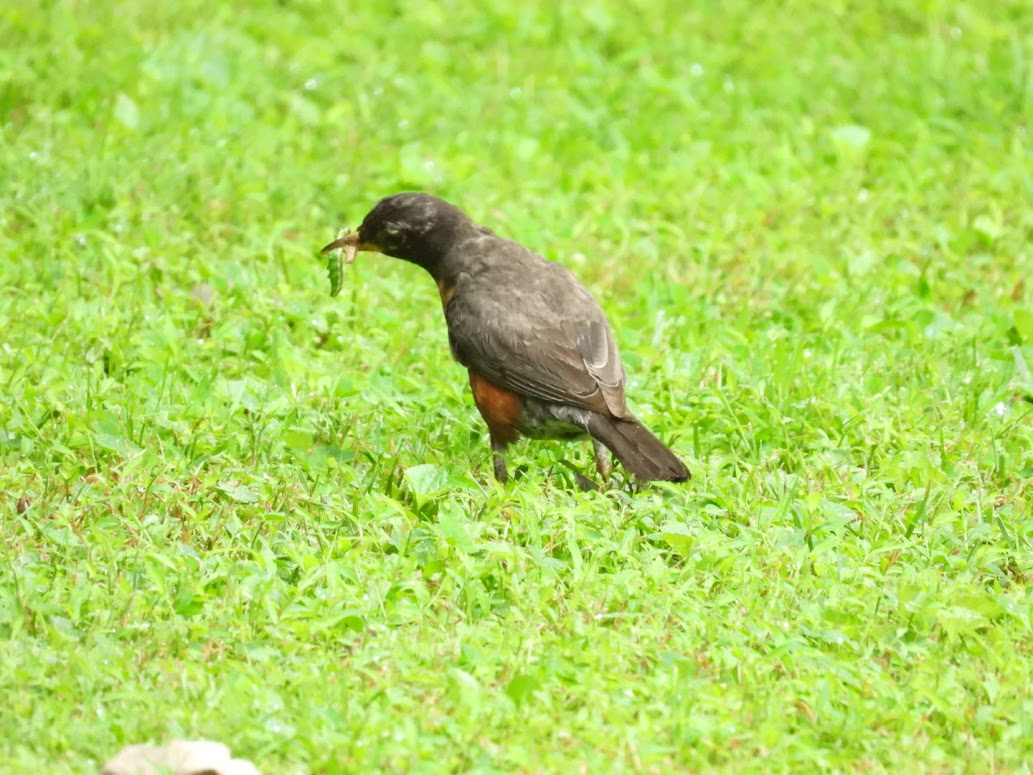 | 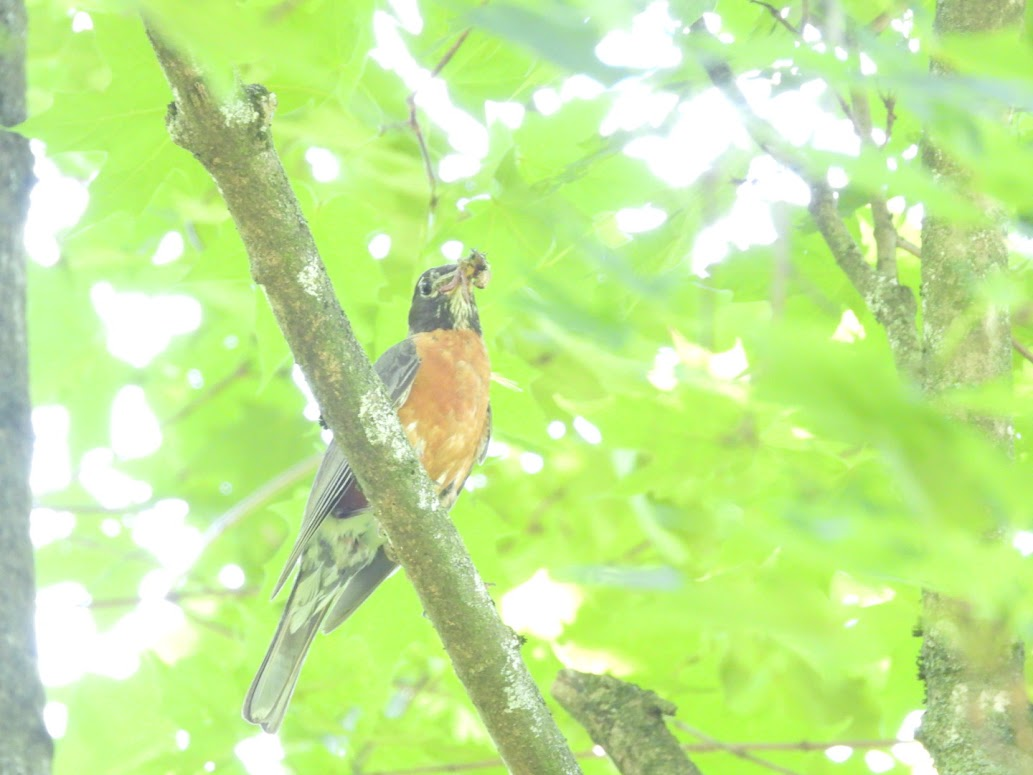 |
| ƒ/6.3, 1/500, ISO1600, 359mm (2000mm equiv, 83.3X) | ƒ/5.6, 1/30, ISO1000, 198mm (1102mm equiv, 45.9X) |
| August 9 | August 9 |
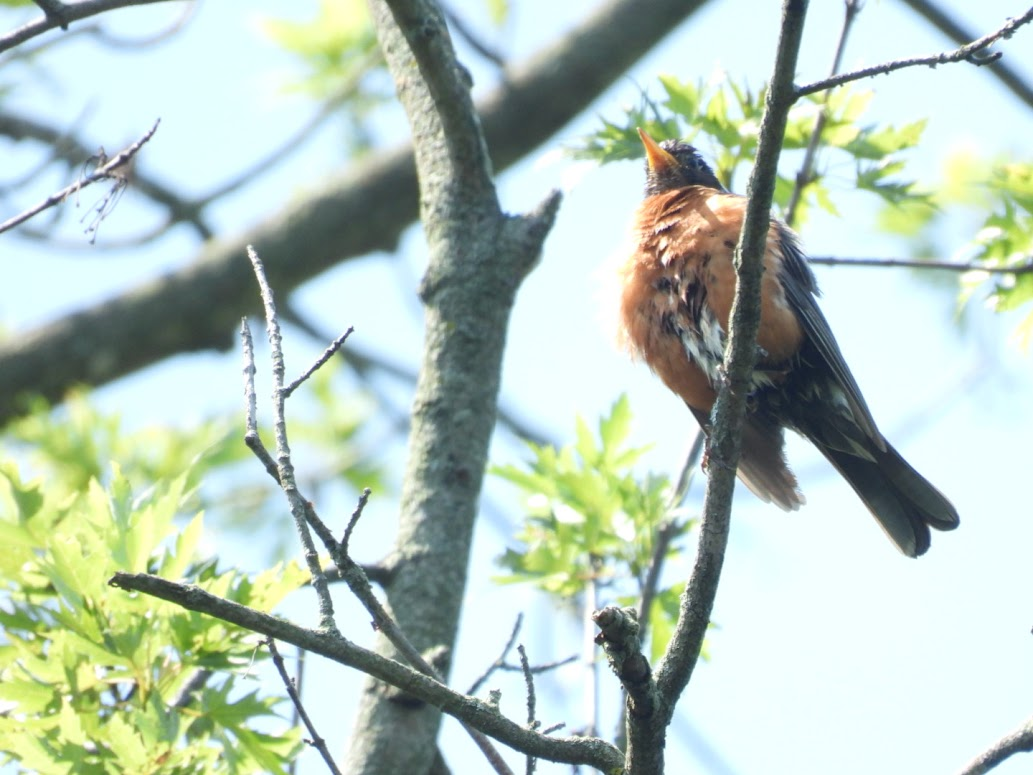 | 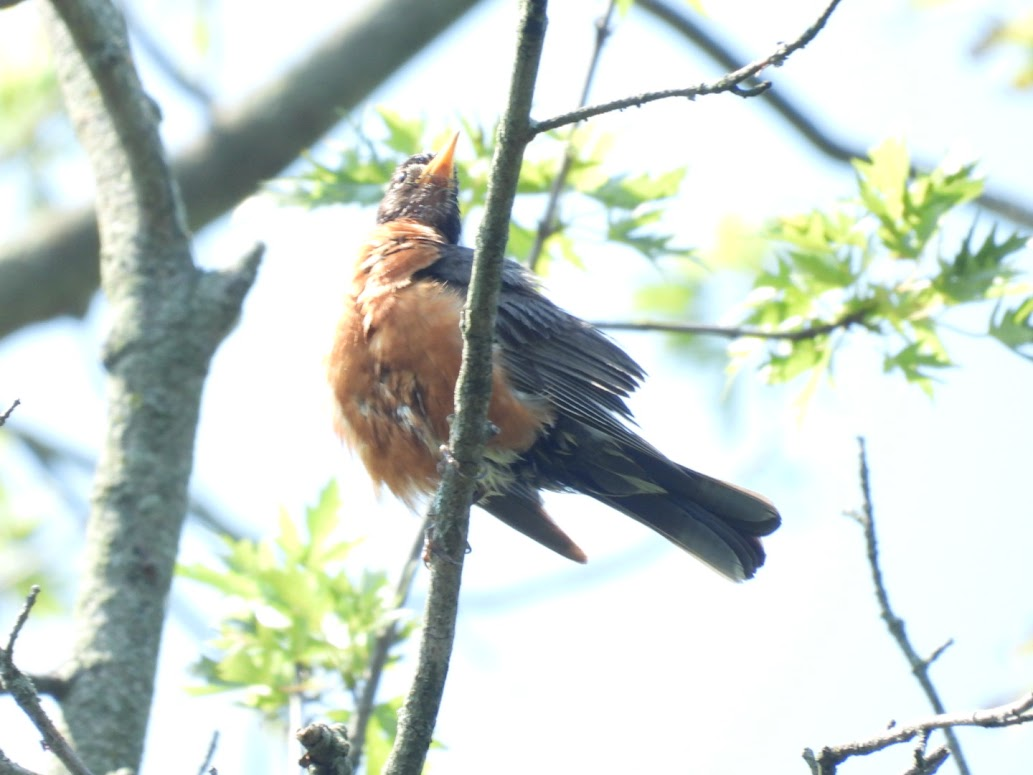 |
| ƒ/7.1, 1/250, ISO400, 432mm (2404mm equiv, 100.2X) | ƒ/8, 1/160, ISO400, 503mm (2800mm equiv, 116.7X) |
| August 9 | August 24 |
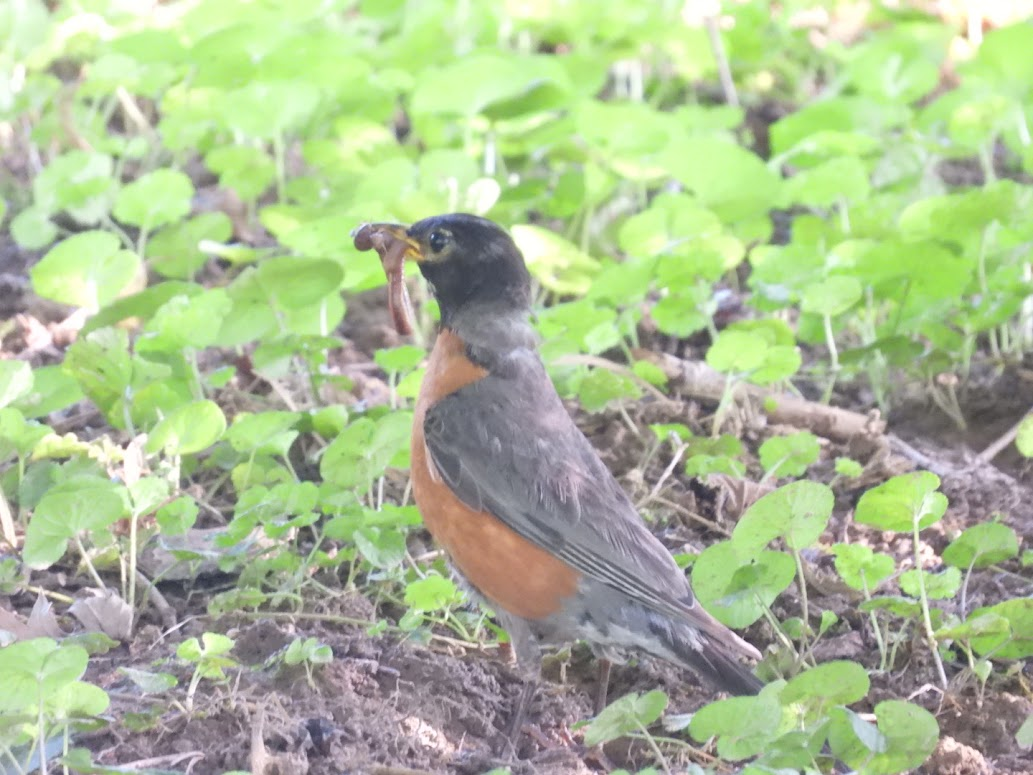 | 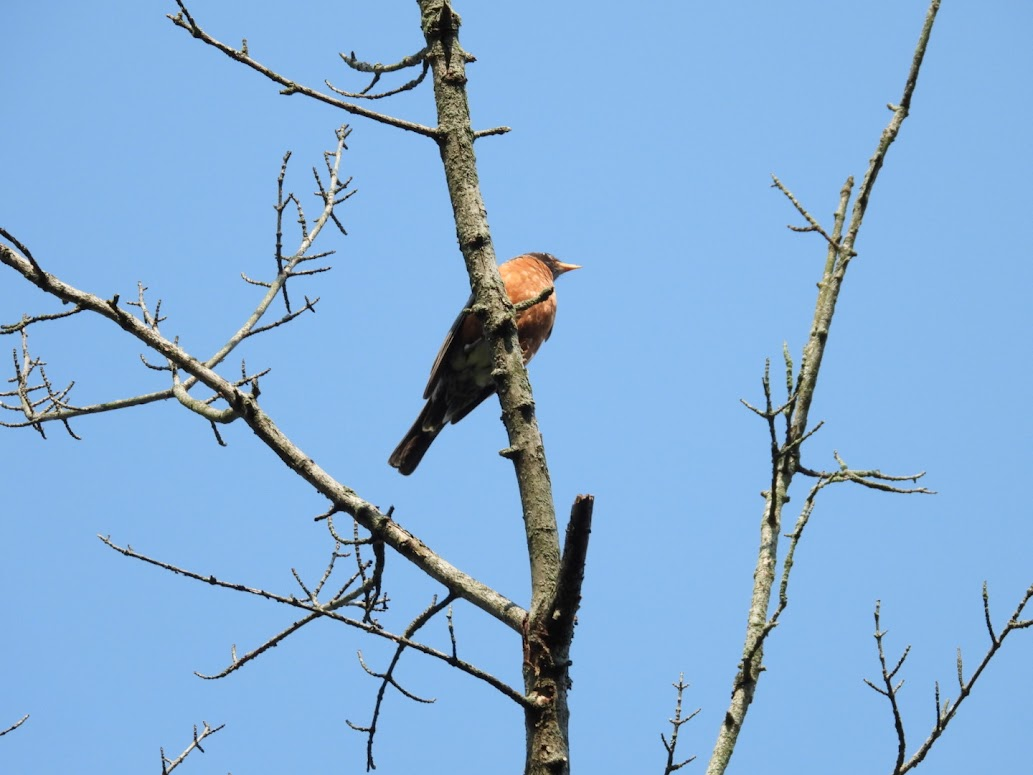 |
| ƒ/6.3, 1/30, ISO1600, 359mm (2000mm equiv, 83.3X) | ƒ/5.6, 1/500, ISO250, 144mm (802mm equiv, 33.4X) |
Gray Catbird
The Gray Catbird is another common bird with low conservation concerns that has followed a similar trajectory to the American Robin. It was common to see them in the lawn during May and June, but they became less common during July and August. One difference between the Gray Catbird and the Robin, however, is that I still hear them quite frequently - basically every time I go out in the yard. They're just very good at hiding in the brush.
I think the one I photographed on August 4th was the most photogenic catbird that I caught on camera this summer. I don't clearly remember the August 11 shots, but I assume it looks wet because I caught it just after it was splashing around in the same air-conditioner condenser puddle where we have previously seen the Song Sparrow and the Chipping Sparrow.
The big gap between August 11 and August 31 reflects the late-summer reduction in frequency of appearances for these birds.
According to the Audubon Society map linked above, the birds are only in Pennsylvania during the breeding season, but according to All About Birds, they have a year-round presence in my part of the state. I'm curious to see whether I will continue hearing their calls during the months of autumn.
| August 4 | August 4 |
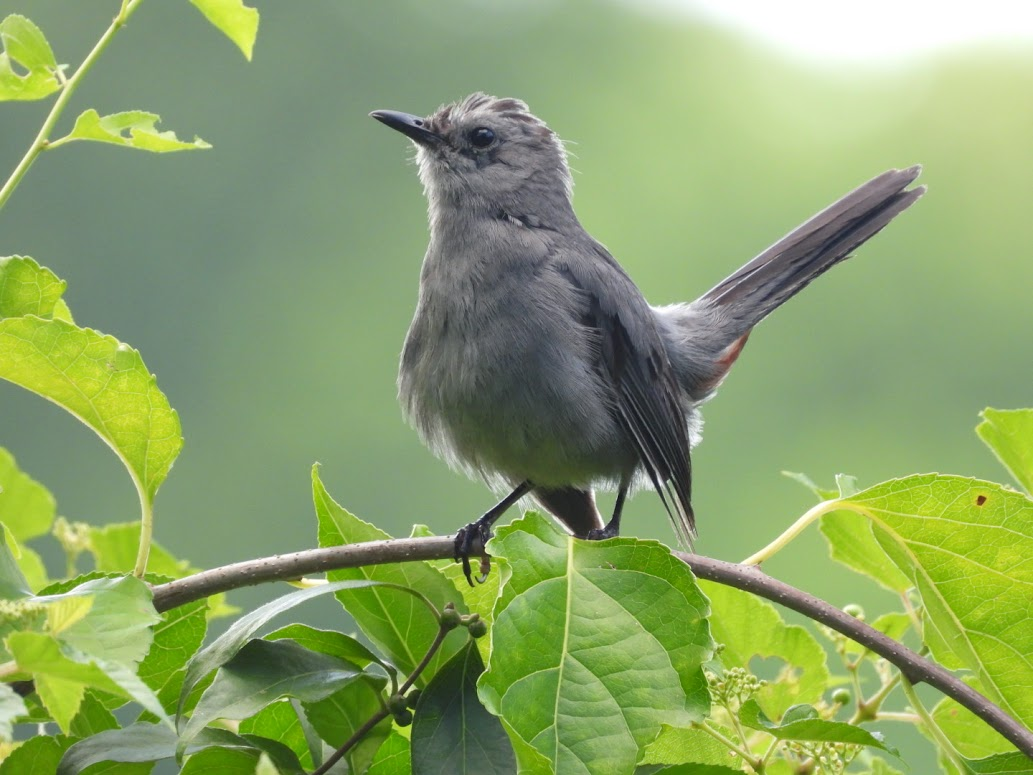 | 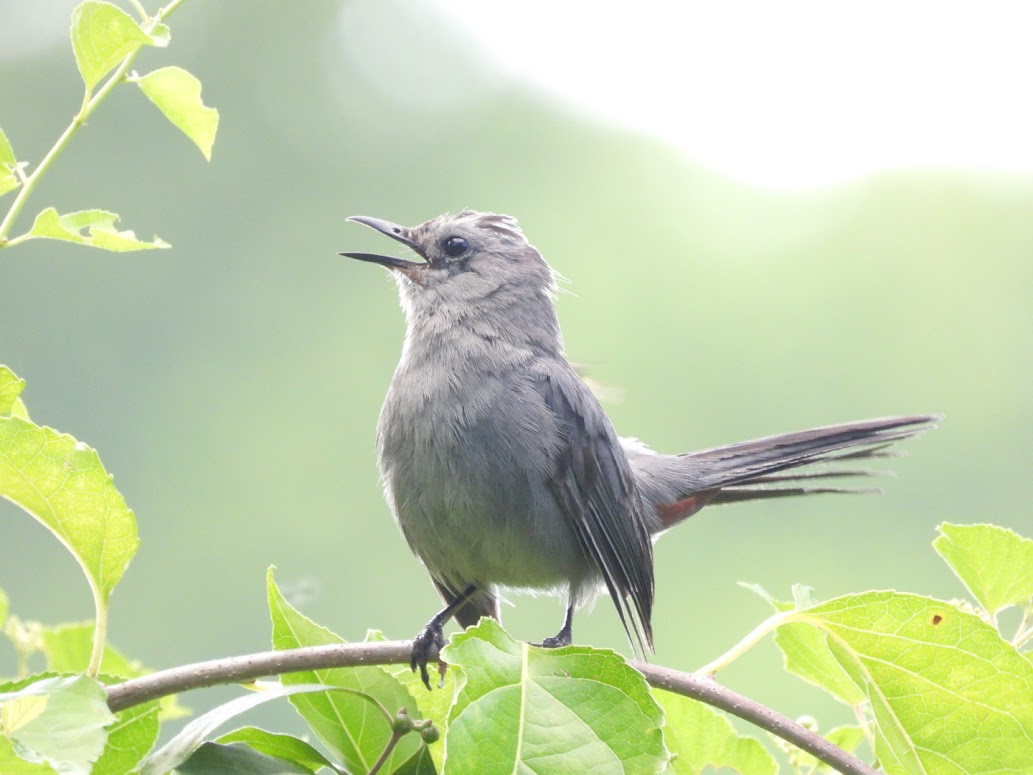 |
| ƒ/6.3, 1/125, ISO400, 324mm (1803mm equiv, 75.1X) | ƒ/6.3, 1/125, ISO720, 324mm (1803mm equiv, 75.1X) |
| August 4 | August 11 |
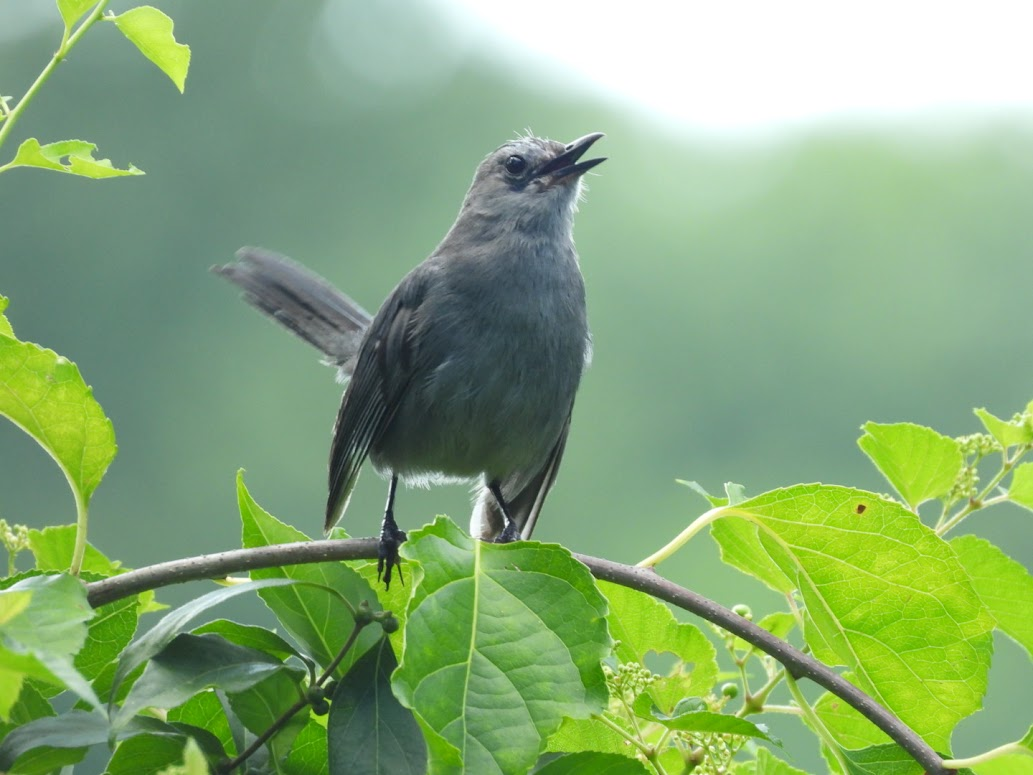 | 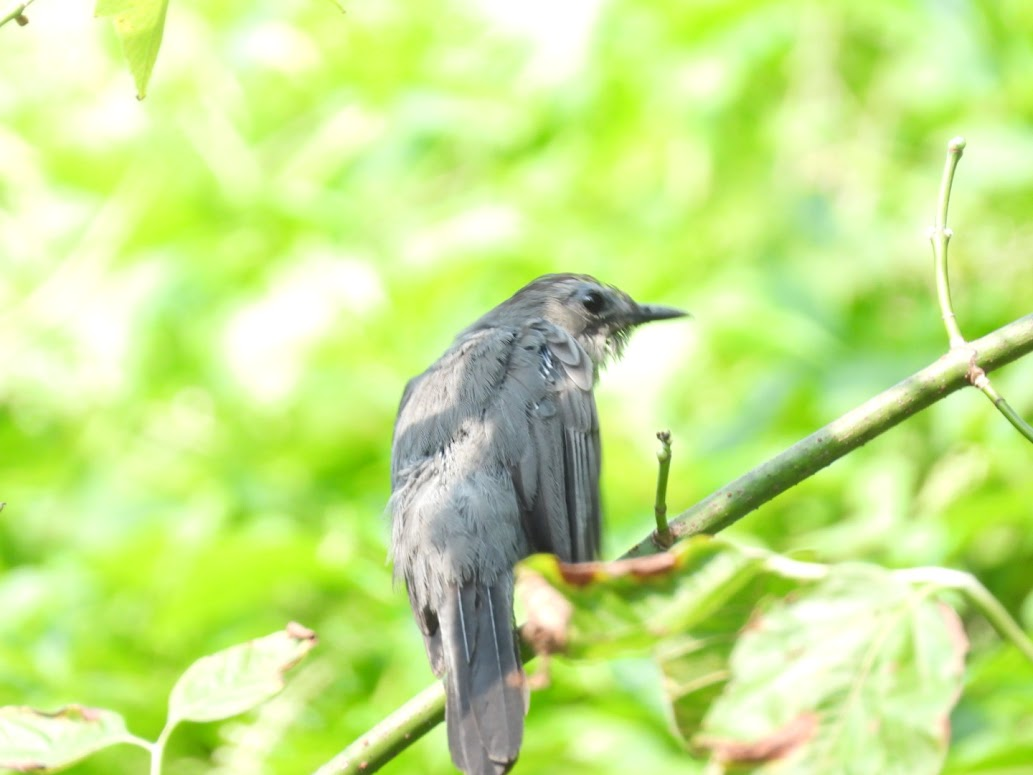 |
| ƒ/6.3, 1/125, ISO400, 306mm (1704mm equiv, 71.0X) | ƒ/6.3, 1/160, ISO400, 324mm (1803mm equiv, 75.1X) |
| August 11 | August 31 |
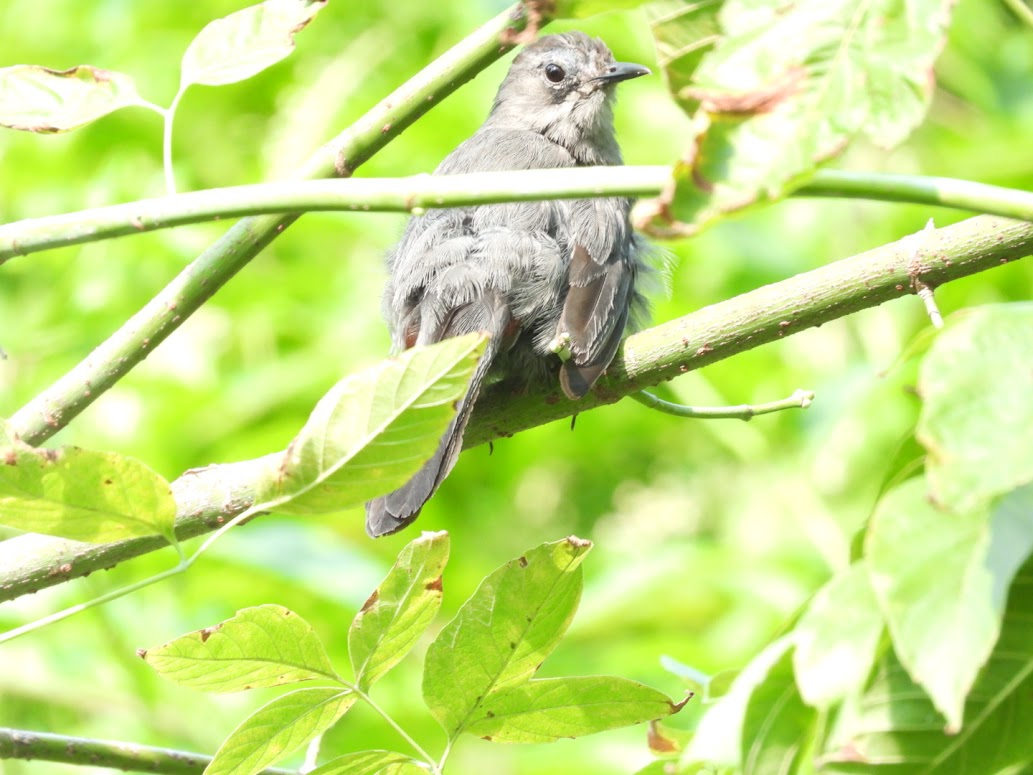 | 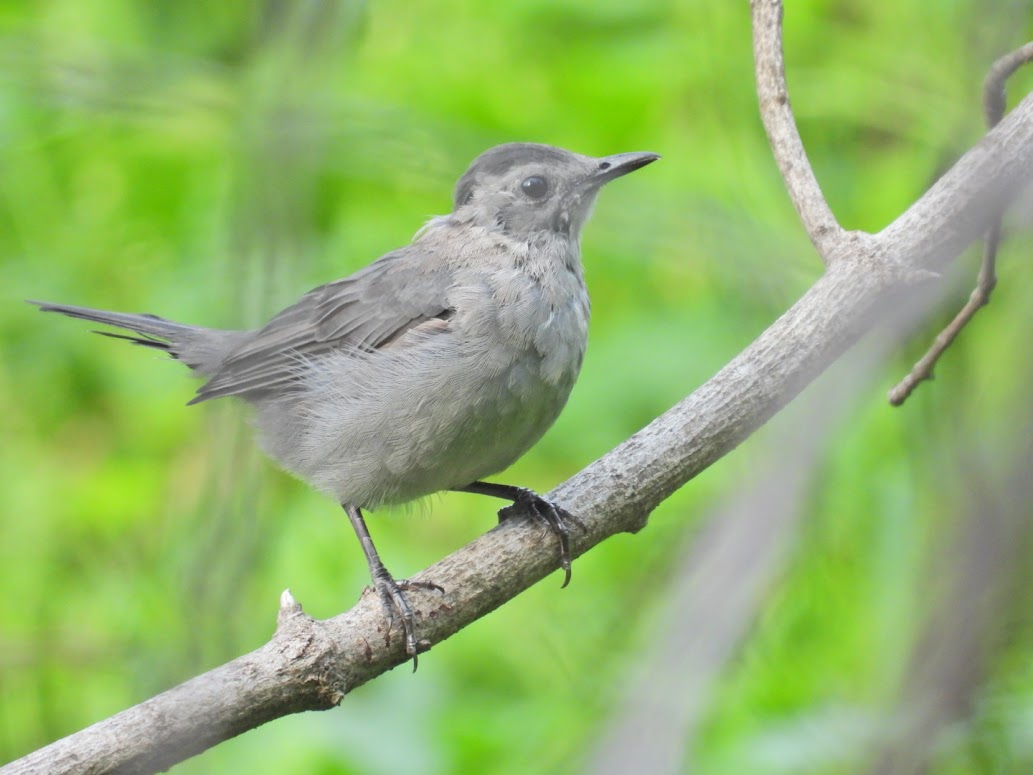 |
| ƒ/6.3, 1/160, ISO400, 324mm (1803mm equiv, 75.1X) | ƒ/7.1, 1/160, ISO450, 467mm (2601mm equiv, 108.4X) |
Eastern Bluebird
The Eastern Bluebird is another species with low conservation risk and a year-round presence in Pennsylvania. It can be found year-round in most of the eastern and central US, expanding north into Canada during summer and south and west into Mexico during the winter. The species was previously in decline, but it has recovered to about 23 million through conservation efforts, like the use of nest boxes.
Personally, I think I've only seen these birds three times. I saw a male and a female in my yard in April and a juvenile female in my yard in September (which will be covered in a post next month). The August 25 observation, a male, was at the Stroud Preserve.
| August 25 | August 25 |
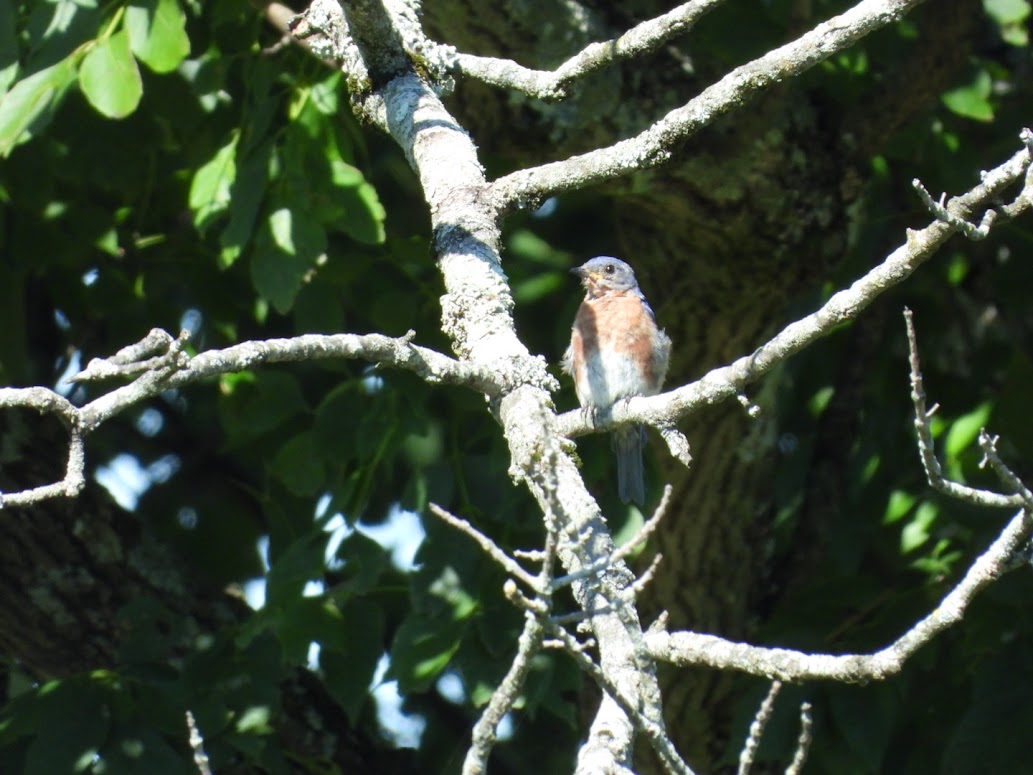 | 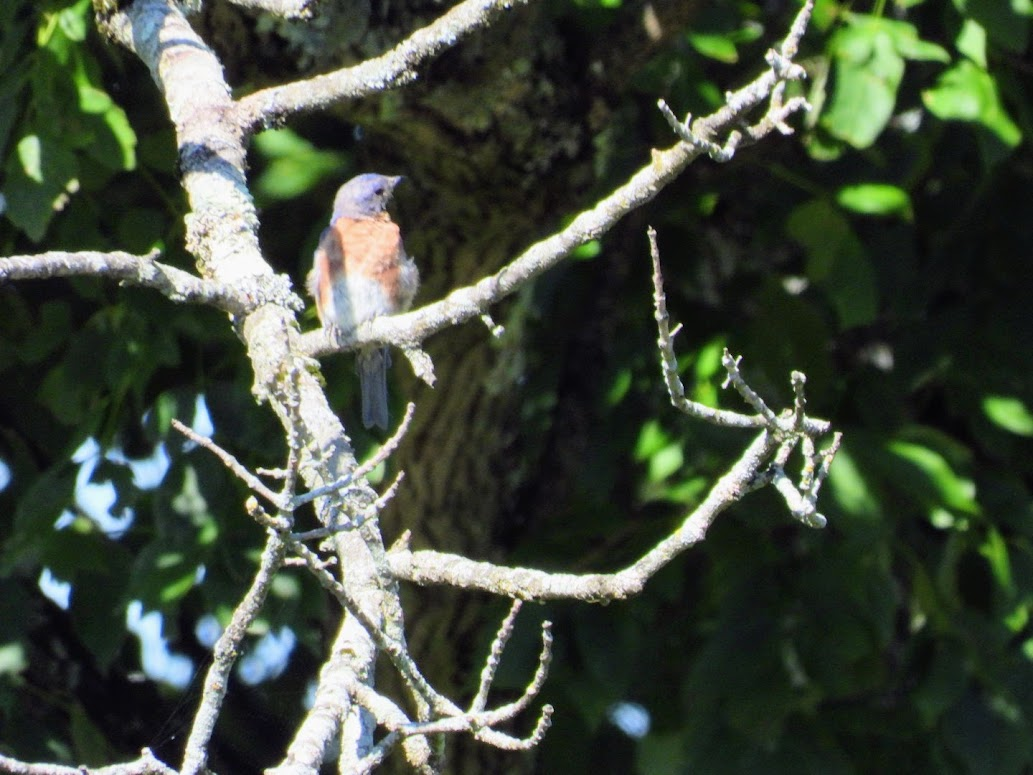 |
| ƒ/8, 1/250, ISO400, 539mm (3000mm equiv, 125.0X) | ƒ/8, 1/400, ISO400, 539mm (3000mm equiv, 125.0X). Lighting adjusted in Google Photos |
Wrap-up
That concludes the third post covering my wildlife photography in August. Seven species with eighteen observations on iNaturalist turned out to include many more photos than I expected when I actually reviewed the month's photos.
From the rabbits, squirrels, and robins at meal time to the hidden cardinal, the squirrel's commando crawl, and the catbird's "puddle bath", the animals in this post had a lot of personality that I hadn't remembered until I started work on this post.
Please keep an eye on this space for two more posts covering August photography. One more post will wrap up the small birds from the month and the other - as usual - will cover the raptors. As the summer closes, I guess we'll expect to see some migratory species in posts after that, but that remains to be seen.
Appendix
A full index of my posts about wildlife photography is here: wildlife photography index
Notes on the use of AI
As previously noted, I use AI for the following purposes in creating this series:
- Wildlife identification (Merlin, iNaturalist, Meta AI, Claude, Gemini)
- Formatting iNaturalist observations, photographs, dates, and camera settings into markdown tables (Claude)
- Proof-reading and editorial advice (Claude, Gemini, Meta AI, ChatGPT, Grok)
Thank you for your attention!
Unless otherwise specified in the text, all photos above were taken by me with a (handheld) Nikon P1000 camera. I'm sharing them under the CC BY 4.0 license (share & adapt freely with attribution to the original source).