The Quiet Art of Making Space for Creativity
There is a moment, often overlooked, when creativity feels less like inspiration and more like permission. Not permission from others, but from ourselves...to slow down, to make something without urgency, to engage in a process that does not demand immediate results.
For many of us, that permission is difficult to grant. Modern life rewards speed and efficiency. We are taught to optimize time, to move quickly from one task to another, to measure output rather than experience. Creativity, especially the kind that involves working with our hands, rarely fits neatly into that framework.
And yet, it persists.
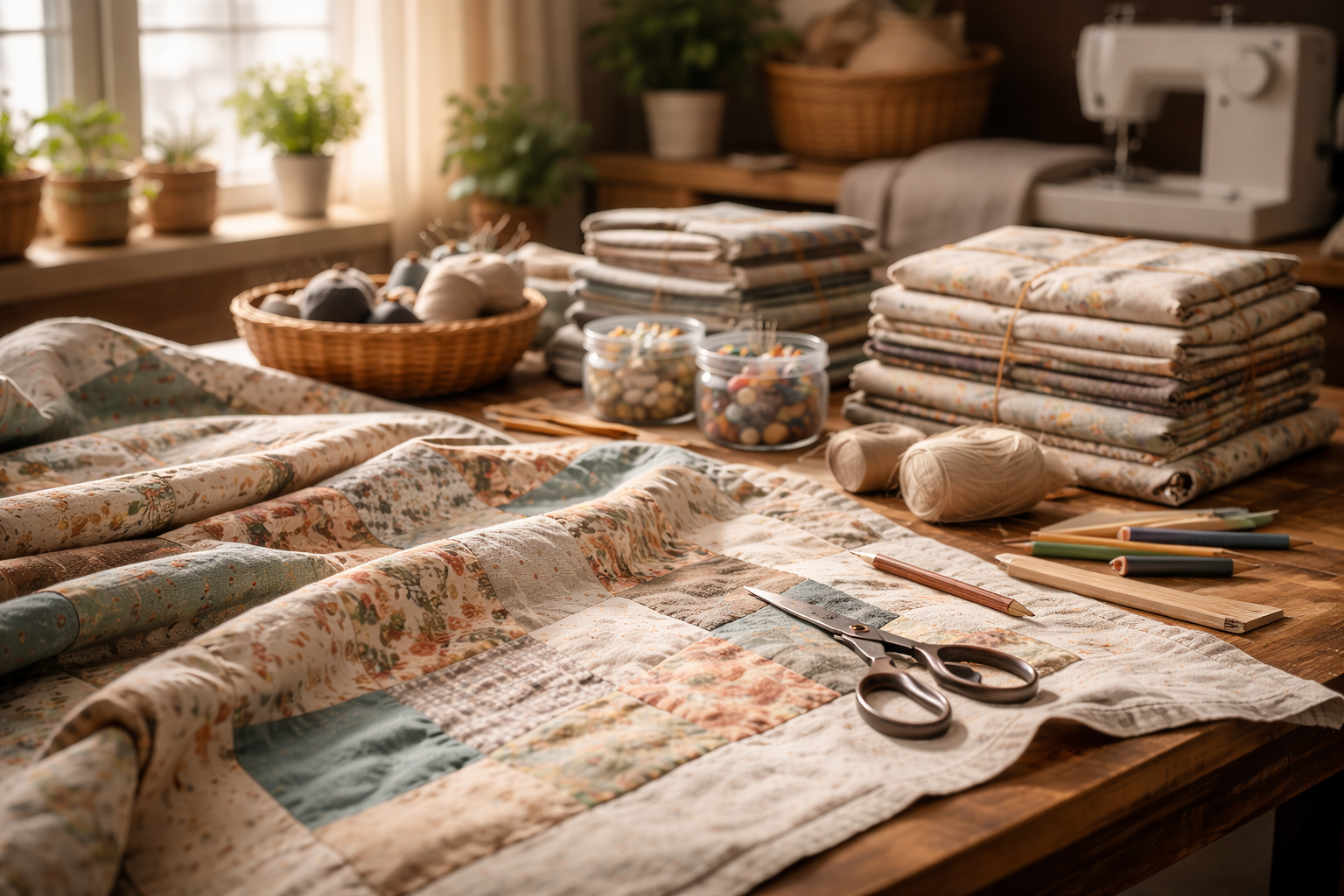
In recent years, I’ve noticed a quiet shift. Not loud or trend-driven, but steady. People are returning to hobbies that require patience: sewing, painting, woodworking, gardening. These are not activities designed for instant gratification. They unfold slowly, often imperfectly, and in doing so, they offer something that faster pursuits cannot.
The Value of Working With Materials
There is a difference between consuming something and creating it. The difference lies not only in effort, but in attention.
When you work with physical materials such as fabric, wood, clay, you begin to understand their limitations and possibilities. You learn that not everything can be rushed. Some materials resist shortcuts. They require preparation, care, and sometimes even a willingness to start over.
I remember the first time I worked on a larger sewing project. What seemed straightforward at first became unexpectedly complex. The fabric behaved differently depending on how it was cut, how it was handled, how it was stitched. Small decisions had visible consequences.
At one point, I found myself researching something as specific as wideback fabric per yard, not because I intended to write about it, but because I had reached a stage where the scale of the material began to matter. It was no longer just about what looked good, but about how the material functioned across a larger surface, how it reduced seams, how it changed the entire process.
That moment stayed with me. It was a reminder that creativity often deepens when we move beyond surface-level choices and begin to understand the materials themselves.
Slowness as a Form of Clarity
There is a misconception that slower activities are less productive. In reality, they often produce a different kind of clarity.
When you spend hours on a single task like cutting, measuring, assembling, you begin to notice patterns in your own thinking. Distractions become more obvious. Impatience reveals itself. At the same time, focus becomes easier to sustain.
Psychologists sometimes describe this state as “flow,” a condition in which attention is fully absorbed in the present moment. It is not limited to creative work, but hands-on activities tend to encourage it more naturally than passive ones.
The appeal of hobbies like sewing or crafting is not only in the final product, but in the mental space they create. They slow the pace of thought. They make room for reflection.
The Relationship Between Space and Creativity
Creative work is influenced not only by time, but by space both physical and mental.
A cluttered environment can make it difficult to focus. Materials scattered without order create friction. You spend more time searching than creating. Over time, this can discourage even the most motivated person.
But space is not only about organization. It is also about scale.
Working on larger projects, whether a piece of furniture, a painting, or a textile, changes how you approach the process. You begin to think in broader terms. Small imperfections matter less when viewed from a distance. The work becomes less about precision in isolation and more about cohesion as a whole.
This shift can be surprisingly liberating. It allows for experimentation. It invites you to step back and see the bigger picture.
Imperfection and Ownership
One of the most overlooked benefits of making things by hand is the relationship we develop with imperfection.
Mass-produced items are designed to be consistent. They aim for uniformity, often at the expense of individuality. Handmade objects, by contrast, carry small irregularities like slight variations in stitching, subtle differences in alignment, textures that cannot be replicated exactly.
At first, these imperfections can feel like mistakes. But over time, they become markers of effort. They tell a story about how the object came to be.
There is a quiet satisfaction in recognizing that something exists because you made it. Not perfectly, but deliberately.
The Return to Tangible Work
As more aspects of life move into digital spaces, the appeal of tangible work grows stronger. Screens offer efficiency, but they rarely provide the same sensory experience as working with physical materials.
The feel of fabric between your hands, the sound of scissors cutting through layers, the rhythm of a sewing machine; these are experiences that engage the body as much as the mind.
They also create a sense of completion that is difficult to replicate digitally. A finished piece occupies space. It can be used, touched, shared.
In a world where so much is temporary or intangible, that physical presence matters.
Making Without Urgency
Perhaps the most important shift is not in what we make, but in how we approach making.
There is value in creating without a deadline, without the pressure to produce something immediately useful or impressive. This kind of work allows for exploration. It creates room for mistakes, revisions, and unexpected outcomes.
Not every project needs to be efficient. Not every effort needs to be optimized.
Sometimes, the act of making is enough.
A Different Measure of Value
We often measure value in terms of speed, cost, or output. But creative work invites a different set of metrics:
- How did the process feel?
- What did it teach you?
- Did it hold your attention in a way that other activities do not?
These questions do not produce numerical answers, but they point to something more enduring.
Working with materials, understanding them, shaping them, adapting to them, reconnects us with a slower, more deliberate way of thinking. It reminds us that not everything needs to be immediate to be meaningful.
And sometimes, the most valuable outcome is not the object itself, but the time and attention we gave to creating it.