Dog Food Market Size, Share and Trends Forecast 2026-2034
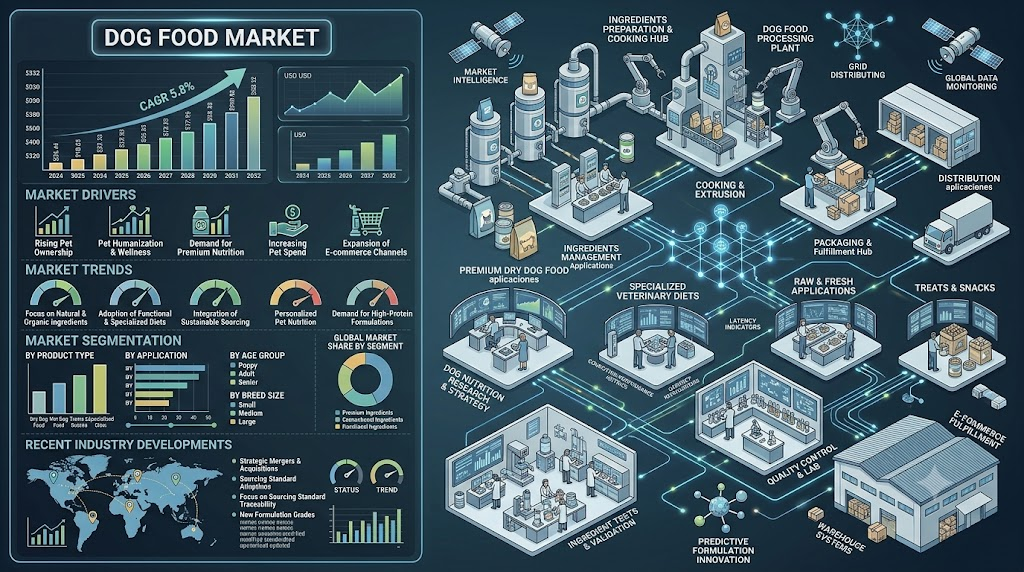
IMARC Group, a leading global market research and management consulting firm, has published its latest market intelligence report on the dog food market. The global dog food market size was valued at USD 75.3 Billion in 2025. Looking forward, IMARC Group estimates the market to reach USD 106.0 Billion by 2034, exhibiting a CAGR of 3.71% from 2026-2034. driven by rising pet ownership and pet humanization trends, growing awareness of pet health and nutrition, expanding e-commerce and specialty retail access, and continuous innovation in functional, breed-specific, and sustainable formulations.
The market is on a steady growth path underpinned by the deepening emotional bond between owners and their pets, with dogs increasingly treated as family members rather than animals to be fed leftovers. Global dog ownership has climbed sharply, with the worldwide dog population reaching 604.5 million in 2022, and rising disposable incomes are letting owners spend more on premium, customized, and health-targeted nutrition. Dry dog food remains the backbone of the category on account of its convenience and shelf stability, while mass-priced products continue to reach the broadest consumer base even as premiumization gathers pace at the top end. North America anchors global demand, but Asia Pacific and Latin America are emerging as the fastest-growing regions as pet ownership expands rapidly in China, India, and Brazil.
Dog Food Market at a Glance:
- Market Size 2025: USD 75.3 Billion
- Forecast Size 2034: USD 106.0 Billion
- Growth Rate 2026-2034: CAGR of 3.71%
- Leading Product Type: Dry Dog Food, 65.3% share in 2025
- Leading Pricing Type: Mass Products, 64.0% share in 2025
- Dominant Region: North America, with over 35.1% revenue share in 2025 (United States holding 87.60% of the regional total)
How AI is Reshaping the Future of the Dog Food Market
- AI-Driven Personalized Nutrition: PawCo Foods launched PawCo AI in March 2026, an AI-powered dog nutrition assistant delivering personalized, veterinary-informed guidance, building on its earlier 2025 partnership with Harvard's Data Analytics Group to develop what the company describes as the first AI-optimized platform for canine nutrition.
- Photo-Based Health Screening for Custom Formulation: Direct-to-consumer brand Ollie uses AI-assisted photo submissions and its "Foodback" data loop to translate real-world pet health outcomes into individualized recipes, a model recognized at Petfood Forum 2026 as a template for hyper-personalized nutrition.
- AI in Formulation and Manufacturing Operations: Industry panels at the 2026 International Production & Processing Expo highlighted AI's expanding role from recipe design through kibble production, with formulation software platforms now used by veterinary nutritionists to build individualized diets at scale.
Grab a sample PDF of this report: https://www.imarcgroup.com/dog-food-manufacturing-plant/requestsample
Dog Food Market Trends and Drivers:
Rising dog ownership is the foundational driver of market growth, with pet food manufacturers reporting a global market value of USD 80.03 Billion in 2022 for dogs, the largest share of any pet category, and forecasts projecting further expansion as commercial pet food increasingly displaces home-prepared meals. Health-conscious ownership is compounding this trend: dog parents are seeking food that addresses specific concerns such as obesity, diabetes, and allergies, prompting manufacturers to expand functional lines targeting immunity, digestive health, and coat condition, alongside a wave of new flavors, textures, and specialized diets such as grain-free and breed-specific formulas.
Sustainability and novel-protein innovation are emerging as a structural differentiator globally. In the United Kingdom, Meatly partnered with The Pack to launch "Chick Bites," the first lab-grown meat dog treats available for purchase, aiming to reduce the environmental footprint of pet food production, while the European pet food industry, through FEDIAF, has authorized insect-based proteins such as black soldier fly and mealworm as sustainable, high-digestibility alternatives to conventional animal protein.
Government and industry regulatory frameworks are increasingly shaping how manufacturers can label, certify, and export products, a dynamic that spans the United States, the European Union, and India and is detailed further below. Regulatory clarity around novel ingredients and premium and functional claims continues to open new product categories even as compliance costs rise for smaller manufacturers.
Global Regulatory, Trade, and Sustainability Landscape Shaping Demand:
- US FDA/AAFCO Framework Evolution: The FDA delegates pet food ingredient and labeling standards to AAFCO, which is preparing the first major update to pet food labels in more than 40 years, while the bipartisan Innovative FEED Act of 2025 (H.R. 2203/S. 1906) proposes deeming AAFCO-listed ingredients GRAS by default and setting FDA review timelines, a change the industry expects to speed new-ingredient approvals.
- EU Novel Protein Authorization: The European Food Safety Authority has cleared multiple insect species, including yellow mealworm and house cricket, as authorized novel food/feed proteins under Regulation (EU) 2015/2283, giving EU manufacturers a regulatory pathway to market sustainable, high-digestibility (up to 90%) alternative-protein dog food.
- India Food Processing Manufacturing Standards: India's food processing sector, which includes pet food manufacturing, operates under the Ministry of Food Processing Industries' quality and safety framework, with cumulative PLI-linked investment across the food processing sector surpassing Rs 9,000 Crore against a committed Rs 7,000 Crore as of 2026.
- Sustainable Packaging Compliance: Leading manufacturers are proactively adopting biodegradable and recyclable packaging materials ahead of tightening extended producer responsibility and packaging-waste rules across the EU and North America.
Key Government Schemes and Policy Programs Supporting the Industry:
- India, PLI Scheme for Food Processing Industry (PLISFPI): India's Ministry of Food Processing Industries is running a Rs 10,900 Crore PLI scheme (FY2021-22 to FY2026-27) covering processed food categories including pet-food-relevant segments, with 128 companies and 274 units approved, cumulative investment surpassing Rs 9,000 Crore, and a target of nearly 2.5 Lakh jobs and Rs 33,494 Crore in additional processed food output by 2026-27.
- United States, Innovative FEED Act (Pending): Reintroduced in March 2025 as H.R. 2203 and S. 1906, the bill would streamline FDA review of new pet food ingredients already listed by AAFCO and set statutory review timelines, a change industry groups say would accelerate innovation in functional and novel-protein dog food.
- European Union, Novel Food Regulation (EU) 2015/2283: The EU's novel food framework has authorized eight insect species for use in animal feed, with EFSA safety opinions on species such as Tenebrio molitor and Acheta domesticus underpinning a growing wave of FEDIAF-recognized sustainable pet food launches across the bloc.
- South Africa, Rising Formal Sector Investment: Reflecting the Middle East and Africa region's fastest-growing status (8.1% CAGR for 2026-2031 per regional trackers), South Africa's RCL FOODS agreed in March 2026 to acquire Martin & Martin for USD 36 Million (ZAR 695 Million) to expand beyond dry food into wet food and pet care, backed by the country's growing formal pet-care retail infrastructure.
Dog Food Industry Segmentation:
The report has segmented the market into the following categories:
Breakup By Product Type:
- Dry Dog Food
- Dog Treats
- Wet Dog Food
Dry dog food leads the market with around 65.3% share in 2025, offering convenience and longer shelf life compared to wet or semi-moist alternatives, which aligns well with the time-constrained routines of urban pet owners, while its cost-effectiveness keeps it competitive across income segments.
Breakup By Pricing Type:
- Premium Products
- Mass Products
Mass products lead the pricing-type segment with around 64.0% share in 2025, as strategic pricing extends accessibility across income levels while manufacturing economies of scale let companies serve a broad consumer base without compromising on baseline nutritional quality.
Breakup By Ingredient Type:
- Animal Derived
- Plant Derived
Animal-derived ingredients lead with around 73.0% share in 2025, reflecting dogs' inherently carnivorous dietary needs; meat, poultry, and fish provide the essential amino acids, vitamins, and minerals central to canine nutrition, reinforcing the premium and "ancestral diet" positioning many brands use to market animal-based formulas.
Breakup By Distribution Channel:
- Supermarkets and Hypermarkets
- Specialty Stores
- Online
- Others
Supermarkets and hypermarkets lead distribution with around 46.1% share in 2025, letting pet owners combine dog food purchases with routine grocery shopping while offering the retail scale to stock both mass-market and premium product lines side by side.
Breakup By Region:
- North America
- Western Europe
- Asia Pacific
- Latin America
- Eastern Europe
- Middle East and Africa
North America accounted for the largest share at over 35.1% in 2025, with the United States alone holding 87.60% of the regional total, driven by high pet ownership, a 9.6% rise in the pet dog population between 2020 and 2022, and strong demand for premium, veterinary-recommended, and subscription-based dog food. Western Europe benefits from FEDIAF-tracked pet care spending representing roughly 30% of the world total, while Asia Pacific is expanding fast, led by China's 113% rise in pet adoption between 2014 and 2019 and India's pet population growing from 22.1 million to 38.5 million between 2018 and 2023 (an 11.7% CAGR).
Competitive Landscape:
The report provides a comprehensive analysis of the competitive landscape in the dog food market with detailed profiles of key companies, including:
- Mars Petcare, Inc.
- Nestlé Purina Pet Care
- Hill's Pet Nutrition
- Del Monte Foods
Mars Petcare and Nestlé Purina Pet Care function as co-leaders of the global market, with Nestlé Purina generating an estimated USD 22.5 Billion in annual turnover in 2024 against Mars Petcare's roughly USD 22 Billion, together commanding an estimated 40-55% of global pet food revenue depending on the category; in economy dry dog food specifically, Mars holds 38.9% share versus Nestlé Purina's 33.2%. General Mills' Blue Buffalo, acquired for approximately USD 8.0 Billion in 2018, remains the clearest example of platform-scale consolidation in the premium natural segment, and General Mills expanded the brand with a national fresh pet food rollout in mid-2025 targeting the multi-billion-dollar fresh category.
Market Concentration Analysis:
- Concentrated at the Top, Fragmented Below: Independent market assessments place the top five global players at roughly 38-55% of global revenue depending on methodology and category, with the remaining share split across hundreds of regional, specialty, and private-label brands, producing a Herfindahl-Hirschman Index that several trackers describe as fragmented overall despite the scale of the two leaders.
- M&A Cycle Reaccelerating in 2026: After a slower 2025 (23 deals, down from 26 in 2024), pet food M&A picked up sharply in February 2026 alone, with Spain's Agrolimen acquiring fresh dog food brand Ollie (reportedly valued above USD 600 Million), Pure Treats acquiring Primal Pet Foods, and France's Nasta Pet Food acquiring FirstMate Pet Food via a roughly USD 138.8 Million unitranche financing.
- Strategic Buyers Overtaking Private Equity: Strategic acquirers accounted for 10 of 18 year-to-date pet-sector deals in 2026, up from just 3 a year earlier, as General Mills, Colgate-Palmolive (via Hill's), and Chewy all pursued targeted premium and functional-nutrition acquisitions rather than opportunistic roll-ups.
What Does The Full Report Cover?
If you are tracking the dog food market for investment decisions, market entry planning, competitive benchmarking, or strategic advisory, IMARC Group's report gives you everything in one place:
- Complete market sizing with revenue forecasts covering the full 2020-2034 projection period
- Quantified growth driver analysis with impact scoring across product type, pricing type, ingredient type, and distribution channel
- Sub-segment breakdowns for dry dog food, dog treats, wet dog food, premium and mass products, and animal- and plant-derived ingredients with individual share data
- Regional and country-level data across North America, Western Europe, Asia Pacific, Latin America, Eastern Europe, and the Middle East and Africa
- Competitive and key company profiles with strategic landscape assessment
- Porter's Five Forces, value chain analysis, and technology landscape mapping
- Investment and growth opportunity mapping across premium nutrition, functional formulations, sustainable protein sources, and direct-to-consumer subscription models
Recent News and Developments in Dog Food Market
- March 2026: PawCo Foods launched PawCo AI, an AI-powered dog nutrition assistant offering personalized, veterinary-informed dietary guidance to owners, extending the company's earlier AI-formulation partnership with Harvard's Data Analytics Group.
- February 2026: Spain's Agrolimen, already the 15th-largest global pet food producer, acquired fresh, human-grade dog food brand Ollie in a deal trade press estimated above USD 600 Million.
- February 2026: France's Nasta Pet Food acquired FirstMate Pet Food, adding 20,000 metric tons of dry food capacity and tripling Nasta's North American manufacturing footprint, financed via a roughly USD 138.8 Million senior unitranche facility from H.I.G.
- March 2026: South Africa's RCL FOODS agreed to acquire Martin & Martin for USD 36 Million (ZAR 695 Million), expanding beyond dry food into wet food and pet care as part of the fast-growing Middle East and Africa region.
- June 2025: General Mills launched Blue Buffalo's fresh, minimally processed pet food line nationally across the United States, targeting the multi-billion-dollar fresh pet food subcategory with distribution across 5,000 retail coolers by Q2.
Note: If you require specific details, data, or insights that are not currently included in the scope of this report, we are happy to accommodate your request. As part of our customization service, we will gather and provide the additional information you need, tailored to your specific requirements. Please let us know your exact needs, and we will ensure the report is updated accordingly to meet your expectations.
Key Questions This Report Answers
- What is the current global dog food market size and what is its projected value?
- Which product type and pricing segments hold the largest share in the global dog food market?
- What are the key drivers of global dog food market growth?
- Which region dominates the global dog food market and why?
- How are evolving FDA, AAFCO, and EU novel-food regulations reshaping dog food product innovation worldwide?
- Who are the top companies in the global dog food market and what are their competitive strategies?
- What are the investment and market entry opportunities across premium nutrition, functional formulations, and sustainable protein sources?
About Us:
IMARC Group is a global management consulting firm that helps the world's most ambitious changemakers to create a lasting impact. The company provides a comprehensive suite of market entry and expansion services. IMARC offerings include thorough market assessment, feasibility studies, company incorporation assistance, factory setup support, regulatory approvals and licensing navigation, branding, marketing and sales strategies, competitive landscape and benchmarking analyses, pricing and cost research, and procurement research.
Media and Sales Contact
IMARC Group
Email: [email protected]
United States: +1-201-971-6302
India: +91-120-433-0800
United Kingdom: +44-753-714-6104
Me sorprende que el 65.3 % del mercado sea seco; ¿cómo creés que la tendencia del packaging eco‑friendly podría redefinir el look de esas bolsas? La apuesta por AI en marzo 2026 (PawCo AI) suena como el nuevo “outfit” tecnológico para nutrir a nuestras mascotas. 🐾