Acetone Rhythm King Wave File Sample Set
10 studio quality samples.
The Acetone Rhythm King, a name whispered with reverence among vintage gear enthusiasts, represents a fascinating and somewhat mysterious branch on the family tree of electronic drum machines. While its sibling, the Rhythm Ace, achieved widespread fame as the first mass-produced transistorized drum machine, the Rhythm King occupied a distinct niche, offering a different set of features and a unique sonic personality that has since become the stuff of legend. To understand the Rhythm King, one must first understand its creator, Ikutaro Kakehashi, and the fertile environment of his company, Ace Tone, in the late 1960s and early 1970s. Following the monumental success of the FR-1 Rhythm Ace in 1967, Ace Electronic Industries expanded its lineup rapidly, catering to a growing market of home organists and professional musicians who craved the convenience of preset electronic rhythms. The Rhythm King series, which includes models like the FR-15, was positioned as a more advanced and versatile option within this burgeoning family .
Unlike the more compact and simpler Rhythm Ace units, the Rhythm King often boasted a larger, more imposing chassis, suggesting a greater sonic capacity within. It was designed to be the flagship, the top-of-the-line rhythm box for the discerning player. While the exact specifications can vary between models and the passage of time has obscured some details, the Rhythm King generally offered a wider palette of sounds and patterns than its predecessors. Where a basic Rhythm Ace might offer a handful of preset variations on a waltz or swing, the Rhythm King aimed to provide a more comprehensive rhythmic toolkit. This likely included a greater number of instrument voices, moving beyond the core kick, snare, and hi-hat to incorporate more exotic percussion sounds like congas, bongos, claves, or tambourines, allowing for more complex and layered Latin and bossa nova patterns, which were immensely popular at the time. Its sound engine was pure analog, built with the same discrete transistors and hand-wired circuitry that gave the Rhythm Ace its warm, organic thump. Each drum sound was synthesized from basic waveforms—a dampened oscillator for the kick, shaped white noise for the snares and cymbals—resulting in those wonderfully artificial yet musically compelling tones that are now so coveted.
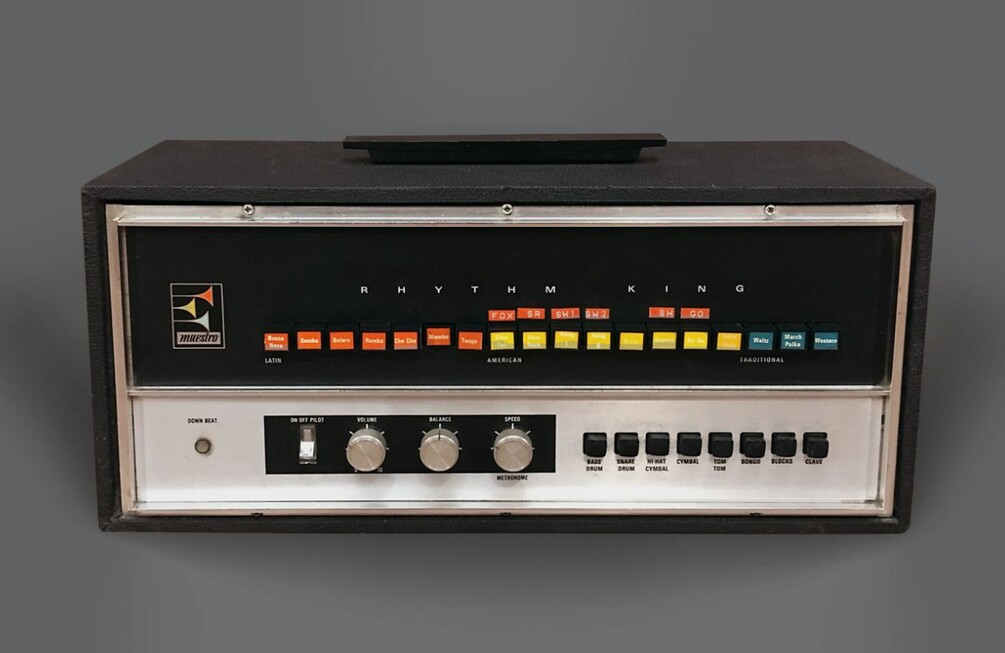
The era in which the Rhythm King emerged was a golden age for rhythm machines, with several companies vying for a slice of the market. A contemporary of the Ace Tone Rhythm King was the Maestro Rhythm King, most notably the model MRK-2. This has led to some confusion over the years, but it highlights the competitive landscape. The Maestro, produced by the Chicago-based musical instrument company, was another heavyweight in the ring, famous for its own distinctive sound and used by artists like Peter Frampton . The fact that two different companies both used the powerful "Rhythm King" moniker speaks to the perceived dominance and appeal of these machines at the time; they were the kings of the rhythmic castle, offering a level of sophistication and power that simpler units couldn't match. For Ace Tone, the name was a bold statement of intent, positioning their machine as the ultimate source for preset electronic percussion.
The internal workings of an Acetone Rhythm King were a marvel of pre-digital engineering. Peeking inside one of these vintage boxes reveals a dense landscape of circuit boards, resistors, capacitors, and those coveted Germanium transistors. The rhythm patterns were generated using a diode matrix, a clever form of read-only memory where the presence or absence of a diode determined whether a particular drum sound would play at a specific point in the pattern. This technology, pioneered by Kakehashi, was the heart of the Rhythm Ace lineage and was brought to its peak in the Rhythm King. The user interface typically featured a series of push-buttons or rotary knobs to select the desired rhythm, along with individual volume controls for the different instrument voices. This allowed musicians to mix their own balance, perhaps pushing the kick drum forward for a dance number or bringing the Latin percussion up front for a more authentic feel. Physical controls for tempo and overall volume rounded out the package, making it a self-contained and highly usable instrument.
Despite its capabilities, the Acetone Rhythm King never achieved the same iconic, household-name status as the earlier Rhythm Ace. It arrived at a time when technology was advancing rapidly, and within a few short years, the industry would be transformed by the arrival of fully programmable drum machines like the Linn LM-1, which offered the ability to create and store original patterns . The Rhythm King, for all its versatility, was still a preset machine. You were limited to the rhythms the engineers had hard-wired into its circuits. This limitation, however, is precisely what defines its charm today. It is a time capsule of 1970s rhythmic sensibilities, offering an authentic snapshot of what were considered the essential dance and accompaniment patterns of the era. The sounds it produces are not just tools for keeping time; they are infused with the sonic character of their age.
Today, the Acetone Rhythm King is a rare and prized artifact. For collectors and producers of electronic music, finding one in working condition is akin to discovering buried treasure. Its value lies not only in its scarcity but in its inimitable sound. In a modern music production landscape dominated by pristine digital audio workstations and an endless array of software plugins, the Rhythm King offers a direct connection to a more tactile and unpredictable era of music-making. Its analog tones have a warmth and presence that digital emulations often struggle to replicate, with each beat carrying the subtle imperfections and character of its vintage components. When its rhythms are fed through modern effects pedals and recording chains, they take on a new life, bridging the gap between the 1970s and the present day. The legacy of the Acetone Rhythm King, therefore, is not one of mass-market dominance, but of a quiet, enduring influence. It stands as a testament to Ikutaro Kakehashi's relentless pursuit of innovation and a monument to the golden age of analog rhythm, a time when the future of music was being built one transistor at a time.