Akai XR-10 Wave File Sample Set
Over 50 studio quality wave file samples.
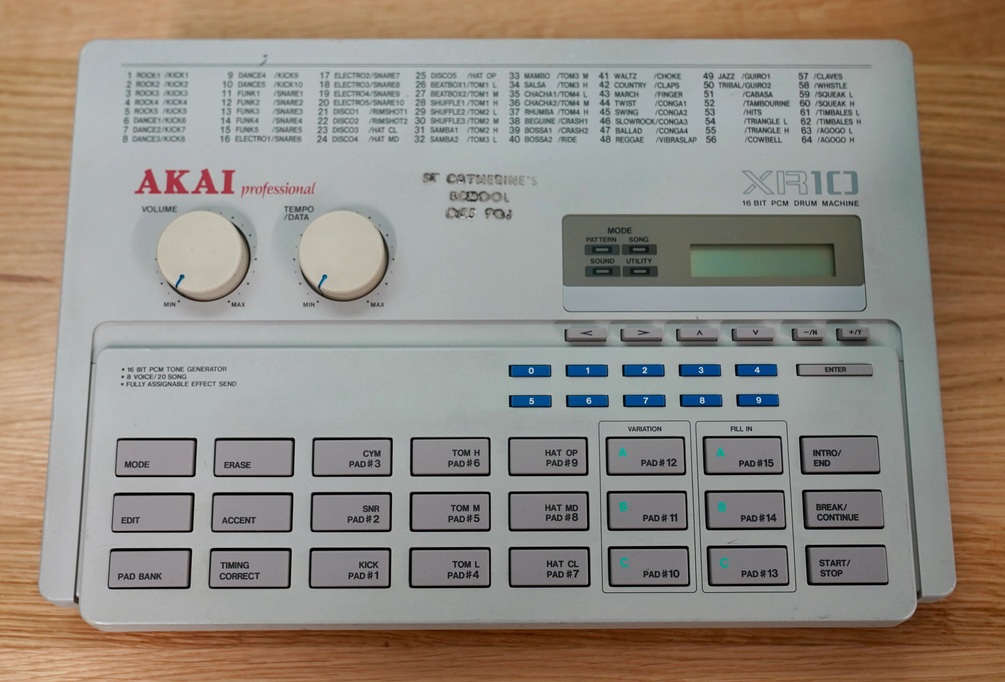
The Akai XR10 arrived in 1990 as a curious departure for a company already synonymous with high-end sampling. While the industry was chasing the pristine realism of the early 90s, Akai released a 16-bit PCM drum machine that prioritized punch over polish. It didn't sample; instead, it offered 65 internal waveforms that captured the transition from the neon-soaked 80s to the grittier textures of industrial and dance music. This machine became a secret weapon for producers like Trent Reznor, who famously utilized its aggressive, slightly cold character to help define the early Nine Inch Nails sound.
The hardware itself is a study in utilitarian design, featuring a wedge-shaped profile and 15 non-velocity-sensitive rubber pads. While the lack of touch sensitivity might seem like a drawback, it contributed to the "stiff" and driving feel of the patterns it produced. Under the hood, the XR10 was surprisingly flexible. Each sound could be manipulated through a suite of parameters—including decay, pitch, pan, and sweep—allowing users to warp standard kicks and snares into metallic thuds or sci-fi chirps. A standout feature was its "reverse" function, which could be applied to any sample to create the sucking, atmospheric transients popular in techno and trip-hop.
Programming the XR10 is a nostalgic exercise in menu-diving, managed through a small 16-character LCD. It holds 450 preset patterns spanning 50 different styles, but the real value lies in the 99 user-programmable slots. With a sequencer resolution of 96 parts per quarter note, it offers enough rhythmic "swing" to feel human, yet it remains most effective when used for rigid, robotic sequences. Its MIDI capabilities allow it to act as a sound module, though many enthusiasts prefer the internal sequencer to capture the specific "jitter" of its vintage clock.
Sonically, the XR10 is defined by its artifacts. When samples are pitched down, the machine introduces a distinctive aliasing noise that adds a layer of digital "grit" impossible to replicate with modern software. The output is famously hot and compressed, ensuring that the kicks and snares cut through a dense mix without much additional processing. Decades after its release, the XR10 remains a cult favourite for those who find modern drum libraries too clean, serving as a reminder that sometimes the limitations of older technology are exactly what give a record its soul.