Why Checking Your Answer Is a Mathematical Skill
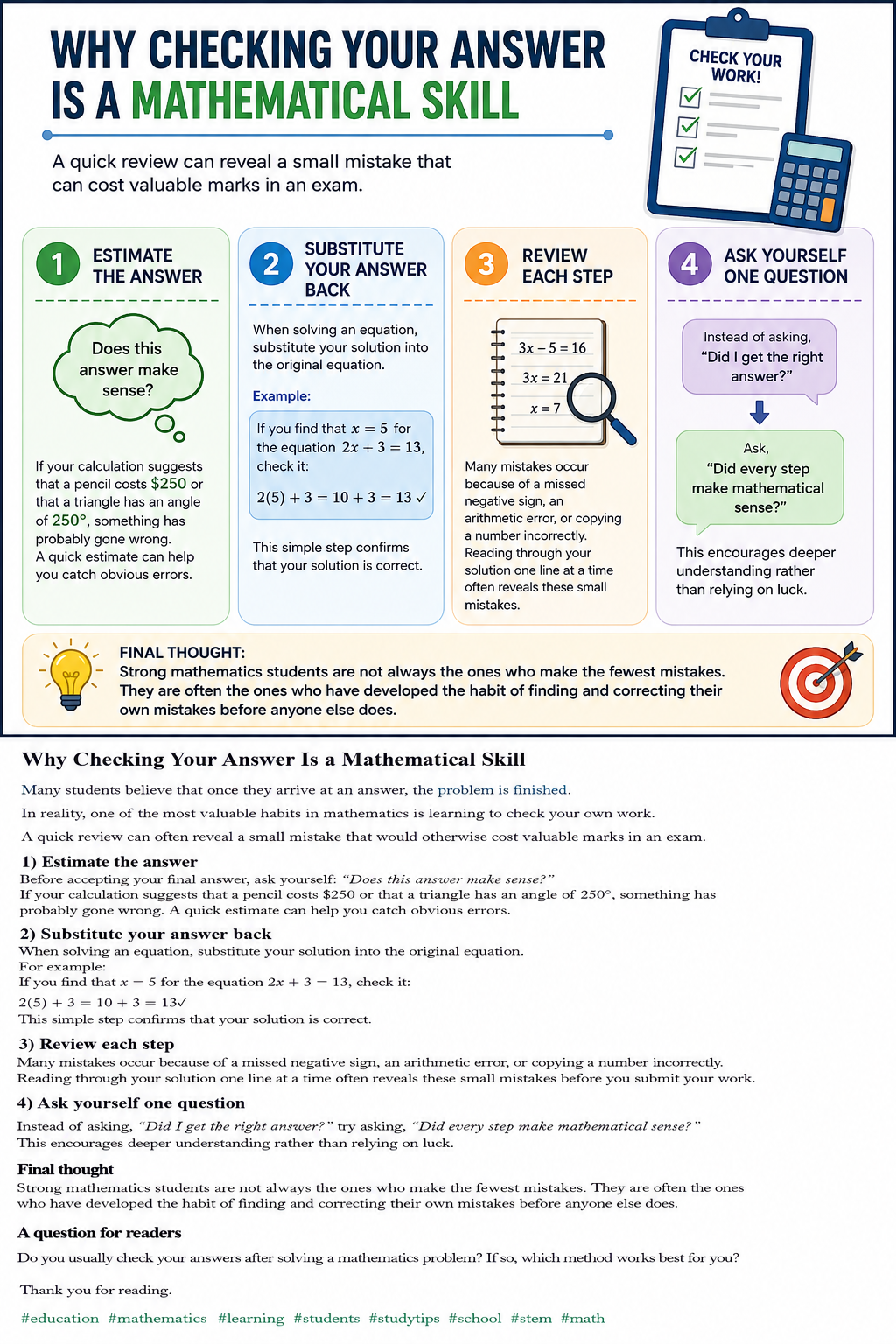
Why Checking Your Answer Is a Mathematical Skill
Many students believe that once they arrive at an answer, the problem is finished.
In reality, one of the most valuable habits in mathematics is learning to check your own work.
A quick review can often reveal a small mistake that would otherwise cost valuable marks in an exam.
Here are four simple ways to check your answer:
1) Estimate the answer
Before accepting your final answer, ask yourself:
"Does this answer make sense?"
If your calculation suggests that a pencil costs $250 or that a triangle has an angle of 250°, something has probably gone wrong.
A quick estimate can help you catch obvious errors.
2) Substitute your answer back
When solving an equation, substitute your solution into the original equation.
For example:
If you find that x = 5 for the equation
2x + 3 = 13
check it:
2(5) + 3 = 10 + 3 = 13 ✓
This simple step confirms that your solution is correct.
3) Review each step
Many mistakes occur because of:
- a missed negative sign,
- an arithmetic error,
- or copying a number incorrectly.
Reading through your solution one line at a time often reveals these small mistakes before you submit your work.
4) Ask yourself one question
Instead of asking,
"Did I get the right answer?"
try asking,
"Did every step make mathematical sense?"
This encourages deeper understanding rather than relying on luck.
Final thought
Strong mathematics students are not always the ones who make the fewest mistakes. They are often the ones who have developed the habit of finding and correcting their own mistakes before anyone else does.
Checking your work may take only a minute, but it can make a significant difference to both your confidence and your results.
A question for readers
Do you usually check your answers after solving a mathematics problem? If so, which method works best for you?
Thank you for reading.