Why Drawing a Diagram Can Make Mathematics Easier
Why Drawing a Diagram Can Make Mathematics Easier
Many students try to solve mathematics problems immediately by applying formulas. While formulas are important, one simple habit can make many questions much easier:
Draw a diagram.
A quick sketch often reveals relationships that are difficult to see from words alone.
When should you draw a diagram?
Drawing a diagram is especially helpful when working with:
- Geometry
- Trigonometry
- Vectors
- Coordinate Geometry
- Word Problems
- Physics questions involving forces or motion
Even a rough sketch is often enough to make the problem clearer.
Example
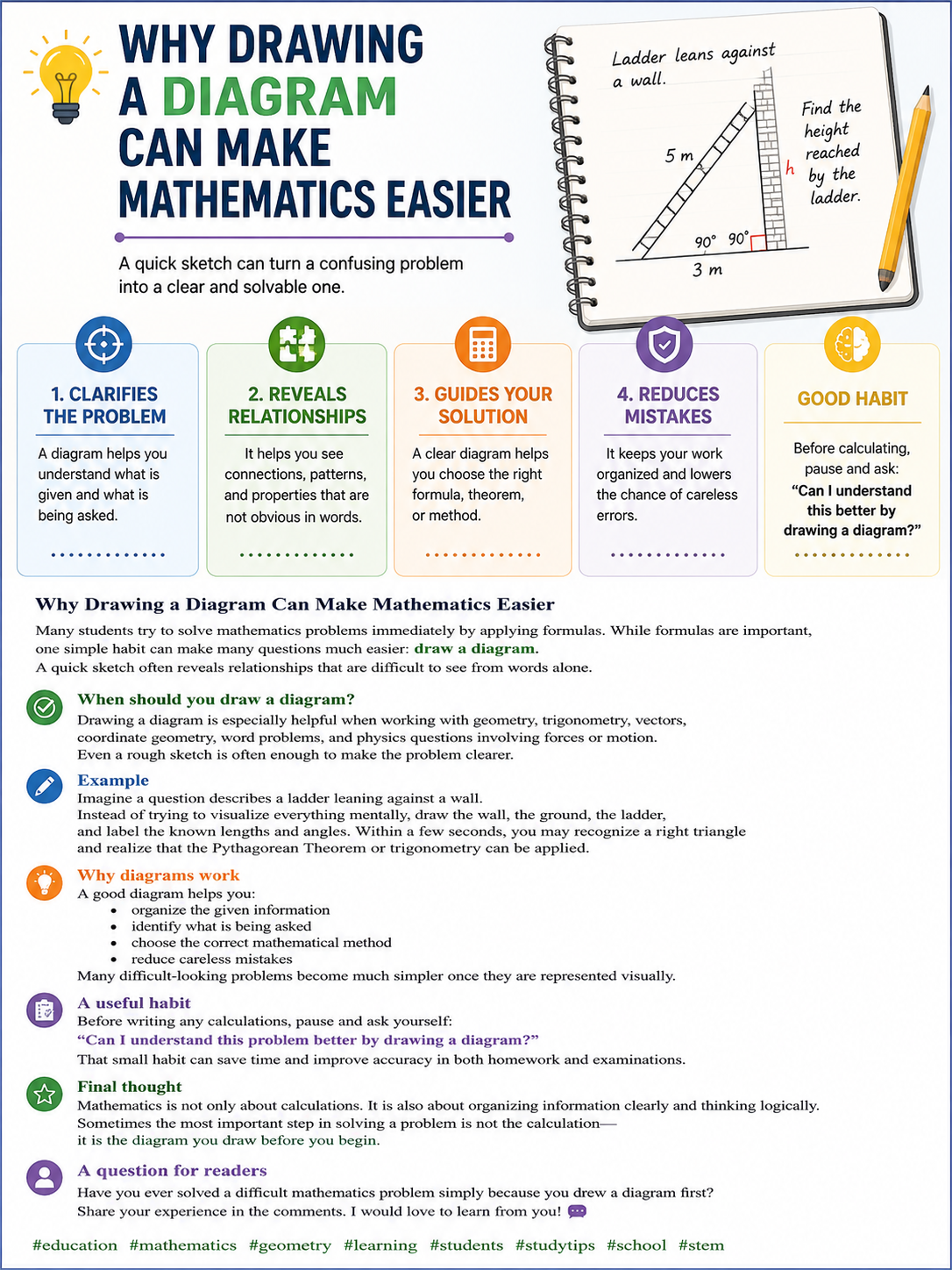
Imagine a question describes a ladder leaning against a wall.
Instead of trying to visualize everything mentally, draw:
- the wall,
- the ground,
- the ladder,
- and label the known lengths and angles.
Within a few seconds, you may recognize a right triangle and realize that the Pythagorean Theorem or trigonometry can be applied.
Why diagrams work
A good diagram helps you:
- organize the given information,
- identify what is being asked,
- reduce careless mistakes,
- and choose the correct mathematical method.
Many difficult-looking problems become much simpler once they are represented visually.
A useful habit
Before writing any calculations, pause and ask yourself:
“Can I understand this problem better by drawing a diagram?”
That small habit can save time and improve accuracy in both homework and examinations.
Final thought
Mathematics is not only about calculations. It is also about organizing information clearly and thinking logically.
Sometimes the most important step in solving a problem is not the calculation—it is the diagram you draw before you begin.
A question for readers
Have you ever solved a difficult mathematics problem simply because you drew a diagram first? Share your experience in the comments.
Thank you for reading.