ERP Integration Consulting Services: How to Connect Systems and Optimize Operations
Most manufacturers in India have already bought an ERP system. Far fewer have made it talk properly to the shop floor, the warehouse, the CRM, or the finance stack sitting alongside it. The result is a familiar pattern: dashboards that look complete, and operations teams that still re-enter the same order data into three different systems every day.
This is the gap that ERP Integration Consulting Services are built to close. Buying and configuring an ERP is only half the project. The half that actually determines whether operations run faster or just look more digital is how well that ERP connects to everything else a plant already runs on.
Why Integration, Not Adoption, Is the Real Bottleneck
India's ERP adoption numbers look strong on the surface, but the data on how well those systems actually connect tells a more cautious story.
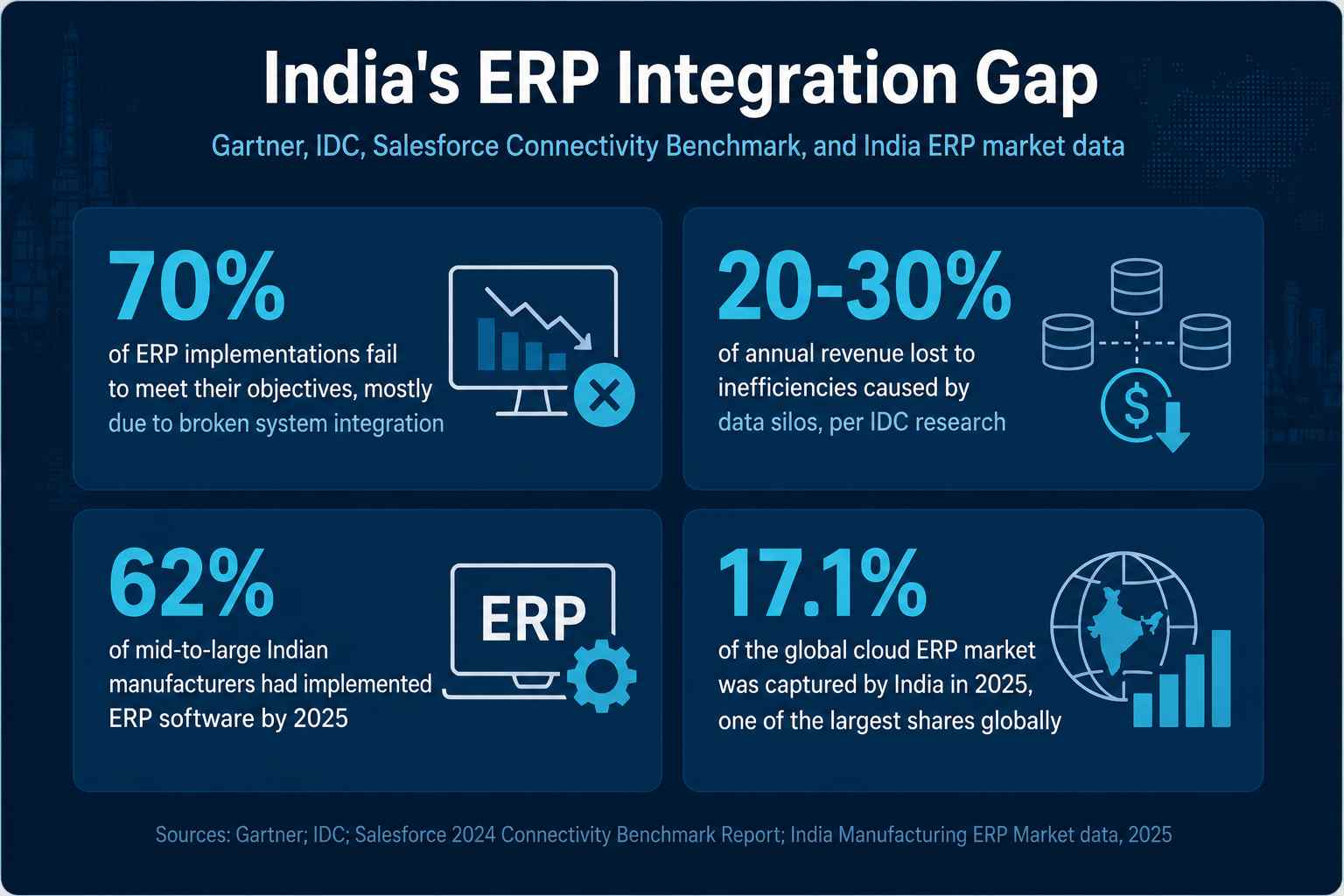
- Over 62% of mid-to-large manufacturing companies in India had already implemented ERP software as of 2025, with cloud deployments accounting for 58.5% of new installations.
- Gartner estimates that 70% of ERP implementations fail to fully meet their original objectives, and the most common reason cited is not the software itself but broken data flow between the ERP and the systems around it.
- According to IDC research, companies lose 20% to 30% of annual revenue to inefficiencies caused by data silos, a gap that compounds every time finance, sales, and operations maintain separate versions of the same customer or order record.
- A 2024 Salesforce Connectivity Benchmark survey found that 72% of IT leaders describe their infrastructure as overly interdependent and fragile, while 80% separately report that data silos are actively holding back their digital transformation plans.
The pattern across these numbers is consistent: the software purchase is rarely the failure point. The connective layer between systems, master data consistency, and real-time synchronization is where most ERP investments quietly underdeliver.
India's ERP Growth Is Outpacing Integration Maturity
India's ERP market is expanding fast enough that integration debt is building up just as quickly as adoption.
- India's manufacturing ERP market was valued at approximately USD 1.78 billion in 2025, with automotive, pharmaceutical, and food and beverage manufacturers together accounting for over 55% of total ERP demand.
- Small and medium enterprises represented close to 65% of total ERP implementations across Indian manufacturing in 2025, many of them adopting cloud ERP for the first time without a parallel plan for connecting it to existing CRM, MES, or warehouse systems.
- India captured a 17.1% share of the global cloud ERP market in 2025, one of the largest country-level shares worldwide, reflecting how quickly cloud-first ERP has become the default rather than the exception.
- Government-backed digitalization pushes under Make in India and Digital India continue to accelerate ERP adoption among export-oriented manufacturers, adding pressure to integrate ERP data with compliance and traceability systems required by overseas buyers.
This growth pattern creates a specific kind of risk. A plant that rolls out ERP quickly to keep pace with expansion, but treats integration as a phase-two project, tends to accumulate the same manual workarounds the ERP was meant to eliminate, just wrapped in a more modern interface.
What Effective ERP Integration Actually Covers
ERP integration is not a single API connection. It is a layered exercise that has to hold up across every system a plant depends on daily.
- Master data governance: establishing a single source of truth for customer, vendor, and material records so the ERP, CRM, and warehouse system are never working from conflicting versions of the same data.
- Middleware and API architecture: choosing between point-to-point connections and a middleware or iPaaS layer based on how many systems need to talk to the ERP and how often that number is likely to grow.
- Legacy system bridging: connecting older shop-floor or finance systems that were never built with modern APIs, often the hardest and most underestimated part of an integration project.
- Real-time versus batch synchronization: deciding which data needs to move instantly, such as inventory levels, and which can sync on a schedule, such as monthly financial consolidation.
- Compliance and data protection alignment: structuring data flows to meet India's Digital Personal Data Protection Act requirements wherever customer or employee data moves between integrated systems.
Why Customized Integration Changes the Outcome
A generic integration template applied across every client tends to under-serve the systems that matter most to a specific plant's operations.
- Sector-specific system stacks: an automotive supplier integrating ERP with a manufacturing execution system has fundamentally different data timing needs than a pharmaceutical company integrating ERP with a quality management system for batch traceability.
- Legacy technical debt: plants running older on-premise systems need a different integration approach than a business built entirely on modern cloud platforms, and treating both the same way wastes budget on one side or under-engineers reliability on the other.
- Growth-stage readiness: an SME implementing its first ERP needs an integration architecture that can scale as it adds systems, rather than a rigid point-to-point setup that has to be rebuilt at the next stage of growth.
- Export compliance requirements: manufacturers supplying global buyers often need ERP data integrated with traceability or quality documentation systems specific to the destination market, not just domestic reporting formats.
How IMARC Engineering's Expertise Can Help in ERP Integration Consulting
IMARC Engineering approaches ERP integration as an operations problem first and a technology configuration second, mapping the actual data flow a plant needs before selecting the connection method.
- Systems and data flow audit: mapping every system currently in use, including undocumented spreadsheets and manual workarounds, before recommending an integration architecture.
- Middleware and architecture selection: choosing between point-to-point, middleware, or API-led integration based on the client's current system count and expected growth, rather than defaulting to whichever approach a vendor prefers.
- Master data governance design: establishing ownership rules and validation checks so customer, material, and vendor records stay consistent across every connected system.
- Legacy system integration: building bridges for older shop-floor or finance systems that lack modern APIs, a common gap in Indian manufacturing environments running a mix of new and decades-old equipment.
- Compliance-aligned data flow design: structuring integrations so customer and employee data handling meets Digital Personal Data Protection Act requirements as data moves between systems.
Talk to Our Team: https://www.imarcengineering.com/contact?service=digital-documentation-erp-integration
Conclusion
India's ERP adoption curve is moving faster than most plants' ability to connect what they have already bought. With 70% of ERP implementations falling short of their objectives largely due to integration failure, the manufacturers who invest in a structured connection layer, not just another software license, will convert ERP spend into actual operational speed rather than a more expensive version of the same disconnected systems.
Frequently Asked Questions
What is ERP integration consulting?
It is the process of connecting an ERP system to other business software such as CRM, MES, WMS, and finance platforms so data flows automatically between them instead of being re-entered manually across systems.
Why do most ERP implementations fail to deliver results?
Gartner estimates 70% of ERP implementations fail to meet their objectives, and the leading cause is broken data flow and poor integration with surrounding systems rather than a flaw in the ERP software itself.
How much does poor system integration actually cost a business?
IDC research estimates that data silos cause businesses to lose 20% to 30% of annual revenue to operational inefficiencies, a gap that grows every time departments maintain separate, unsynchronized versions of the same data.
Which systems should be integrated with ERP first?
CRM, manufacturing execution systems, and warehouse management systems typically carry the highest integration priority, since delays or mismatches in these data flows directly affect order accuracy, production visibility, and inventory reliability.
Contact Us:
IMARC Engineering
Phone: +91-120-433-0800
Email: [email protected]
India: C-130, Sector 2, Noida, Uttar Pradesh 201301
LinkedIn: https://www.linkedin.com/showcase/imarc-engineering/