EV Battery Simulator: Scaling the Simulation from Cell-Level to Full Pack
As electric vehicles continue to evolve toward higher efficiency, longer range, and faster charging, the complexity of their battery systems increases dramatically. Modern EV battery packs are no longer simple assemblies of cells — they are highly engineered systems integrating thermal management, battery management systems (BMS), contactors, sensors, safety circuits, and high-voltage distribution networks.
For automotive R&D teams, testing these systems using real batteries at every development stage is costly, time-consuming, and potentially hazardous. This is where the EV battery simulator becomes an essential development tool. More importantly, today’s advanced simulators allow engineers to scale testing from individual cell behavior up to full-pack emulation.
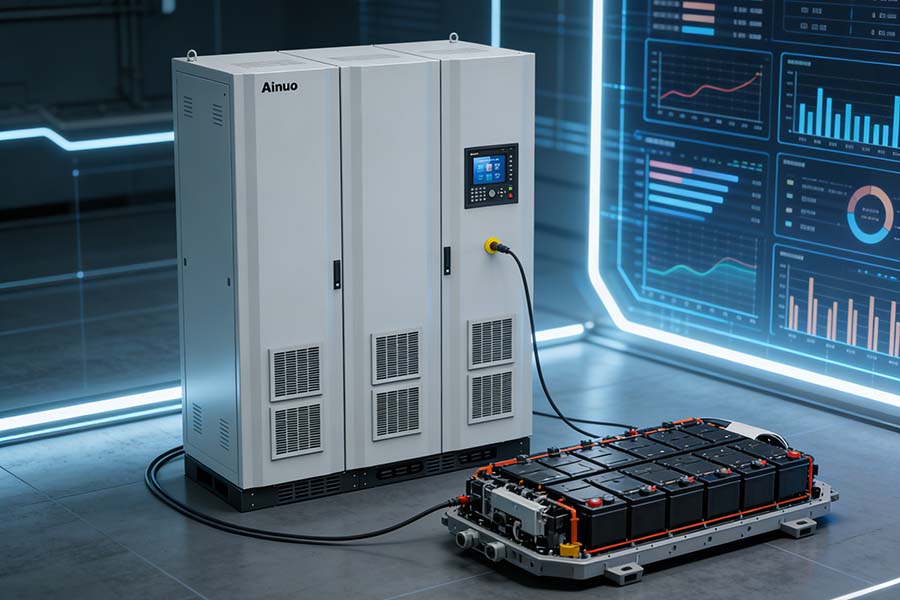
In this article, we explore how EV battery simulation scales from cell-level modeling to complete pack representation — and why this scalability is critical for modern vehicle development.
Why Scalable Battery Simulation Matters
Battery systems in EVs are hierarchical by design:
- Cell level – the fundamental electrochemical unit
- Module level – multiple cells arranged in series/parallel
- Pack level – modules combined into high-voltage assemblies
- Vehicle level – integration with powertrain, charging, and control systems
Each level presents unique testing requirements. Engineers may need to validate:
- Cell behavior under dynamic load
- BMS balancing algorithms
- Module-level voltage monitoring
- High-voltage inverter interaction
- Regenerative braking scenarios
- Fast-charging performance
A scalable EV battery simulator enables seamless testing across these layers without requiring physical battery hardware at each stage.
Stage 1: Cell-Level Simulation
At the foundation of any EV battery pack lies the individual lithium-ion cell. At this level, simulation focuses on electrical characteristics such as:
- Open-circuit voltage (OCV) curves
- Internal resistance
- State-of-charge (SoC) response
- State-of-health (SoH) degradation
- Temperature-dependent voltage variation (electrically modeled)
What Engineers Validate at the Cell Level
Cell-level simulation is particularly useful for:
- Developing BMS algorithms
- Validating SoC estimation models
- Testing cell balancing strategies
- Injecting fault conditions (overvoltage, undervoltage, short circuit)
Instead of waiting months to observe real aging or degradation, engineers can program aging profiles into the simulator and test edge cases immediately.
Benefits of Cell-Level Simulation
- Safe replication of failure modes
- Repeatable and precise test conditions
- Fast iteration during early design
- Reduced dependence on physical cell inventory
At this stage, the simulator behaves as a highly accurate electronic representation of a single cell — but the real power lies in scaling beyond this.
Stage 2: Module-Level Simulation
Battery modules combine multiple cells in series and parallel configurations. Voltage increases, current capability grows, and balancing becomes more complex.
A scalable EV battery simulator must support:
- Series voltage stacking
- Parallel current scaling
- Individual channel control (for multi-cell emulation)
- Independent internal resistance modeling
Key Challenges at Module Level
At this level, engineers are often validating:
- BMS voltage monitoring accuracy
- Cell balancing circuits
- Thermal management responses
- Fault isolation strategies
Simulation allows controlled mismatches between cells, such as varying internal resistance or capacity differences, to test how well the BMS compensates.
For example, engineers can simulate:
- One weak cell in a module
- Uneven aging across parallel strings
- Gradual capacity fade
These scenarios are difficult, expensive, and sometimes dangerous to replicate with physical modules.
Stage 3: Pack-Level Emulation
When scaling to the pack level, complexity increases significantly. Modern EV packs typically operate between 400V and 800V, with some high-performance architectures exceeding this range.
A pack-level EV battery simulator must provide:
- High-voltage capability
- High current sourcing and sinking
- Bidirectional operation
- Fast transient response
- Programmable dynamic impedance
Emulating Real-World Conditions
At the pack level, the simulation must reflect realistic driving and charging conditions, including:
- Rapid acceleration load spikes
- Regenerative braking current injection
- DC fast charging cycles
- Cold-start voltage sag
- Low SoC power limitations
The simulator must respond in microseconds to replicate voltage drops and recovery behavior accurately. Without high transient response and low output impedance, results can deviate significantly from real-world performance.
Stage 4: Full Vehicle System Integration
The highest level of scaling integrates the simulated battery pack with:
- Traction inverter
- DC-DC converters
- Onboard charger (OBC)
- High-voltage junction box
- Thermal management systems
- Vehicle control unit (VCU)
At this stage, battery simulation becomes a central component of Hardware-in-the-Loop (HIL) or Power-HIL setups.
Why Full-Pack Simulation Is Essential
Using a real battery pack in early integration testing carries risks:
- High stored energy hazards
- Expensive damage if faults occur
- Limited repeatability
- Complex safety compliance
An EV battery simulator eliminates many of these risks while allowing engineers to safely test:
- Short circuits
- Overcurrent events
- Contact failures
- Charging communication errors
- Emergency shutdown sequences
Additionally, fault injection becomes simple and controlled — something nearly impossible with physical packs.
Key Technical Requirements for Scalable Simulation
To move seamlessly from cell to full pack, an EV battery simulator must offer certain architectural strengths.
1. Modular and Stackable Design
The simulator should allow multiple units to be connected in series or parallel. This enables:
- Higher voltage scaling
- Increased current capacity
- Flexible reconfiguration
2. Advanced Battery Modeling Software
Hardware alone is insufficient. Sophisticated modeling software must support:
- Custom battery profiles
- SOC/SOH mapping
- Drive cycle emulation
- User-defined impedance curves
3. Bidirectional Power Flow
Modern EVs rely heavily on regenerative braking and bidirectional charging. A scalable simulator must both source and sink power efficiently.
4. Automation and Communication Interfaces
Scaling testing requires integration with:
- CAN communication
- Ethernet-based control
- LabVIEW or MATLAB environments
- Automated regression test platforms
Without automation support, pack-level testing becomes slow and labor-intensive.
Advantages Over Physical Battery Testing
Scaling simulation offers multiple strategic advantages:
Faster Development Cycles
Engineers can move from algorithm testing to full pack validation without waiting for physical battery availability.
Increased Safety
High-energy battery packs pose real risks. Simulation reduces exposure during early-stage testing.
Improved Repeatability
Unlike real batteries, simulators do not degrade between tests. Results remain consistent.
Lower Long-Term Cost
While high-performance simulators require an initial investment, they reduce the need for multiple physical prototypes and damaged components.
Supporting Future EV Architectures
The industry is moving toward:
- 800V and 1000V systems
- Ultra-fast charging
- Vehicle-to-grid (V2G) applications
- Solid-state battery development
Scalable EV battery simulators allow R&D teams to prepare for these architectures without redesigning their test infrastructure.
As voltage increases and systems become more integrated, simulation flexibility becomes not just beneficial — but essential.
Conclusion
An EV battery simulator is far more than a programmable power supply. When designed for scalability, it becomes a foundational tool for automotive R&D, enabling engineers to emulate battery behavior from individual cells to full high-voltage packs.
By supporting cell-level algorithm development, module-level validation, pack-level stress testing, and full vehicle integration, scalable simulation accelerates innovation while improving safety and cost efficiency.
As EV technology advances, the ability to scale battery simulation seamlessly will remain a critical competitive advantage for automotive manufacturers and suppliers alike.